
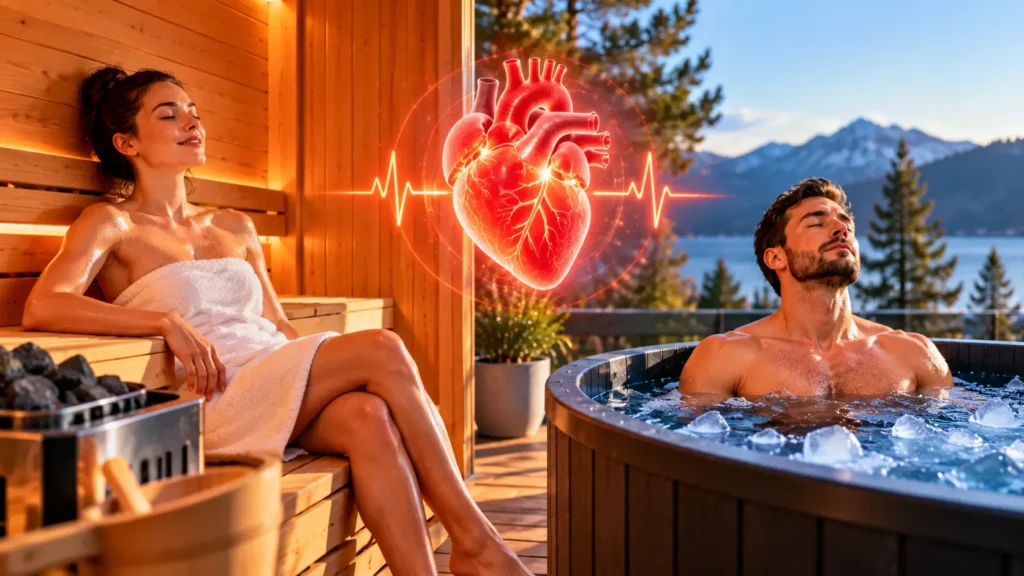
Sauna Benefits for Heart Health
What Is Sauna Bathing and Cold Plunging?
Before we get into the research, let’s get the basics straight.
A sauna is a small room heated to high temperatures. A traditional Finnish sauna usually runs between 150°F and 195°F (about 65°C to 90°C) with low humidity. Infrared saunas work differently: they warm your body directly with infrared light and often run cooler, around 120°F to 140°F.
A cold plunge means sitting or standing in cold water for a short time. Most home tubs and cold plunge setups are kept between 39°F and 59°F (4°C to 15°C), and sessions are usually only a few minutes long.
People often combine the two. This is called contrast therapy: you warm up in the sauna, cool down in the water, and repeat. It feels intense, but many people say they feel calm and clear-headed afterward.
Read More: Vitamin D Foods for Adults Who Stay Indoors: 12 Easy Picks
Sauna Benefits for Heart Health: What the Research Says
Let’s start with the question that brings most people here: sauna benefits for heart health. Is there real science behind it?
The most quoted evidence comes from Finland. A large, long-running study followed more than 2,300 middle-aged Finnish men for around 20 years. Researchers found that men who used a sauna four to seven times a week had a noticeably lower risk of fatal heart-related events than men who went just once a week. The gap was big enough to make headlines around the world.
But here’s the part many blog posts skip: this was an observational study. That means researchers noticed a pattern. They did not prove that saunas caused the better outcomes. People who use saunas regularly may also be more active, more social, and more relaxed in general. So the findings are encouraging, but they are not a guarantee.
Still, scientists have some ideas about why heat might help the cardiovascular system:
- Blood vessels relax and widen. Heat makes your blood vessels dilate, which may temporarily lower blood pressure.
- Heart rate goes up. During a sauna session, your heart rate can climb to a level similar to light or moderate exercise. That does not replace a workout, but it does give your heart a gentle challenge.
- Circulation improves. More blood flows to your skin and muscles while you sit in the heat.
- Stress drops. Lower stress levels are linked to better heart health over time.
Smaller studies have also suggested that regular sauna use may support better blood vessel function and may be linked to lower blood pressure in some adults. Researchers are still working to understand how strong these effects are.
The honest summary? Sauna use looks promising as a supportive habit, not a cure or a replacement for medication, exercise, a balanced diet, or regular checkups.
Other Possible Benefits of Using a Sauna
Heart health is not the only reason people love the heat. Here are some other benefits people report, along with a reality check on each:
- Muscle relaxation. Warmth helps loosen tight muscles after a long day or a hard workout.
- Better sleep. Many people feel sleepier after a warm sauna session in the evening. Just do not go right before bed if it leaves you wired.
- Stress relief. Quiet time, no phone, and warm air can feel like a mini reset.
- Mood boost. Some people notice a calm, happy feeling after a session.
- Temporary relief from stiff joints. Warmth can ease aches for a while, though it does not fix the underlying problem.
None of these should be treated as guaranteed results. Everyone’s body responds differently.
Is Cold Plunge Safe for Beginners?
Now let’s flip to the other side of the coin. If you are wondering, is cold plunge safe for beginners, the short answer is: it can be, for many healthy adults, but only if you start slowly and respect the risks.
What happens to your body in cold water
When you step into very cold water, your body goes through something called the cold shock response. Your breathing speeds up, your heart rate jumps, and your blood vessels tighten. This is totally normal, but it puts sudden stress on your heart and lungs. For most healthy people, it passes within a minute or two as you calm your breathing.
Who should be extra careful
Cold exposure is not for everyone. Please talk to a doctor first if you:
- Have heart disease, an irregular heartbeat, or high blood pressure
- Have had a stroke
- Are pregnant
- Have Raynaud’s disease or circulation problems
- Take medications that affect your heart or blood pressure
- Feel dizzy or faint easily
Beginner safety tips
If you get the green light, here is a gentle way to begin:
- Start with a cool shower. Finish your normal shower with 20 to 30 seconds of cold water for a week or two.
- Choose a mild temperature. Beginners often start around 55°F to 60°F instead of going straight to ice-cold water.
- Keep it short. Thirty seconds to one minute is plenty on your first try. Most people never need more than two to five minutes.
- Control your breathing. Take slow breaths in through your nose and long breaths out. Do not hold your breath.
- Never plunge alone. Have someone nearby, especially at first.
- Avoid alcohol and drugs. They affect judgment and body temperature.
- Get out if something feels wrong. Numbness, dizziness, chest pain, or confusion are all signs to stop right away.
- Warm up slowly afterward. Dry off, put on warm clothes, and sip something warm. Do not jump straight into a very hot shower if you feel shaky.
Never jump into natural bodies of freezing water, like lakes or rivers in winter, without proper experience and supervision. Cold water can be dangerous much faster than people expect.
Possible benefits of cold plunging
People often say cold water gives them a sharp wake-up feeling, better focus, and a mood lift. Some research suggests cold exposure may reduce muscle soreness after exercise. One thing worth knowing: some studies suggest that taking cold baths right after strength training may slow muscle growth over time. If building muscle is your main goal, you may want to avoid plunging immediately after lifting.
The research on cold plunges is newer and smaller than the research on saunas, so it is wise to stay curious but cautious.
How Often Should You Use a Sauna Per Week?
This is one of the most common questions I hear: how often should you use a sauna per week?
There is no single perfect number. But here is a practical way to think about it, based on what researchers have studied and what experienced sauna users commonly do.
| Experience Level | Sessions Per Week | Time Per Session |
|---|---|---|
| Complete beginner | 1 to 2 | 5 to 10 minutes |
| Getting comfortable | 2 to 3 | 10 to 15 minutes |
| Regular user | 3 to 4 | 15 to 20 minutes |
In the Finnish study mentioned earlier, the group with the lowest risk used saunas four to seven times a week, often for around 15 to 20 minutes. But those were people who grew up with sauna culture and built up slowly over many years. You do not need to copy them right away.
A simple beginner plan
- Week 1 to 2: Go once or twice for 5 to 10 minutes. Stay on the lower bench where it is cooler.
- Week 3 to 4: Add a third session and stretch to about 10 to 15 minutes.
- After a month: If you feel good, you can slowly build toward more sessions. Listen to your body more than any chart.
Tips for safer sauna sessions
- Drink water before and after. Heat makes you sweat, and dehydration can sneak up quickly.
- Skip alcohol before or during a session. It increases the risk of dizziness and fainting.
- Leave if you feel lightheaded, nauseous, or unwell.
- Cool down gradually. Sit for a few minutes before standing up quickly.
- Avoid saunas when sick with a fever or when you are very dehydrated.
- Check with your doctor if you have low blood pressure, heart problems, are pregnant, or take medications that affect heat tolerance.
More is not always better. Pushing too hard, too long, or too often can leave you tired and dehydrated instead of refreshed.
Cold Plunge vs Sauna Which Is Better?
Here is the big showdown. If you are trying to decide cold plunge vs sauna which is better, the honest answer is that it depends on what you want and what your body can handle.
Quick comparison
| Factor | Sauna | Cold Plunge |
|---|---|---|
| Main feeling | Relaxed, warm, sleepy | Alert, sharp, energized |
| Research on heart health | More research, promising observational data | Newer, limited research |
| Beginner friendliness | Easier for most people | Requires more caution |
| Typical session length | 10 to 20 minutes | 1 to 5 minutes |
| Cost to start | Gym or spa access is cheap, home units cost more | Tubs and chillers can be pricey, or use a cold shower |
| Best for | Stress relief, relaxation, unwinding | Wake-up boost, post-workout cooling |
Choose a sauna if…
- You want a relaxing, low-effort habit
- You are interested in the sauna benefits for heart health that researchers have studied
- You are sensitive to cold
- You want something that feels like a treat at the end of the day
Choose a cold plunge if…
- You enjoy a sharp, energizing challenge
- You are healthy and have no cardiovascular concerns
- You want a morning wake-up routine
- You like building mental toughness
Cold Plunge vs Sauna Which Is Better
Many people love contrast therapy. A common pattern looks like this:
- Sauna for 10 to 15 minutes
- Cold plunge or cold shower for 30 seconds to 2 minutes
- Rest for a few minutes
- Repeat once or twice if you feel good
Most people finish on the cold side, but if that feels too intense, finishing with a warm rest period is perfectly fine. Keep in mind that going back and forth between extreme heat and cold puts extra demand on your body, so beginners should ease into it, and anyone with heart concerns should get medical guidance first.
How to Build a Realistic Routine
If you are just getting started, here is an example of how a simple week might look:
- Monday: 10-minute sauna session after work
- Wednesday: 30-second cold shower finish in the morning
- Friday: 12-minute sauna session, then a cool shower
- Sunday: Rest, or a longer sauna session if you feel great
FAQs: Sauna Benefits for Heart Health
Are there proven sauna benefits for heart health?
Sauna Benefits for Heart Health Studies, especially from Finland, link regular sauna use with lower rates of heart-related problems. However, most of this evidence is observational, so it shows an association and not proof of cause and effect. It is best seen as a supportive habit, not a treatment.
Is cold plunge safe for beginners with no health problems?
For many healthy adults, short and mild cold exposure can be done safely when you start slowly, control your breathing, and never plunge alone. If you have any heart, blood pressure, or circulation issues, ask your doctor first.
Is cold plunge safe for beginners with no health problems?
For many healthy adults, short and mild cold exposure can be done safely when you start slowly, control your breathing, and never plunge alone. If you have any heart, blood pressure, or circulation issues, ask your doctor first.
How often should you use a sauna per week to see results?
Beginners can start with one or two short sessions a week and slowly build up. Many studies looked at people using saunas several times a week, but you do not need to start there.
Cold Plunge vs Sauna Which Is Better for beginners?
Saunas are generally easier and gentler for most beginners. Cold plunges need more caution because of the cold shock response.
Final Thoughts: Sauna Benefits for Heart Health
So, are saunas and cold plunges worth trying? For many healthy adults, yes, as long as you go slowly and stay realistic. The research on sauna benefits for heart health is encouraging, though it does not promise miracles. Cold plunging can feel energizing, but it needs more care, especially for beginners.
Read More: Warm Foods to Eat During a Cold: 15 Easy, Comforting Ideas