
Myopia vs Hyperopia
What Is Myopia (Nearsightedness)?
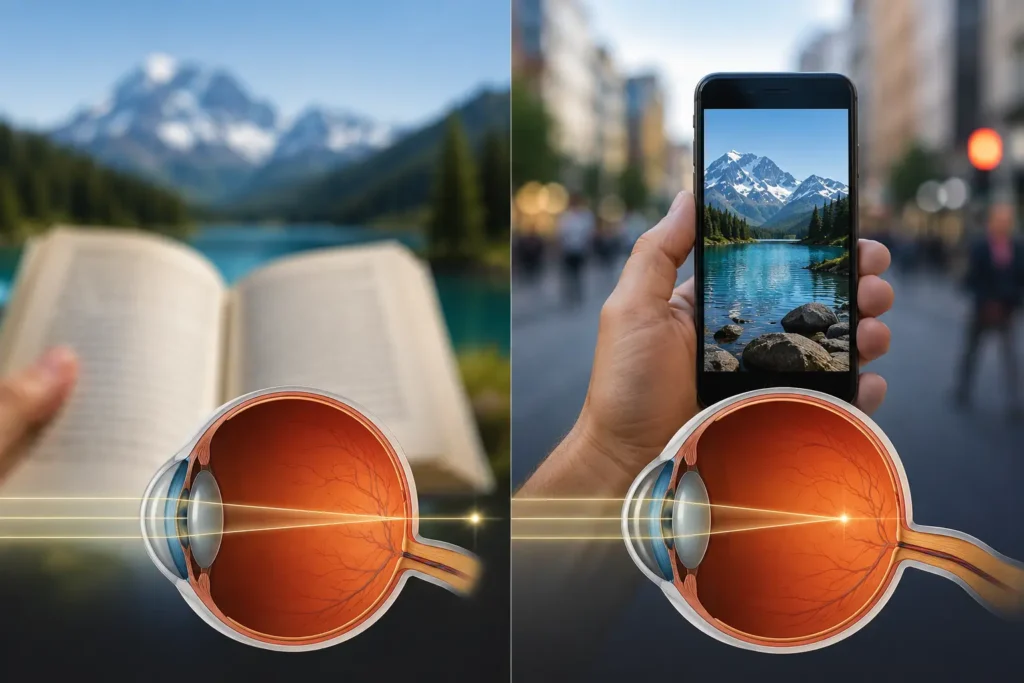
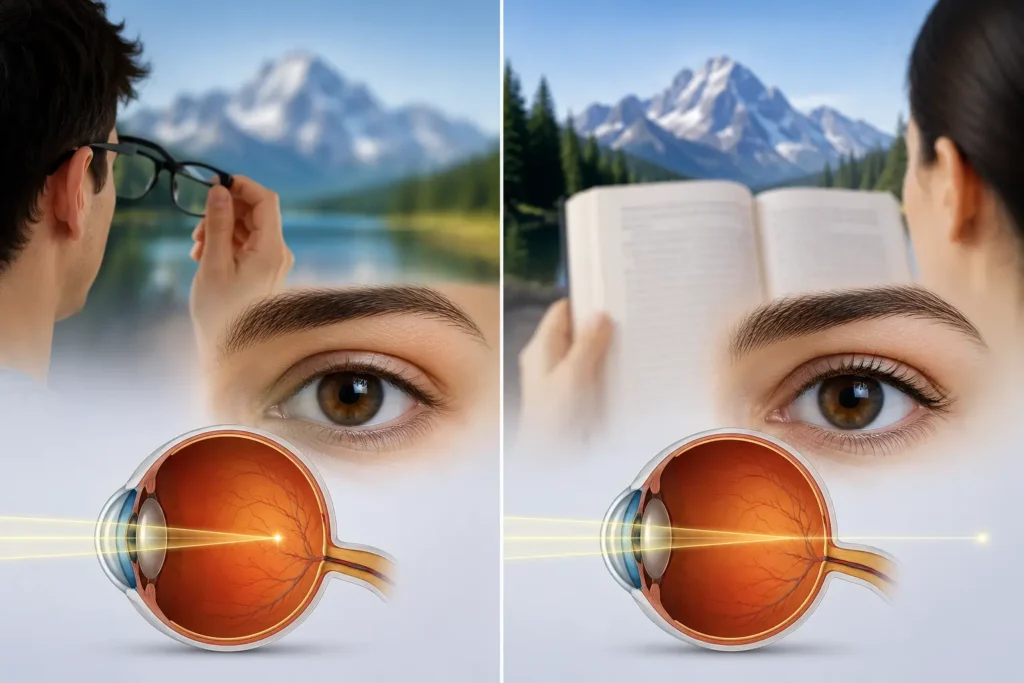
Myopia, commonly called nearsightedness, is a refractive error where distant objects appear blurry while close-up objects stay clear. It happens when the eyeball is slightly longer than normal, or the cornea is too curved. This causes incoming light to focus in front of the retina instead of directly on it, distorting anything far away.
Myopia is becoming increasingly common in the US. Research shows myopia prevalence has nearly doubled since the 1970s, with roughly 42% of American adults now affected, and an estimated 9.2 million children between ages 3 and 19 living with the condition.
What Is Hyperopia (Farsightedness)?
Hyperopia, or farsightedness, is essentially the mirror image of myopia. People with hyperopia typically see distant objects clearly but struggle with anything close-up, like a book, a phone screen, or fine print. It occurs when the eyeball is shorter than average or the cornea is flatter than normal, causing light to focus behind the retina rather than on it.
Hyperopia is also widespread — studies estimate it affects somewhere between 10% and 30% of US adults, depending on age group and severity, with prevalence generally increasing after age 40.
Quick note: I am not a doctor. I’m a health content writer who researches topics carefully using credible medical sources like Cleveland Clinic, academic eye institutes, and peer-reviewed studies. This article is for general education only — not a diagnosis. If you’re experiencing vision changes, please book an appointment with a licensed optometrist or ophthalmologist.
Read More: Fresh Garlic vs Garlic Powder: Nutrition, Benefits & Best Choice (2026)
Myopia vs Hyperopia: Key Differences at a Glance
| Feature | Myopia (Nearsighted) | Hyperopia (Farsighted) |
|---|---|---|
| Distance vision | Blurry | Clear |
| Close-up vision | Clear | Blurry |
| Eyeball shape | Too long | Too short |
| Cornea shape | Too curved | Too flat |
| Common onset | Childhood, worsens through teens | Often present at birth, may improve with age |
| Lens prescription | Minus (−) lenses | Plus (+) lenses |
| Common symptoms | Squinting at distant objects, headaches while driving | Eye strain during reading, headaches after close work |
What Causes Myopia and Hyperopia?
Both conditions are refractive errors, meaning the eye can’t bend (refract) light correctly onto the retina — but the underlying causes differ.
Myopia Causes
- Genetics — children with one or both myopic parents have a significantly higher risk.
- Excessive near work — extended screen time, reading, and close-up tasks are strongly linked to myopia progression.
- Limited outdoor time — reduced exposure to natural light appears to accelerate myopia in children.
- Elongated eyeball growth — often triggered by the environmental factors above during childhood development.
Hyperopia Causes
- Genetics — farsightedness often runs in families and is frequently present from birth.
- Shorter eyeball length — the primary structural cause in most cases.
- Flatter cornea curvature — reduces the eye’s ability to bend light adequately.
- Age-related changes — while different from presbyopia, some age-related lens stiffening can worsen uncorrected hyperopia symptoms after 40.
Myopia vs Hyperopia Symptoms
Myopia Symptoms Explained
Common signs of myopia include:
- Blurry vision when looking at distant objects (road signs, whiteboards, TV)
- Squinting to see clearly
- Frequent headaches, especially after driving or watching distant screens
- Eye strain or fatigue
- Sitting closer to the TV or holding books/phones very close
Myopia Symptoms in Children
Kids often don’t realize their vision has changed, which makes parental observation important. Watch for:
- Sitting unusually close to the television
- Holding books or tablets very close to the face
- Complaining of headaches after school
- Difficulty seeing the whiteboard, leading to poor academic performance
- Excessive blinking or eye rubbing
Hyperopia Symptoms in Adults
In adults, hyperopia symptoms tend to show up during close-focus tasks:
- Blurry near vision when reading or using a phone
- Eye strain or a burning sensation during prolonged close work
- Headaches, especially in the evening after screen use
- Difficulty focusing quickly when shifting between near and far objects
- In some cases, blurry vision at all distances if hyperopia is more severe
Can You Have Myopia and Hyperopia Together?
This is one of the most common points of confusion, and the answer is: not in the same eye at the same time, but yes, in a broader sense.
- Anisometropia — this is when one eye is myopic and the other is hyperopic. It’s an entirely real and diagnosable condition, and it usually requires customized lens prescriptions for each eye.
- Astigmatism combined with either condition — many people have Myopia vs Hyperopia alongside astigmatism (an irregularly shaped cornea), which adds another layer of blur at all distances.
- Presbyopia overlap — after age 40, naturally occurring presbyopia (age-related loss of near focus) can make hyperopia symptoms feel more pronounced, or make previously mild symptoms suddenly noticeable.
A comprehensive eye exam is the only reliable way to know exactly which combination you’re dealing with.
How to Tell If You Have Myopia vs Hyperopia
While only an eye care professional can officially diagnose either condition, a few practical clues can point you in the right direction:
- If far-away objects are blurry but close-up work is easy → likely myopia
- If close-up work is blurry but distance vision is clear → likely hyperopia
- If you get headaches primarily while driving or watching TV → possible myopia
- If you get headaches primarily while reading or using your phone → possible hyperopia
- If everything looks blurry regardless of distance → could indicate high hyperopia, high myopia, or astigmatism
Myopia vs Hyperopia Eye Exam and Testing
Eye doctors use a handful of standard tests to distinguish between the two conditions:
- Visual acuity test — the classic eye chart test to measure how clearly you see at various distances.
- Retinoscopy — a handheld device shines light into the eye to observe how it reflects off the retina, helping estimate the refractive error.
- Autorefraction — a computerized device quickly estimates your prescription.
- Manual refraction (“Which is better, one or two?”) — fine-tunes the exact lens prescription needed.
- Dilated eye exam — allows the doctor to examine the retina and rule out other underlying issues, especially important for high Myopia vs Hyperopia.
Myopia vs Hyperopia Treatment Options
The good news: both conditions are highly treatable, and the tools available have improved significantly in recent years.
Common treatment options include:
- Prescription glasses — concave (minus) lenses for myopia, convex (plus) lenses for hyperopia.
- Contact lenses — soft or rigid gas-permeable lenses tailored to the specific refractive error.
- LASIK or PRK surgery — reshapes the cornea to correct light focus; effective for both conditions in eligible candidates.
- Orthokeratology (Ortho-K) — specialized overnight contact lenses that temporarily reshape the cornea; used for both myopia control in kids and some hyperopia cases.
- Low-dose atropine eye drops — primarily used to slow myopia progression in children.
- Refractive lens exchange (RLE) — sometimes used for higher degrees of hyperopia, particularly in older adults.
Best Glasses for Myopia vs Hyperopia
The core difference in eyewear comes down to lens shape:
- Myopia glasses use concave lenses, which are thinner in the center and thicker at the edges, spreading light out before it enters the eye.
- Hyperopia glasses use convex lenses, which are thicker in the center, bending light inward so it focuses properly on the retina.
If you’ve ever noticed someone’s glasses make their eyes look smaller (myopia) or larger (hyperopia) through the lens, that’s this exact optical difference in action.
Myopia vs Hyperopia Surgery Options
For people who want to reduce or eliminate dependence on glasses and contacts, several surgical options exist for both conditions:
- LASIK — reshapes the cornea using a laser; suitable for mild to moderate Myopia vs Hyperopia.
- PRK — similar to LASIK but removes the outer corneal layer instead of creating a flap; often recommended for thinner corneas.
- Implantable Collamer Lens (ICL) — a lens implanted inside the eye without removing corneal tissue, useful for higher prescriptions.
- Refractive Lens Exchange — replaces the eye’s natural lens, more commonly used for significant hyperopia in older adults.
Eligibility for any of these procedures depends on corneal thickness, overall eye health, and prescription strength — something only an eye surgeon can properly evaluate.
Myopia Progression in Kids: What Parents Should Know
Pediatric myopia has become a genuine public health concern in the US, not just a minor inconvenience. A few points worth knowing:
- Screen time increases during recent years have been linked to a measurable rise in childhood myopia rates.
- Outdoor time appears to be protective — some research points to roughly 76+ minutes of daily outdoor time as meaningfully reducing myopia risk in children who aren’t yet nearsighted.
- Myopia management tools like Ortho-K lenses, low-dose atropine drops, and specialized contact lenses (such as multifocal soft lenses) have been shown to significantly slow progression compared to standard glasses alone.
- Early intervention matters: children who develop myopia before age 10 are at a higher lifetime risk of progressing to high myopia, which carries increased risk of complications later in life.
Parents noticing any of the childhood symptoms mentioned earlier should schedule a comprehensive eye exam rather than waiting for a school screening, since school-based checks can miss subtler cases.
Myopia vs Hyperopia: Which Is Worse?
Neither condition is inherently “worse” — severity and long-term risk depend more on degree than on which type you have.
- High myopia (a strong nearsighted prescription) is associated with an increased long-term risk of retinal detachment, glaucoma, and myopic maculopathy, since the elongated eyeball puts extra stress on internal eye structures.
- High hyperopia carries its own risks, including a higher chance of angle-closure glaucoma and, in children, an increased likelihood of developing amblyopia (“lazy eye”) or strabismus (crossed eyes) if left uncorrected.
In short: both conditions deserve regular monitoring, and the real risk factor is uncorrected or untreated vision problems — not which category you fall into.
FAQs: Myopia vs Hyperopia
Can hyperopia turn into myopia or vice versa? Generally, no — they stem from different eye shapes and structural causes. However, mild childhood hyperopia sometimes naturally reduces as the eye grows, and separately, some adults may develop myopic shifts due to unrelated lens changes with age.
Is Myopia vs Hyperopia more common in the US? Myopia currently affects a larger share of the population, especially younger age groups, largely due to lifestyle factors like screen time and reduced outdoor activity.
Can diet or eye exercises fix these conditions? No. Both are structural, not muscular, conditions. While good nutrition supports general eye health, it cannot reshape the eyeball or cornea.
At what age should a child get their first eye exam? Most pediatric eye specialists recommend a first comprehensive exam around age 3, with regular follow-ups through school years, since early detection makes management significantly more effective.
Do I need glasses forever once diagnosed? Not necessarily. Many people switch between glasses, contacts, or eventually pursue surgical correction depending on lifestyle, prescription stability, and personal preference.
Final Thoughts: Myopia vs Hyperopia
Myopia vs Hyperopia might sit on opposite ends of the refractive-error spectrum, but they share one thing in common: both are manageable with the right combination of early detection, correction, and — in some cases — proactive treatment to slow progression. If you or your child are showing any of the Myopia vs Hyperopia Symptoms covered here, the best next step isn’t guesswork — it’s a comprehensive eye exam with a licensed professional who can pinpoint exactly what’s going on and recommend the right path forward.
Read More: Best Vitamins for Hair Growth and Thickness: The Complete Guide