

Improve Deep Sleep Naturally Without Medication
If you are over 30 and lying awake at 2 AM wondering why you wake up exhausted despite sleeping 7 to 8 hours, you are not alone. Research confirms that deep sleep — also known as slow-wave sleep — begins to decline as early as your late 20s. By your mid-30s, many adults lose up to 40% of the deep, restorative sleep they once had.
What Is Deep Sleep and Why Does It Matter After 30?
Deep sleep is Stage 3 of the Non-REM sleep cycle. It is the stage when your brain clears toxins, your body repairs muscle tissue, and your immune system recharges. Without enough of it, no amount of caffeine truly compensates.
Common signs you are not getting enough deep sleep:
- You feel groggy even after 8 hours of sleep
- You struggle to concentrate or remember things
- You feel physically sore or unrecovered in the morning
- You crave sugar and carbs throughout the day
7 Powerful Ways to Improve Deep Sleep Naturally Without Medication
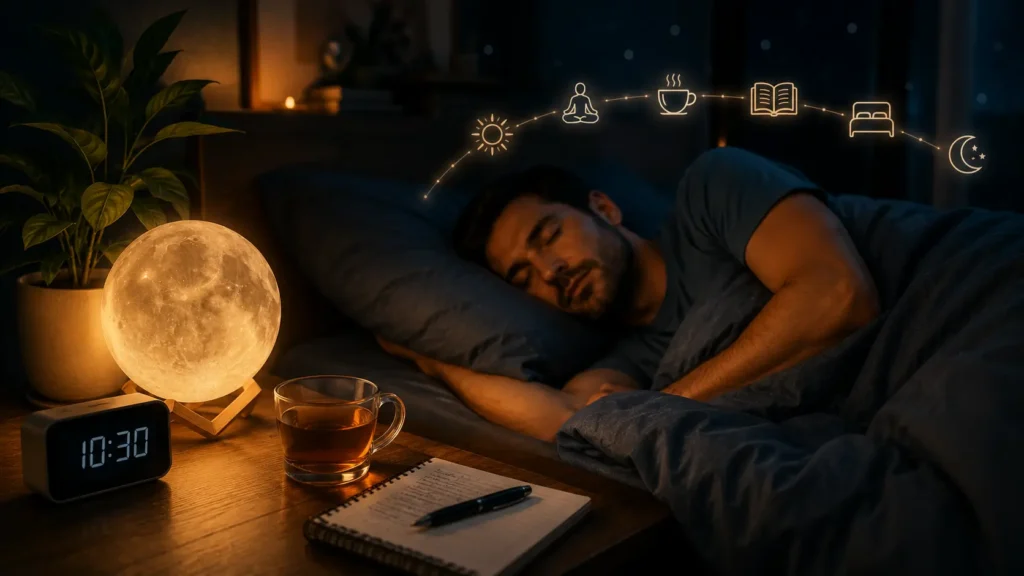
1. Keep a Consistent Sleep Schedule — Even on Weekends
Your body runs on a circadian rhythm — an internal 24-hour clock. Going to bed and waking up at the same time every day, including weekends, is the single most effective habit for improving deep sleep quality.
Try this: Set a fixed wake-up time and stick to it for 21 days straight. Your body will naturally begin pulling you toward deeper sleep stages faster.
Read More: Best Foods Rich in Vitamin B12 for Brain Health — Choices for People Over 40 and 50
2. Lower Your Core Body Temperature Before Bed
Deep sleep is triggered when your core body temperature drops. Adults over 30 often struggle with this because of stress hormones and metabolic changes.
- Take a warm shower or bath 60–90 minutes before bed
- Keep your bedroom temperature between 65–68°F (18–20°C)
- Use breathable, cotton bedding
3. Reduce Blue Light Exposure After Sunset

Screens emit blue light that suppresses melatonin production — the hormone that signals your brain to enter deep sleep.
- Use Night Shift or a blue light filter app after 7 PM
- Switch to dim, warm-toned lighting in the evening
- Do a 20-minute screen-free wind-down routine before bed
4. Try Magnesium Glycinate for Natural Sleep Support
Magnesium plays a direct role in activating the nervous system pathways responsible for deep sleep. Magnesium-rich foods include dark leafy greens, pumpkin seeds, almonds, and dark chocolate.
5. Limit Alcohol — It Destroys Deep Sleep Architecture
Alcohol helps you fall asleep but severely fragments deep sleep. Even one or two drinks reduces slow-wave sleep by up to 20%. Finish your last drink at least 3 hours before bedtime.
6. Exercise Regularly — But Time It Wisely
- Morning or afternoon cardio (brisk walking, cycling, swimming)
- Strength training 3x per week
- Avoid intense workouts within 2 hours of bedtime
7. Manage Stress With a Pre-Sleep Wind-Down Ritual
Build a 20–30 minute wind-down ritual:
- Journaling: write down 3 things you are grateful for
- 4-7-8 breathing: inhale 4 counts, hold 7, exhale 8
- Light reading (physical book, not a screen)
- Progressive muscle relaxation
FAQs
How long does it take to improve deep sleep naturally? Most people notice improvements within 2–4 weeks. Full results often take 6–8 weeks.
Can deep sleep be recovered after sleep deprivation? Yes, the brain has a rebound mechanism — but chronic sleep debt has lasting effects, so consistency matters.
Is 7 hours enough deep sleep for adults over 30? Total 7–9 hours is recommended, with 15–23% being deep sleep. Quality over quantity is key.
Final Thoughts
Improving deep sleep naturally without medication is absolutely achievable for adults over 30 — but it requires consistency. Start with two or three changes, track your sleep, and build from there.
Save this guide, share it with someone who struggles with sleep, and start tonight with just one change — a consistent wake-up time.
Read More: Causes of Irregular Periods in Women in Their 30s