
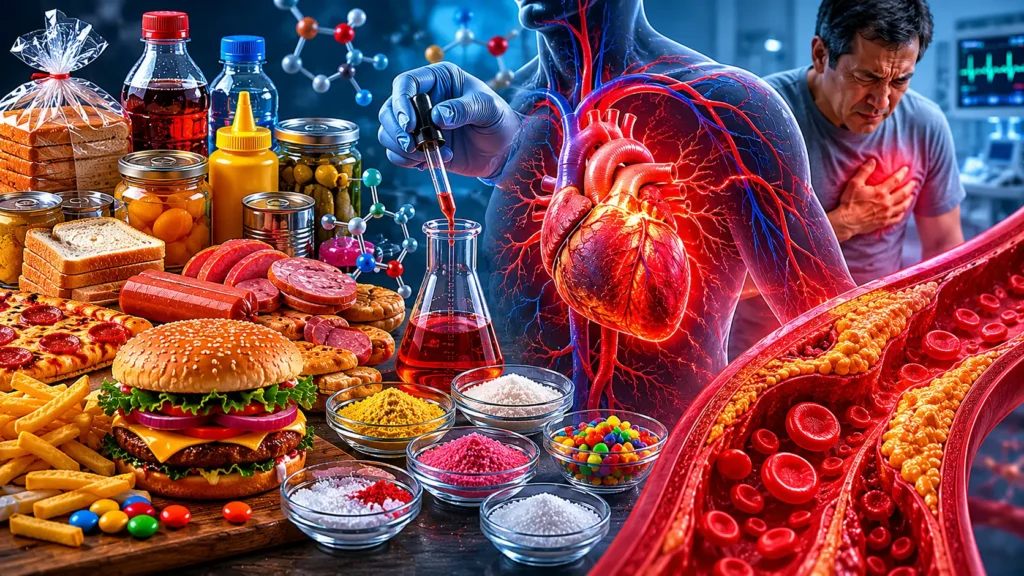
Food Preservatives Are Linked to Heart Disease
Which 8 food preservatives are linked to heart disease, according to the 2026 study that shocked the medical world? A landmark French research project tracking over 112,000 people for nearly a decade has just delivered an answer — and the findings are already changing how doctors and nutritionists think about packaged food.
The study, published on May 20, 2026 in the prestigious European Heart Journal, is the largest investigation of its kind ever conducted. For years, scientists suspected that food preservatives might be harming our hearts. But until now, hard evidence from real-world human data was missing. That gap has been definitively closed — and what the researchers found should make every person who eats processed food stop and read their food labels.
112K+ Participants tracked in France
7–8 Years of health monitoring
29% Higher hypertension risk
16% Higher cardiovascular disease risk
1. The Food Preservatives Cardiovascular Health Risk Study Explained
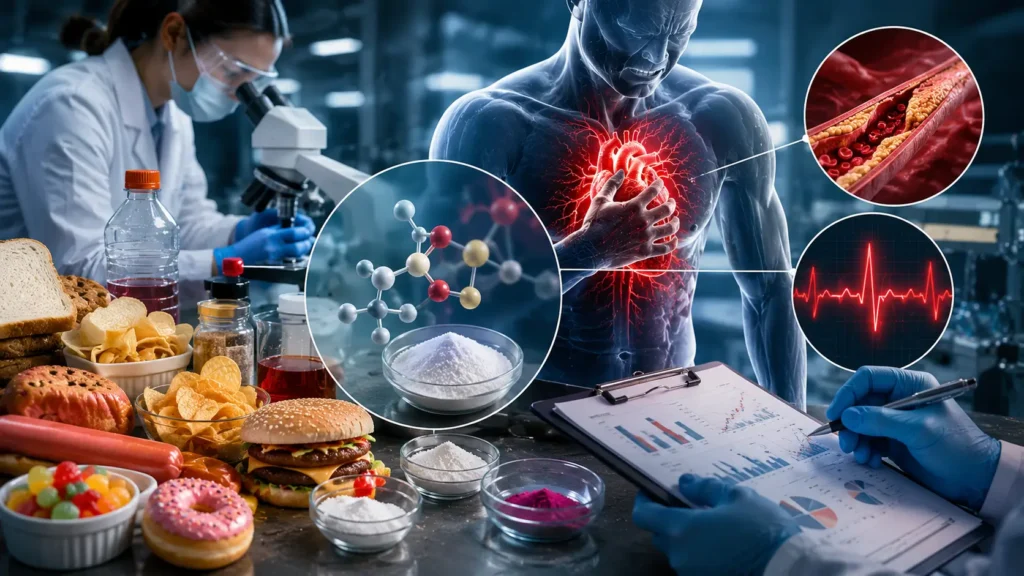
To understand the food preservatives cardiovascular health risk 100,000-person study, we need to start with how it was conducted — because the methodology is what makes this research so credible and alarming.
The study is part of NutriNet-Santé, France’s long-running national nutrition research program launched in 2009. More than 112,000 adults aged 15 and above participated. Every six months, each volunteer recorded every single thing they ate and drank — by brand name — for three consecutive days. Researchers then used a detailed database of commercial food product ingredients to identify exactly which preservatives each person was consuming, and in what quantities.
Read More: AI Heart Test ECG to Track Puberty Development in Children: What Parents Should Know
Their health outcomes — including the development of high blood pressure (hypertension), heart attacks, strokes, and angina — were tracked through France’s national healthcare system over an average of seven to eight years. The result is a dataset of extraordinary depth that no previous study could match.
“Experimental studies suggest that some preservative food additives may be harmful to cardiovascular health, but we have not had enough evidence on the impact of these ingredients in humans. As far as we know, this is the first study of its kind to investigate the links between a wide range of preservatives and cardiovascular health.” — Anaïs Hasenböhler, Nutrition Researcher, Sorbonne Paris North University
The key finding: 99.5% of all participants had consumed at least one food preservative within the first two years of joining the study. In other words, virtually no one eating a modern diet can completely avoid these additives.
2. Which 8 Food Preservatives Are Linked to Heart Disease? Full 2026 List
Researchers examined 58 preservatives in total, then conducted a deep analysis of the 17 consumed by at least 10% of participants. Of these, 8 food preservatives were specifically linked to heart disease and high blood pressure. Here is every one of them — with their E-numbers, where you’ll find them, and the specific risk they carry:
Potassium Sorbate
E202 Found in: cheese, wine, dried fruits, baked goods. Prevents mold growth.
Hypertension Risk Potassium Metabisulphite
E224 Found in: wine, fruit juices, seafood, dried vegetables. An antimicrobial agent.
Hypertension Risk Sodium Nitrite
E250 Found in: bacon, ham, hot dogs, processed deli meats. Prevents botulism.
Hypertension Risk Ascorbic Acid (Vitamin C)
E300 Found in: juices, canned foods, cereal, frozen fish. Prevents browning.
Hypertension + CVD Risk Sodium Ascorbate
E301 Found in: cured meats, sausages, processed snacks. Antioxidant preservative.
Hypertension Risk Sodium Erythorbate
E316 Found in: hot dogs, cured meats, pickles. Maintains meat color stability.
Hypertension Risk Citric Acid
E330 Found in: soft drinks, candy, sauces, canned tomatoes, dairy. Acidulant and preservative.
Hypertension Risk Rosemary Extract
E392 Found in: oils, snacks, meat products. Marketed as a “natural” preservative.
Hypertension Risk
The Most Alarming Finding Ascorbic acid (E300) — commonly known as Vitamin C — was the only preservative linked not just to high blood pressure but directly to cardiovascular disease itself, including heart attacks and strokes. This is particularly shocking because ascorbic acid is widely marketed as a beneficial, natural additive.
3. How High Are the Cardiovascular Health Risks? Numbers Explained
The scale of risk revealed in this food preservatives cardiovascular health risk 100,000-person study is significant enough that researchers and cardiologists are now calling for an urgent review of food labelling regulations across Europe and beyond.
- People who ate the most non-antioxidant preservatives (like E202, E224, E250) had a 29% higher risk of hypertension compared to those who ate the least
- The same group showed a 16% higher risk of cardiovascular disease — including heart attacks, strokes, and angina
- People who consumed the most antioxidant preservatives (like E300, E301, E316, E330, E392) showed a 22% higher risk of hypertension
- The findings held up even after researchers controlled for overall diet quality, smoking, exercise habits, and obesity
- The association was strongest in participants who consumed processed foods most frequently — not just occasionally
What Does This Mean Scientifically? The study is observational — meaning it shows a strong association between preservative consumption and heart disease, but cannot definitively prove that preservatives alone cause heart disease. However, researchers note that the association remained robust even after controlling for dozens of other dietary and lifestyle factors. As one independent expert stated: “There are signals in the results that warrant further investigation” — which in scientific language means: take this very seriously.
4. How to Avoid Harmful Food Preservatives for Better Heart Health in 2026
Knowing how to avoid harmful food preservatives for better heart health in 2026 requires practical, actionable steps — not just fear. Here is a complete strategy based on the study’s findings:
Read E-Numbers on Every Label
The eight preservatives identified in the study all have specific E-numbers. Make it a habit to check ingredient lists for E202, E224, E250, E300 (in large amounts), E301, E316, E330, and E392. In the US, these appear as full chemical names rather than E-numbers — look for “sodium nitrite,” “citric acid,” “potassium sorbate,” and “sodium erythorbate” on packaged food labels.
Reduce Ultra-Processed Food Consumption
| High-Preservative Foods to Limit | Heart-Healthy Alternatives | Preservative Avoided |
|---|---|---|
| Packaged deli meats, bacon, ham | Fresh cooked chicken, fish, eggs | E250 (Sodium Nitrite) |
| Canned fruit juices, soft drinks | Fresh squeezed juice, water, herbal tea | E300, E330 |
| Dried fruits with long shelf life | Fresh or frozen unsweetened fruits | E202, E224 |
| Packaged snacks, crackers, chips | Homemade popcorn, nuts, raw vegetables | E392, E300 |
| Commercial sauces and condiments | Homemade sauces, olive oil + lemon | E330, E202 |
Cook More From Scratch
The simplest way to eliminate preservatives entirely is home cooking. When you cook from whole ingredients — fresh vegetables, unprocessed meats, whole grains, legumes — you bypass the entire system of industrial food preservation. Even cooking two or three meals a week from scratch can meaningfully reduce your overall preservative intake.
Choose Shorter Ingredient Lists
A practical rule of thumb: if a food product has more than five ingredients, or if you cannot pronounce several of them, it is likely high in preservatives and other additives. Products with shorter, recognizable ingredient lists are generally lower in the preservatives identified in this study.
5. Common Packaged Food Ingredients That Damage Heart Health — Full Breakdown
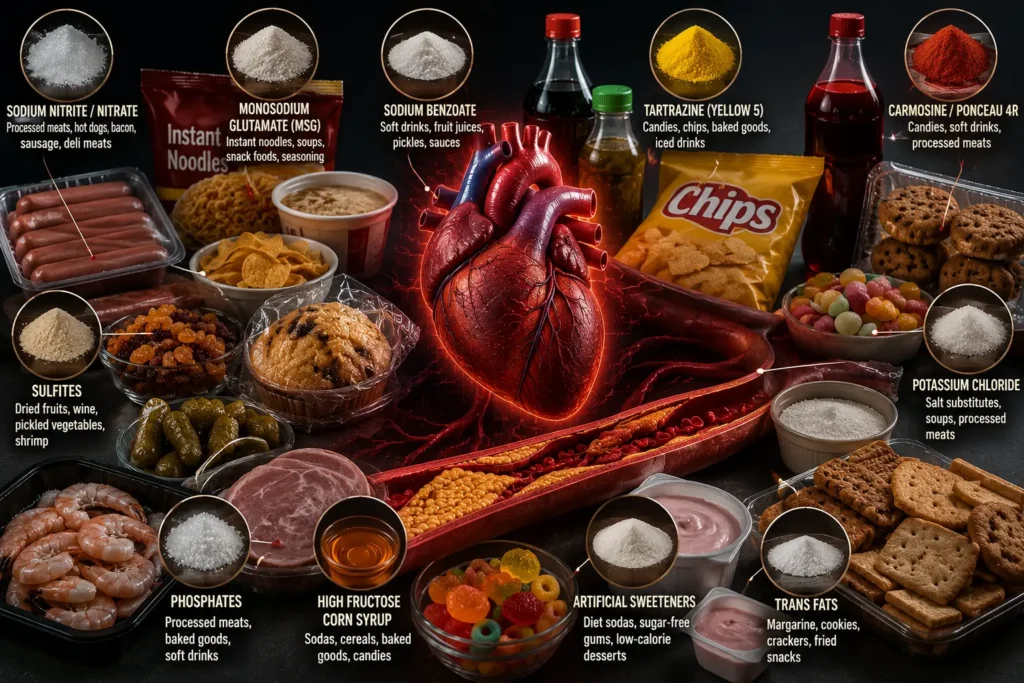
Beyond the eight specific preservatives, this research connects to a broader picture of common packaged food ingredients that damage heart health. The study’s lead researchers emphasized that preservatives are just one piece of the ultra-processed food puzzle:
- Sodium nitrite in processed meats — linked to hypertension and colorectal cancer in multiple studies; the most well-established risk on this list
- Citric acid in soft drinks — now linked to hypertension; previously considered safe because it occurs naturally in citrus fruits
- Rosemary extract in snacks — a so-called “natural” preservative that is now showing cardiovascular associations at industrial doses
- Potassium sorbate in cheese and baked goods — one of the most widely used preservatives globally, now linked to elevated blood pressure
- Sulphite compounds (E224) in wine and seafood — previously associated with asthma and allergic reactions; now also linked to heart risk
The “Natural” Preservative Trap One of the most important takeaways from this study is that the words “natural preservative” or “contains Vitamin C” on a food label do not mean the product is heart-safe. Ascorbic acid (E300) and rosemary extract (E392) are both marketed as natural alternatives to synthetic preservatives — yet both appear in the list of eight preservatives linked to hypertension. At industrial doses used in mass food production, even naturally occurring compounds can carry cardiovascular risk.
What the Researchers Recommend The study team and independent cardiologists reviewing the research have called for: (1) clearer front-of-pack labeling identifying preservative E-numbers, (2) further mechanistic studies to understand exactly how each preservative damages blood vessel and heart function, and (3) regulatory review of acceptable daily intake levels — particularly for sodium nitrite (E250) and ascorbic acid (E300) in combination with other additives.
FAQs
Which 8 food preservatives were linked to heart disease in the 2026 study?
The eight preservatives identified are: Potassium Sorbate (E202), Potassium Metabisulphite (E224), Sodium Nitrite (E250), Ascorbic Acid/Vitamin C (E300), Sodium Ascorbate (E301), Sodium Erythorbate (E316), Citric Acid (E330), and Rosemary Extracts (E392). All eight were linked to high blood pressure, and E300 was additionally linked directly to cardiovascular disease.
How many people were in the food preservatives heart disease study?
The NutriNet-Santé study tracked 112,000+ adults in France over an average of seven to eight years. Published in the European Heart Journal on May 20, 2026, it is the largest study of its kind ever conducted on this topic.
The Bottom Line: Your Food Label Is a Health Warning
The 2026 NutriNet-Santé study has changed the conversation around food preservatives permanently. For the first time, we have large-scale, long-term human data showing that eight of the most common preservatives in everyday packaged foods are significantly linked to high blood pressure and cardiovascular disease — including ones widely considered safe or even beneficial.
This does not mean panic. It means awareness. Read your labels. Cook fresh when you can. Treat the words “natural preservative” with the same critical eye you would give any chemical additive. Your heart is tracking what you eat every single day — and this study shows it has been keeping score all along.
Read More: Iron Deficiency Symptoms in Women: 10 Essential Natural Iron Sources & Treatment Guide