
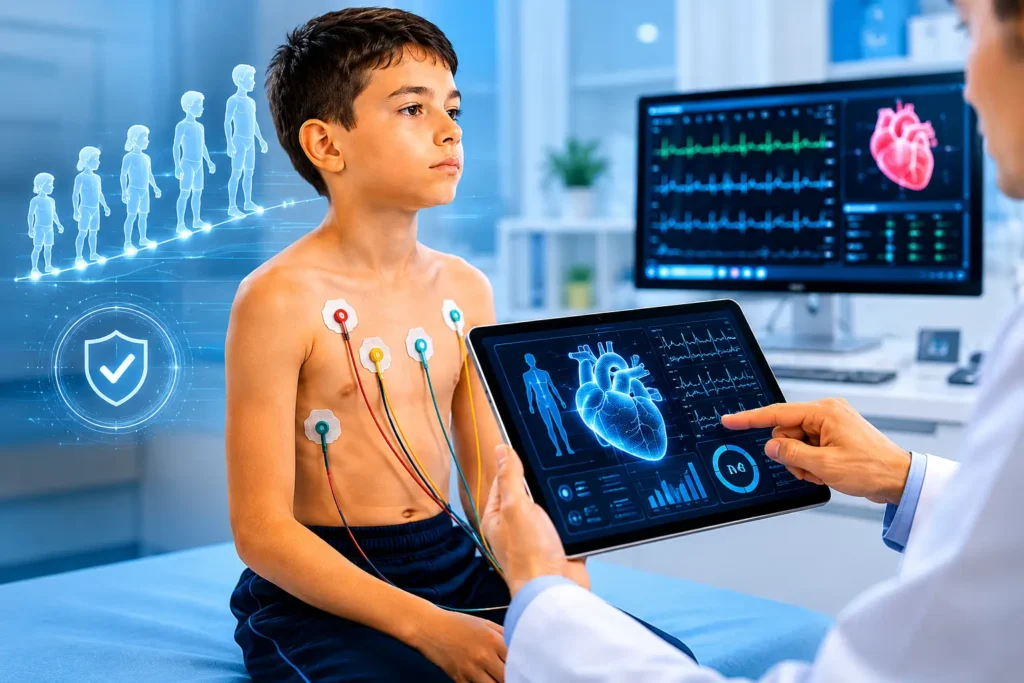
AI Heart Test ECG
AI heart test ECG to track puberty development in children is no longer science fiction — a groundbreaking 2026 study has just proven it works, and every parent, pediatrician, and health researcher needs to understand why this matters.
For decades, tracking a child’s journey through puberty has depended on uncomfortable hormonal blood tests or subjective physical examinations. But a team of researchers at Wake Forest University School of Medicine has just published a study showing that a simple, routine heart test — an electrocardiogram (ECG) — analyzed by artificial intelligence can accurately reflect a child’s biological development stage without a single blood draw.
60K+
Children’s ECGs analyzed in the study
0–18
Age range of children studied
91%
AI accuracy (AUC) in post-pubertal group
0
Hormone tests needed for this method
1. What Is the AI ECG Puberty Research Tracking Study? Explained for Parents
Understanding the AI ECG Puberty Research tracking study explained for parents starts with knowing what an ECG actually is. An electrocardiogram is a painless, non-invasive test that records the electrical activity of the heart using small sensors placed on the skin. It takes just 10 seconds and is already performed routinely in hospitals worldwide for millions of children every year.
What the Wake Forest researchers did was remarkable: they took 61,930 standard ECG recordings from children aged 0–18 years stored at the University of Tennessee Health Science Center and fed them into an AI model originally trained on adult data. Without any retraining, the AI began detecting predictable patterns in how the electrical signals of the heart changed as children matured through puberty.
“One of the most exciting aspects of this work is that it shows routine ECG data may contain meaningful information about biological maturation in children and adolescents.” — Tolga Hayit, Ph.D., Co-Lead Author, Wake Forest University School of Medicine
The result was the creation of a new metric called the Electrocardiographic Sex Index (ESI) — an AI-generated score that reflects where a child sits on the continuous spectrum of biological development, rather than simply placing them in a fixed category.
Read More: Iron Deficiency Symptoms in Women: 10 Essential Natural Iron Sources & Treatment Guide
2. Can an ECG Test Predict Biological Age in Kids? What 2026 Research Shows
The big question many parents are asking: can ECG test predict biological age in kids 2026? The answer from this study is a qualified but exciting yes.
Researchers found that the AI-generated ESI score changed in a highly predictable pattern across three key age groups:
| Developmental Stage | Age Range | ESI Score Behavior | AI Accuracy (AUC) |
|---|---|---|---|
| Pre-pubertal | 0 – 7 years | ESI scores very similar across all children — little difference by sex | 0.67 (lower) |
| Peri-pubertal | 8 – 14 years | ESI begins diverging noticeably between boys and girls | 0.91 (high) |
| Post-pubertal | 15 – 18 years | ESI plateaus — development has stabilized; differences are clear | 0.98 (very high) |
This pattern mirrors the well-known Tanner staging system — the standard 5-stage clinical scale doctors currently use to assess puberty physically. The fact that AI could replicate this from nothing but heart electrical signals is, frankly, extraordinary.
Key Scientific Insight The AI’s lower accuracy in pre-pubertal children is actually scientifically meaningful. It confirms that sex hormones are primarily responsible for the heart changes the AI detects — before hormones kick in, the hearts of boys and girls look virtually identical on an ECG.
3. The Non-Hormonal Method to Measure Child Development Using AI — Why It’s a Game-Changer

One of the most important implications of this research is the development of a non-hormonal method to measure child development using AI. To understand why this matters, we need to know what researchers currently face without it.
The Problem With Current Methods
Pediatric researchers who study large groups of children often have access to thousands of patient records — but those records rarely include detailed hormone measurements or Tanner staging data. This forces scientists to group all children simply as “male” or “female” by birth sex — a blunt tool that completely misses the gradual, individual nature of biological development.
- ▶Hormone blood tests require needles — stressful for children and often avoided in large research studies
- ▶Tanner staging requires physical examination by a doctor — not feasible for large dataset research
- ▶Current sex-based grouping ignores that two 12-year-olds can be at completely different biological stages
- ▶Missing developmental data leads to inaccurate treatment dosing in pediatric drug research
How AI Heart Test ECG Solves This
The ESI score gives researchers a continuous, non-invasive measure of biological maturity. Since ECGs are already collected routinely during hospital visits for unrelated reasons — a heart murmur check, a sports physical, an emergency visit — the data already exists in millions of patient archives. The AI simply extracts developmental information that was already there but previously invisible to the human eye.
What This Means for Parents This does not mean your child’s next routine ECG will automatically “diagnose” their puberty stage. The ESI is currently a research tool. However, in the coming years, it could become a standard part of pediatric health monitoring — giving doctors a richer, more precise picture of your child’s development without additional tests.
4. HowAI Heart Test ECG Reads the Electrical Signals of Puberty
How exactly does the AI heart test ECG track puberty development in children at a biological level? The answer lies in the well-documented relationship between sex hormones and the heart.
When puberty begins — typically between ages 8–13 in girls and 9–14 in boys in the United States — the body releases increasing levels of estrogen and testosterone. These hormones don’t just cause the visible changes we associate with puberty. They also directly affect:
- ▶Heart rate patterns — girls typically develop slower resting heart rates post-puberty
- ▶QRS complex duration — the electrical wave pattern showing heart muscle contraction changes measurably
- ▶QT interval — the time for the heart’s ventricles to repolarize changes with hormone levels
- ▶P-wave morphology — subtle changes in how the atria contract become detectable
The AI Heart Test ECG model, trained on data from 90,133 pediatric patients at Mayo Clinic, learned to detect these micro-changes — too subtle for human cardiologists to consciously identify — and convert them into a meaningful developmental score. This is the power of AI applied to medical data at scale.
5. What Comes Next? Future of AI ECG Puberty Research
While this research is groundbreaking, the scientists are honest about its current limitations. The study establishes proof-of-concept but does not yet assess real-world clinical outcomes for children. The research team has outlined the next steps clearly:
- ▶Longitudinal studies needed — tracking the same children’s ESI scores over years to confirm accuracy over time
- ▶Incorporation of Tanner staging data to directly validate ESI against the gold standard
- ▶Study of how ESI may predict cardiovascular risk in children based on developmental maturity
- ▶Potential use in improving drug dosing research for pediatric medications
- ▶Exploring ESI in children with hormonal conditions such as precocious puberty or delayed development
Important Limitation for Parents The AI ESI model currently performs less accurately in very young children (under age 7, AUC = 0.67), because sex hormone differences have not yet emerged in ECG patterns. This does not reflect a flaw in AI — it confirms that the tool is genuinely measuring hormone-driven biological change, not just statistical noise.
FAQs: AI Heart Test ECG
What is the AI ECG puberty tracking study and who conducted it?
The study was conducted by researchers at Wake Forest University School of Medicine, led by Dr. Tolga Hayit and Dr. Ibrahim Karabayir. Published in May 2026 in the European Heart Journal – Digital Health, it analyzed over 61,930 ECGs from children aged 0–18 to develop an AI-based Electrocardiographic Sex Index (ESI) that tracks biological development through puberty.
Can ECG test predict biological age in kids in 2026?
Yes, with high accuracy in older children. The AI model achieved an AUC of 0.98 in post-pubertal children and 0.91 in the peri-pubertal age group. However, it is currently a research tool and not yet used for individual clinical diagnosis.
The Verdict: A Quiet Revolution in Pediatric Healthcare
The discovery that a routine, painless, 10-second heart test — analyzed by artificial intelligence — can track a child’s puberty development without hormones or invasive procedures is one of the most exciting pediatric health breakthroughs of 2026. For researchers struggling with incomplete datasets, for parents seeking less invasive monitoring options, and for doctors needing more precise tools, the AI ECG Puberty Research tracking method represents a profound step forward.
Read More: Measles Outbreak 2026 Bangladesh Deaths Children Latest: What Indian Parents Should Know