
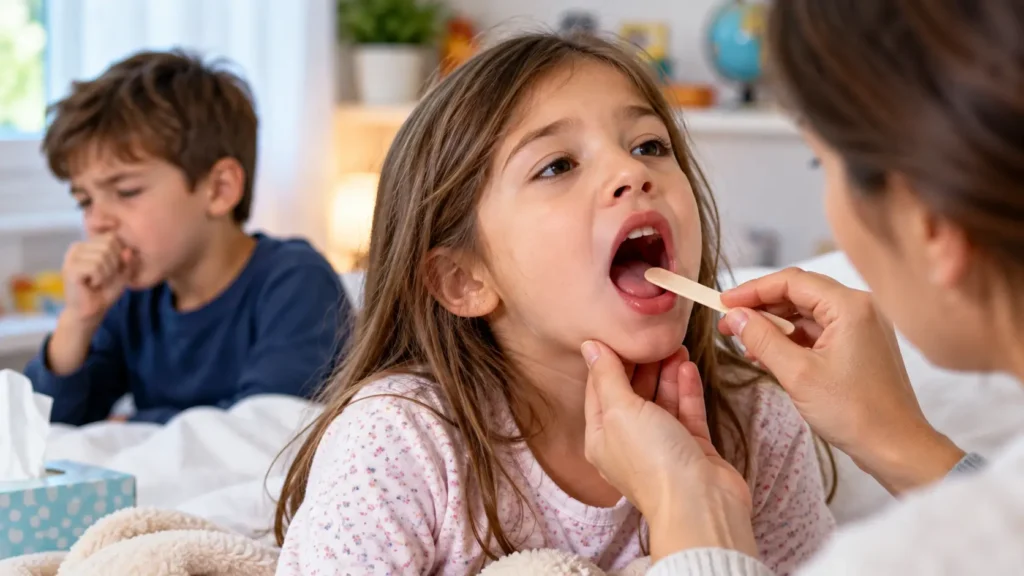
Strep Throat Symptoms September 2026
If your child came home from school this week complaining of a sore throat, you’re not imagining that it feels like everyone’s kid has it right now. Strep throat cases are climbing across the United States Strep Throat Symptoms September 2026 and pediatricians’ offices are getting busier by the day. As a parent, knowing the early signs of strep throat in children — and understanding how it’s different from a regular cold — can help you get your child treated faster and avoid unnecessary complications.
I am not a doctor, and this blog post is for general informational purposes only. It is not a substitute for professional medical advice, diagnosis, or treatment. Always consult a licensed healthcare provider if your child shows symptoms of illness.
Read More: Salt Water Gargling for Flu Prevention: Simple, Effective Tips
Why Strep Throat Cases Are Rising This September 2026
This isn’t just a feeling — it’s backed by federal health data. Reports of group A strep infections are beginning to increase in the United States as children return to school, according to CDC surveillance data updated in Strep Throat Symptoms September 2026. Emergency department visit data are already showing an uptick in cases involving strep throat and scarlet fever, both caused by group A strep bacteria.
This pattern isn’t unusual, but it is worth paying attention to. Classrooms, school buses, and after-school activities bring kids into close contact all day long — exactly the conditions that group A strep bacteria need to spread from one child to another. September and October, right as the new school year settles in, tend to mark the beginning of a seasonal climb that typically continues into the colder months.
So if it feels like strep throat is “going around” your child’s school right now, that instinct is likely correct — and it’s a good reason to learn what to watch for before it lands in your house.
Early Signs of Strep Throat in Children Parents Should Know
Catching the early signs of strep throat in children early can make a real difference in how quickly your child starts feeling better. Unlike a cold that creeps in slowly over a day or two, strep throat tends to hit fast.
Common symptoms to watch for:
- Sudden sore throat that comes on quickly, sometimes appearing red or raw
- Pain when swallowing — Strep Throat in Kids may refuse food or complain that drinking hurts
- Fever, often one of the first signs parents notice
- Red, swollen tonsils, sometimes with white patches or streaks of pus
- Swollen, tender lymph nodes in the front of the neck
- Tiny red spots on the roof of the mouth (called petechiae, a fairly specific clue)
These symptoms typically show up two to five days after a child is exposed to the bacteria, so if your child was around a sick classmate or sibling earlier in the week, keep an eye out around that timeframe.
Less common symptoms, especially in younger kids
Not every child presents with the “textbook” version of strep throat. Headache, nausea or vomiting, a fine rash associated with scarlet fever, and stomach pain are also possible, particularly in children. These symptoms can easily be mistaken for a stomach bug, so if your child has a sore throat plus stomach upset, it’s worth mentioning strep throat to the doctor.
Can Strep Throat in Kids Without a Fever?
This is one of the most common questions parents search for — and yes, it’s genuinely possible. While fever is one of the classic symptoms, it doesn’t show up in every single case. Some children, especially in the very early stages of infection, may have a sore throat, painful swallowing, and swollen tonsils without a noticeably high temperature.
This matters because a lot of parents assume “no fever means it’s not serious” and wait it out at home. But strep throat is a bacterial infection, not a virus, so it won’t resolve on its own the way a mild cold might. If your child has a sore throat that came on suddenly, along with swollen glands or white patches on the tonsils — even without a fever — it’s still worth getting a rapid strep test. A quick swab at the doctor’s office is the only reliable way to confirm strep, since symptoms alone can’t always tell the difference.
How Do Children Get Strep Throat?
Understanding How Do Children Get Strep Throat helps explain why it spreads so easily in school settings — and what you can actually do to reduce the risk.
Strep throat is caused by group A Streptococcus bacteria, and it spreads mainly through:
- Respiratory droplets — coughing or sneezing near others
- Close contact with someone who’s infected, such as a sibling or classmate
- Sharing cups, utensils, or food with someone who’s sick
- Touching contaminated surfaces and then touching the mouth or nose
Close contact with another person who has strep throat is the single most common risk factor, and the bacteria often spread easily between people living in the same household. Parents of school-age children and other adults who spend a lot of time around kids also face a higher risk of catching it themselves.
Crowded environments only add fuel to the fire. Daycare centers, schools, and other group settings where Strep Throat in Kids are in close quarters make it much easier for group A strep to pass from child to child.
As for who’s most at risk by age: strep throat is most common in children between 5 and 15 years old, while it’s relatively rare in children younger than 3. If you have a toddler with a sore throat, it’s more likely to be viral — but it’s still worth having it checked, especially if an older sibling recently tested positive for strep.
Strep Throat vs. Common Cold: Spot the Difference

One of the trickiest parts of parenting through cold and flu season is figuring out what you’re actually dealing with. Here’s a simple way to think about it.
Symptoms that point toward a virus, not strep throat:
- Cough
- Runny or stuffy nose
- Hoarse or raspy voice
- Pink eye (conjunctivitis)
If your child has a cough, runny nose, hoarseness, or pink eye alongside the sore throat, it’s more likely a viral infection rather than strep. Strep throat, on the other hand, usually shows up without a cough or congestion — the sore throat is often the standout symptom, arriving suddenly and severely.
Of course, strep throat in kids can have overlapping infections too, which is exactly why a rapid strep test at your pediatrician’s office is so useful. Viruses actually cause the majority of sore throats overall — strep throat only accounts for around 1 in 10 sore throats in adults and roughly 3 in 10 in children. That means most sore throats aren’t strep at all, but it’s common enough in kids that it shouldn’t be ruled out without testing.
When to Call the Doctor
You don’t need to panic over every scratchy throat, but it’s worth scheduling a same-day or next-day visit if your child has:
- A sore throat that came on suddenly and severely
- Fever along with a sore throat
- White patches or pus visible on the tonsils
- Difficulty or pain swallowing that’s affecting eating or drinking
- Close contact with someone recently diagnosed with strep
A quick in-office test can confirm the diagnosis in minutes, and if it comes back positive, your pediatrician will typically prescribe antibiotics.
What Happens If Strep Throat Goes Untreated?
This is the part that makes strep throat different from a typical viral sore throat — and why testing matters. If left untreated, complications can occur when the bacteria spread to other parts of the body, including ear infections, sinus infections, and abscesses around the tonsils or in the neck. In rarer cases, untreated strep throat can lead to more serious conditions like rheumatic fever, which affects the heart, joints, brain, and skin, or post-streptococcal glomerulonephritis, a kidney condition.
These complications are uncommon in the U.S. today, largely because antibiotics work quickly and effectively against strep — but they’re a good reminder of why “wait and see” isn’t the best approach with a suspected case.
How to Protect Your Family This Fall
With cases climbing as the school year gets underway, a few simple habits go a long way:
- Wash hands frequently, especially after school and before meals
- Avoid sharing cups, utensils, water bottles, or food with anyone who’s sick
- Wash dishes and cups thoroughly after a sick family member uses them
- Teach kids to cover coughs and sneezes with an elbow, not hands
- Keep sick kids home until they’ve been on antibiotics for at least 24 hours and are fever-free
- Don’t ignore a sudden sore throat — get it checked rather than waiting it out
Quick FAQ: Strep Throat in Kids
How long is strep throat contagious?
Early Signs of Strep Throat in Children are generally considered contagious until they’ve been on antibiotics for about 24 hours, or until symptoms resolve if untreated.
Can strep throat go away without antibiotics?
It can eventually clear on its own in some cases, but treatment with antibiotics is recommended to reduce symptom duration, prevent spread, and lower the risk of complications.
Is strep throat the same as scarlet fever?
Scarlet fever is caused by the same bacteria as strep throat but comes with an added rash — it’s essentially strep throat plus a distinctive skin reaction.
Can adults catch strep throat from their kids?
Yes. Parents and caregivers who are frequently around school-age children face a higher risk of catching it themselves.
Final Thoughts: Strep Throat Symptoms September 2026
Strep throat symptoms in September 2026 are showing up earlier and more frequently than many parents expect, largely tied to the start of the school year. Knowing the early warning signs — a sudden sore throat, painful swallowing, swollen glands, and sometimes fever, sometimes not — puts you in a much better position to act quickly. When in doubt, a quick visit to the pediatrician and a rapid strep test will give you a clear answer, rather than guessing based on symptoms alone.
Read More: Pumpkin Health Benefits for Adults: 9 Reasons to Eat More Pumpkin This Fall

