

Ozempic Linked to 30% Lower Breast Cancer Risk
A groundbreaking study published June 2, 2026, in JCO Oncology Practice — and presented to a standing-room audience at the 2026 American Society of Clinical Oncology (ASCO) Annual Meeting in Chicago — has revealed that women taking GLP-1 drugs like Ozempic, Wegovy, Mounjaro, and Zepbound are approximately 30% less likely to develop breast cancer than women not taking these medications.
The Study Involved Over 110,000 Real Women — Not a Small Sample
One of the first questions skeptics ask about any health study is: How many people were actually studied?
This time, the answer is hard to dismiss.
Researchers at the University of Pennsylvania Perelman School of Medicine, led by Dr. Elizabeth McDonald, analyzed electronic health records from 111,646 women between the ages of 45 and 80. All participants:
- Had a BMI of 25 or higher (overweight or obese)
- Had undergone breast imaging within the Penn Medicine health system
- Were tracked between January 2022 and June 2025
Of these women, 15,264 (13.7%) had documented GLP-1 prescriptions. The remaining 96,382 (86.3%) had no exposure to GLP-1 drugs. This large, real-world dataset makes the findings significantly more meaningful than a small lab study.
Read More: Oura Ring 5 vs WHOOP 5: Which Health Tracker Is Right for You in 2026?
The 30% Risk Reduction Held Across Age, Race, and Body Weight

Perhaps the most striking aspect of this research is how consistent the finding was.
The Ozempic breast cancer risk reduction did not disappear when researchers controlled for:
- Age
- Race and ethnicity
- Body mass index (BMI)
- Breast density
- Diabetes status
In the full study population, women on GLP-1 drugs had 35.1% lower odds of developing breast cancer. In the carefully matched analysis — where researchers paired GLP-1 users with non-users who had similar characteristics — the risk reduction remained at a powerful 30.5%.
Among GLP-1 users, only 1.62% were diagnosed with breast cancer, compared to 2.47% of non-users. That difference may sound small in percentage terms, but across millions of American women, it translates to tens of thousands of potential diagnoses prevented.
GLP-1 Drugs Lower Breast Cancer Risk Through 4 Biological Pathways
The finding that GLP-1 drugs lower breast cancer risk is not just a statistical coincidence. Researchers have identified at least four biological reasons why this makes scientific sense:
1. Weight Loss Lowers Estrogen After menopause, fat tissue becomes the body’s primary source of estrogen. Excess estrogen fuels the growth of hormone-receptor-positive breast cancer — the most common type. GLP-1 drugs promote significant sustained weight loss, directly reducing this estrogen load.
2. Reduced Chronic Inflammation Obesity triggers ongoing low-grade inflammation throughout the body. This inflammation creates an environment where abnormal cells survive and multiply more easily. GLP-1 agonists are proven to reduce key inflammatory markers, interrupting one of cancer’s main enablers.
3. Improved Insulin Sensitivity High blood insulin levels — common in obesity and type 2 diabetes — act as a powerful growth signal for tumor cells. By dramatically improving insulin sensitivity, GLP-1 drugs may reduce the biological “fuel” that early cancer cells need to grow.
4. Possible Direct Action on Tumor Cells The most exciting emerging theory: some research presented at ASCO 2026 suggests that GLP-1 receptors may be expressed directly on certain tumor cells. This means drugs like Ozempic and Wegovy could potentially act on cancer cells directly — not just through weight loss. This pathway is still being investigated.
Can Ozempic Prevent Breast Cancer in Women Over 40?
This is the question every woman wants answered directly: Can Ozempic prevent breast cancer in women over 40?
Here is the completely honest answer:
The evidence is compelling — but not yet definitive.
This was an observational study. Researchers tracked women who were already taking GLP-1 drugs; they did not randomly assign women to a treatment group. That means the study establishes a strong association, not a proven cause-and-effect relationship.
What we know for certain:
- The risk reduction was statistically significant and consistent
- The study size (111,000+ women) gives the findings real credibility
- The findings have already triggered a new clinical trial to formally test GLP-1 drugs for breast cancer prevention
- GLP-1 drugs are not FDA-approved for cancer prevention as of June 2026
- No doctor should prescribe Ozempic specifically to prevent breast cancer yet
The bottom line: This research is serious enough that your doctor needs to know you are asking about it — especially if you are overweight and over 40.
Wegovy, Mounjaro, and Zepbound Show the Same Promising Effect
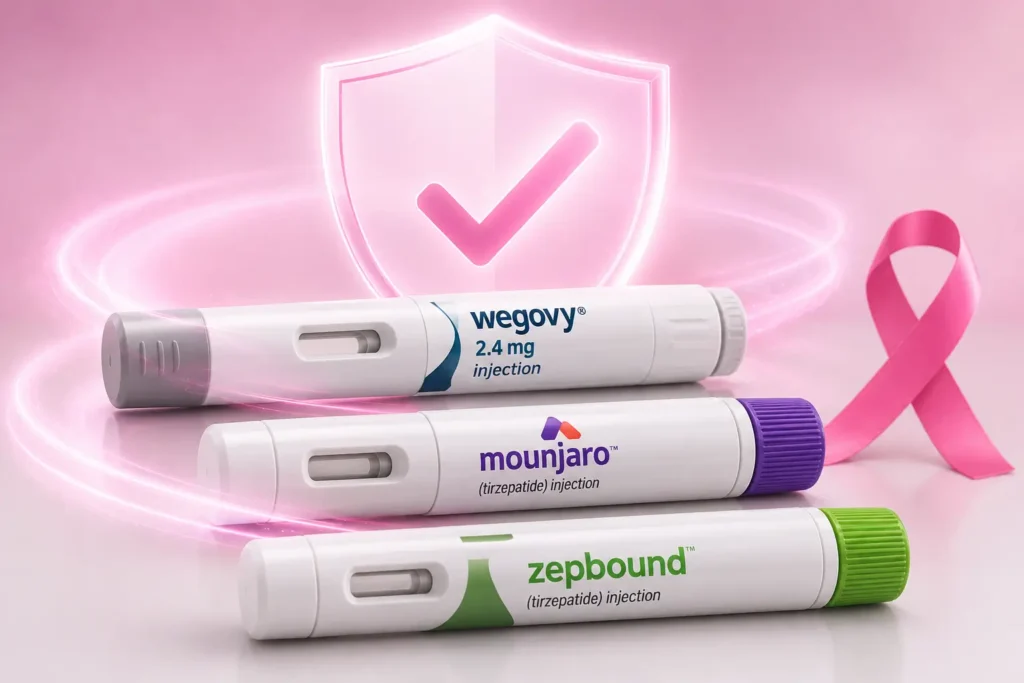
An important clarification for women wondering which specific drug was responsible for the cancer risk reduction:
The study examined the entire GLP-1 drug class — not just Ozempic alone.
Here is a quick breakdown of the medications included:
| Medication | Brand Name | Active Ingredient |
|---|---|---|
| Ozempic / Wegovy | Semaglutide | GLP-1 agonist |
| Mounjaro / Zepbound | Tirzepatide | GLP-1 / GIP dual agonist |
| Victoza / Saxenda | Liraglutide | GLP-1 agonist |
The Wegovy Mounjaro Zepbound cancer risk research applies across this entire drug family. The study did not break down results by specific medication — the protective association was seen across all GLP-1 users as a group.
This is important because it suggests the benefit may come from the class of drug and its metabolic effects — not from any single brand.
This Is Not the First Time GLP-1 Drugs Have Been Linked to Lower Cancer Risk
The June 2026 breast cancer finding did not emerge from nowhere. It is part of a rapidly growing body of evidence connecting GLP-1 drugs to cancer protection:
- November 2025: A major UC San Diego study found GLP-1 drugs like Ozempic and Wegovy were linked to dramatically lower cancer death rates in colon cancer patients
- February 2026: Three WHO-commissioned reviews confirmed GLP-1 drugs deliver significant metabolic benefits, with researchers noting cancer risk signals worth investigating
- June 2026 (ASCO): Multiple studies showed GLP-1 drugs may slow metastatic cancer progression in lung, breast, colorectal, and liver cancers
- June 2026: The Penn Medicine breast cancer study — 30% risk reduction in 111,000+ women
The pattern across multiple cancers, multiple research teams, and multiple years is becoming difficult to ignore.
What Women Over 40 Should Do Right Now — A Practical Action Plan
This research does not mean every woman over 40 should rush to get an Ozempic prescription. But it does mean there are clear, smart steps you can take today:
If you are already taking a GLP-1 drug (Ozempic, Wegovy, Mounjaro, or Zepbound):
- This finding adds one more reason to stay consistent with your treatment plan
- Continue your regular mammogram schedule — GLP-1 drugs do not replace screening
- Mention the ASCO 2026 findings at your next doctor’s visit
If you are overweight or obese and considering GLP-1 therapy:
- Breast cancer risk reduction is now part of a growing list of potential benefits — alongside heart protection, sleep apnea improvement, and kidney health
- Ask your doctor whether you qualify for a GLP-1 prescription under your current insurance plan
If you have a family history of breast cancer or carry the BRCA gene:
- Do not make any medication changes based on this study alone
- Ask your oncologist specifically about GLP-1 therapy given your personal risk profile
- Ask whether you may qualify for upcoming clinical trials testing GLP-1 drugs for breast cancer prevention
What you should never do:
- Do not skip mammograms because you are on GLP-1 therapy
- Do not self-prescribe or purchase GLP-1 drugs without medical supervision
- Do not treat this study as a guarantee — it is a strong signal, not a cure
The Bottom Line
The connection between Ozempic breast cancer risk reduction and GLP-1 drugs lower breast cancer risk is one of the most exciting and potentially impactful findings in women’s health in years.
A study of 111,000+ real women showed a consistent, significant, 30% reduction in breast cancer risk across all ages, races, and body types. Four credible biological mechanisms explain why it makes scientific sense. And a new clinical trial has already been launched to confirm what the data strongly suggests.
Read More:- GLP-1 Drugs Beyond Weight Loss: Ozempic’s Impact on Heart Health & Longevity (2026)