
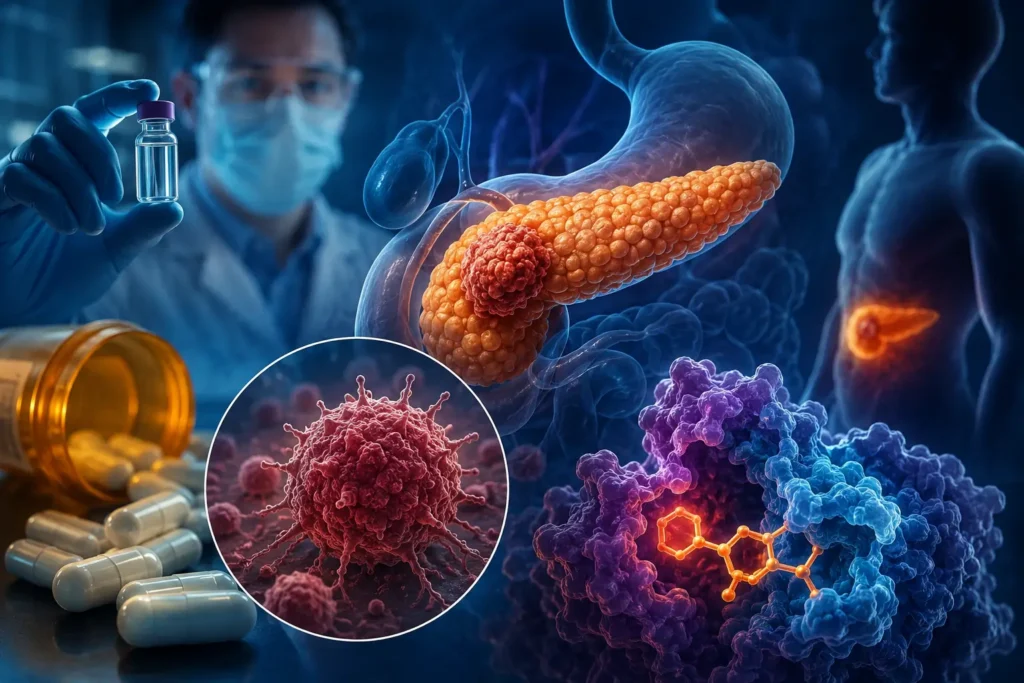
Daraxonrasib Pancreatic Cancer Drug 2026
For decades, pancreatic cancer has been called one of medicine’s most cruel puzzles. It hides silently, spreads fast, and kills in under a year after diagnosis at the metastatic stage. The mutation behind most cases — a gene called KRAS — was labelled “undruggable” for over 40 years. Scientists simply could not find a way to block it.
13.2 months median survival
Daraxonrasib
6.7 months median survival
Standard Chemo
2× Nearly doubles
overall survival
90% of pancreatic cancers have
KRAS mutation
1. What Is Daraxonrasib? The Science in Simple Terms
Daraxonrasib is an oral pill — you take it once a day — developed by a California-based biotech company called Revolution Medicines. It belongs to a completely new class of cancer drugs called RAS(ON) multi-selective inhibitors. In plain terms, it is designed to target and block the KRAS protein that drives most pancreatic cancers from spreading and growing.
The KRAS gene mutation is present in over 90% of pancreatic cancer cases. For decades, scientists tried to block this mutation but kept failing — the protein’s structure offered no good “pocket” for a drug to grab onto. Daraxonrasib works by using a tri-complex mechanism that locks onto the active, switched-on form of the mutant protein — something previous drugs could not do.
2. The RASolute 302 Trial — What the Numbers Actually Mean
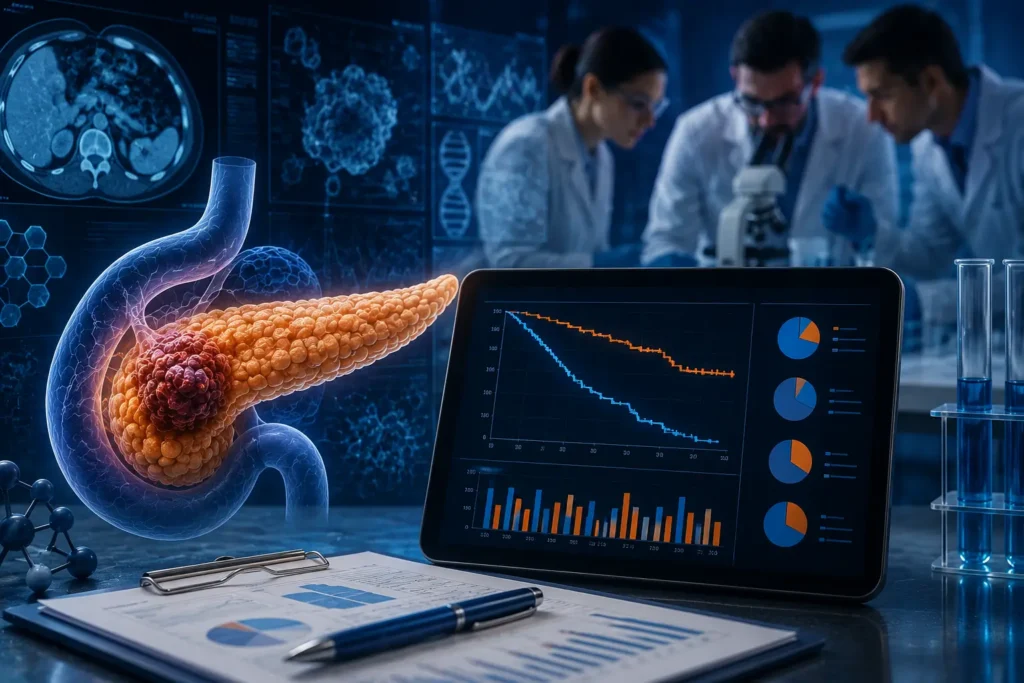
The results come from a Phase 3 clinical trial called RASolute 302, presented at the ASCO 2026 Annual Meeting by Dr. Brian Wolpin of Dana-Farber Cancer Institute. Here is a clear comparison of daraxonrasib versus standard chemotherapy:
| Outcome | Daraxonrasib | Standard Chemo |
|---|---|---|
| Median Overall Survival | 13.2 months | 6.7 months |
| Response Rate (Tumour Shrinkage) | 33.2% | 11.8% |
| Serious Side Effects (Grade 3+) | 43.6% | 57.5% |
| Stopped Due to Side Effects | 1.2% | 11.2% |
| Form | Oral pill (once daily) | IV Chemotherapy |
The hazard ratio was 0.40 — meaning patients on daraxonrasib had a 60% lower risk of dying compared to those on chemotherapy. These numbers were so strong that the trial met all its primary and secondary endpoints simultaneously — a rare feat in oncology.
3. Why Doctors Called It “Landscape-Changing”
“These results are landscape-changing for metastatic pancreatic cancer patients with a KRAS mutation. We are seeing unprecedented survival and efficacy in second-line treatment. The RAS revolution is here, and this study is proof of principle that targeting KRAS in pancreatic cancer is feasible and effective.”
— Dr. Rachna Shroff, Chief of Hematology/Oncology, University of Arizona Cancer Center & ASCO Expert, May 31, 2026
The word “unprecedented” is not used lightly in oncology. For context — before daraxonrasib, second-line chemotherapy for metastatic pancreatic cancer offered a median survival of just 6 to 7 months, with brutal side effects. There was no established standard of care. Patients and doctors had almost no good options after first-line treatment failed. Daraxonrasib changes that reality for the first time in the history of the disease.
4. What Is the KRAS Mutation and Why Did It Take 40 Years to Target?
The KRAS protein acts like an “on switch” for cell growth. In normal cells, this switch turns on and off. In cancer cells with a KRAS mutation, the switch gets permanently stuck in the “on” position — cells keep dividing uncontrollably. Over 90% of pancreatic cancers are driven by this exact malfunction.
For over four decades, scientists around the world tried to design drugs that could block KRAS. The challenge: the protein’s surface was unusually smooth, with no obvious groove or pocket for a drug molecule to attach to. Researchers called it “undruggable.” What Revolution Medicines discovered was a way to form a three-part molecular complex — drug, protein, and a co-factor — that effectively locks the mutant protein in an inactive state. This breakthrough is now called tri-complex inhibition.
5. FDA Status — When Will Daraxonrasib Be Approved?
The FDA has already granted daraxonrasib:
- Breakthrough Therapy Designation — fast-track review for drugs showing major advantage over existing treatments
- Orphan Drug Designation — for treatment of pancreatic cancer
- Expanded Access Program (from May 1, 2026) — meaning advanced pancreatic cancer patients who have already had chemotherapy can now apply to access daraxonrasib before full approval, subject to oncologist request
Revolution Medicines shipped the first doses of daraxonrasib on May 30, 2026, and has confirmed an FDA approval submission is imminent. Full formal FDA approval is expected sometime in late 2026, pending no unexpected findings.
7. What Comes Next — Daraxonrasib for Other Cancers
Pancreatic cancer is just the beginning. Revolution Medicines is testing daraxonrasib in several other ongoing Phase 3 trials:
- Non-Small Cell Lung Cancer (NSCLC) — RASolve 301 trial, enrollment nearly complete
- First-line pancreatic cancer — testing daraxonrasib as the very first treatment, replacing chemotherapy entirely
- Colorectal cancer — early-stage trials underway
- Other RAS-mutant solid tumours — preliminary results described as “promising”
The company’s companion drug, zoldonrasib, is also in Phase 3 trials for KRAS G12D-specific cancers, suggesting an entire new generation of precision oncology drugs is emerging from this research platform.
FAQ
Q: Who can take daraxonrasib right now?
Currently, daraxonrasib is available in the US under an expanded access programme for patients with previously treated metastatic pancreatic cancer. The prescribing oncologist must request permission from Revolution Medicines. It is not yet formally approved for routine clinical use.
Q: Does daraxonrasib work for all pancreatic cancers?
The RASolute 302 trial specifically targeted patients with KRAS mutations, which covers over 90% of pancreatic cancer cases. Importantly, the trial showed survival benefits even for patients with rarer RAS variants and even wild-type (non-mutant) RAS — suggesting a broader benefit than initially expected.
Q: Is daraxonrasib a cure for pancreatic cancer?
No. The current data is for second-line treatment of metastatic (spread) pancreatic cancer. It nearly doubles survival time compared to chemotherapy, which is a massive advance — but it is not a cure. Research is ongoing for earlier-stage disease settings where longer-term outcomes may be even better.
Conclusion: A New Era for One of Medicine’s Hardest Cancers
The daraxonrasib pancreatic cancer drug 2026 results represent the most significant advance in this disease in modern oncology. Doubling survival time, reducing serious side effects, achieving a 33% tumour response rate, and doing all of this with a simple daily pill — this is the kind of breakthrough that changes medical textbooks.
For the 53,000 Americans and hundreds of thousands of people globally who receive a pancreatic cancer diagnosis each year, daraxonrasib offers something that has been in short supply for four decades: real hope.
Read More: World Bicycle Day 2026: Cycling Benefits for Mental Health