
AI Designed Universal Coronavirus Vaccine Human Trial 2026
The world has been stuck in the same exhausting loop since 2020. A new COVID variant appears. Scientists scramble to update vaccines. Governments rush to distribute boosters. And by the time millions are vaccinated, the virus has mutated again. Doctors call it the “reactive cycle.” Scientists have spent years trying to break it. On June 5, 2026, a team at the University of Cambridge announced they have taken the most serious step yet toward ending this cycle — forever.
The world’s first human trial of an AI-designed universal coronavirus vaccine — called pEVAC-PS — has just passed its initial safety test. Results were published in the peer-reviewed Journal of Infection on June 5, 2026. This is not a routine vaccine update. It is a fundamentally new type of vaccine — designed entirely by artificial intelligence — that targets an entire family of viruses, including ones that have not yet infected humans.
Here are 6 critical facts every informed person needs to understand about this ai designed universal coronavirus vaccine human trial 2026 results.
39 Healthy volunteers
Phase 1 trial
0Serious adverse
events reported
Needle-free
microfluidic delivery
Targets entire
Sarbeco virus family
Read More: Daraxonrasib Pancreatic Cancer Drug 2026: What Patients Should Know
What Is pEVAC-PS? A Whole New Category of Vaccine
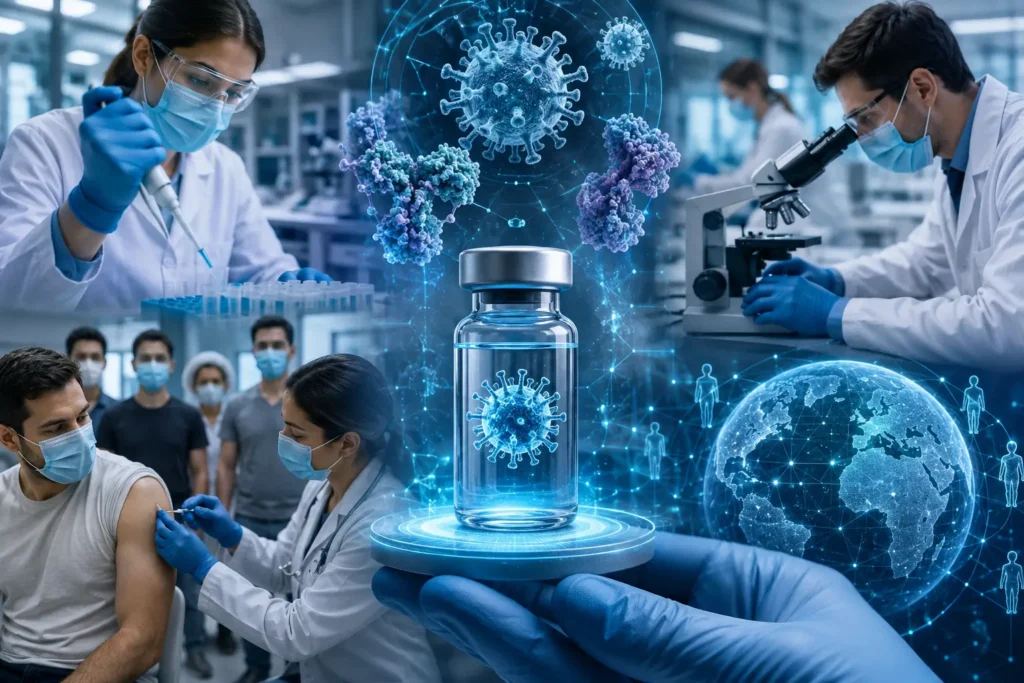
The vaccine is named pEVAC-PS and was created by researchers at the University of Cambridge and its spin-out company DIOSynVax — which stands for Digitally Immune Optimised Synthetic Vaccines. Founded in 2017, DIOSynVax was built on a single idea: that artificial intelligence could design better vaccine antigens than human researchers working manually.
Traditional vaccines work by using pieces of a specific, known virus strain to teach the immune system what to fight. The problem is obvious — when the virus mutates significantly, the vaccine’s targeting becomes less accurate and boosters are needed. pEVAC-PS takes a completely different approach. Instead of targeting one strain, the AI analysed thousands of genetic sequences across the entire Sarbecovirus coronavirus family and designed a single synthetic “super-antigen” that captures shared structural features across all of them — including viruses that have never jumped to humans yet.
How Did AI Actually Design This Vaccine? The Process Explained
This is where the science becomes genuinely revolutionary. Here is the step-by-step process behind the cambridge diosynvax pevac ps pan sarbecovirus vaccine june 2026:
- Global Sequence Harvesting: AI systems ingested thousands of genetic sequences from Sarbeco coronaviruses collected through worldwide surveillance networks — including SARS-CoV-2 variants, SARS-CoV-1, and dozens of bat coronaviruses.
- Conserved Feature Mapping: Machine learning algorithms identified structural regions that remain largely unchanged across the entire virus family — the “conserved” zones that evolution rarely alters even as surface proteins mutate rapidly.
- Super-Antigen Synthesis: The AI designed a completely synthetic antigen — not from any real virus — that represents these shared features. This “super-antigen” teaches the immune system to recognise the whole family, not just one strain.
- Computer Simulation Validation: Before any human was involved, the entire vaccine design was tested in computer simulations to model immune response, safety profiles, and broad-spectrum coverage.
- First Human Trial: The Phase 1 trial enrolled 39 healthy adults aged 18–50 at NIHR Clinical Research Facilities in Southampton and Cambridge, UK. The trial ran from late 2021 through September 2023 but results were published June 5, 2026.
- “We’ve converted vaccine development from being reactive to being future-proof. Our vaccines will continue to provide protection against viruses even as they mutate into new strains.”
- — Professor Jonathan Heeney, Professor of Comparative Pathology, University of Cambridge, June 2026
What Did the Trial Actually Find? The Full Results
The Phase 1 trial was a dose-escalation study — participants received either 0.2 mg, 0.4 mg, 0.8 mg, or 1.2 mg of pEVAC-PS on Day 0 and Day 28. The primary goal was safety. Here is what the data showed:
- Safety: Zero serious adverse events at any dose level. The vaccine was well tolerated across all four cohorts — a critical first hurdle cleared.
- Immune response to SARS-CoV-2 and SARS: Participants showed measurable T-cell and antibody immune responses — confirming the vaccine activated the intended immune pathways.
- Cross-protection against bat viruses: Immune responses were detected against related bat coronaviruses that have never caused human outbreaks — the most significant finding of the trial.
- Needle-free delivery confirmed viable: The vaccine was delivered using the PharmaJet Tropis microfluidic jet device — a pressure-based system that injects the vaccine intradermally without a needle.
pEVAC-PS vs. Traditional COVID Vaccines — Side-by-Side
To understand how radical this technology is, compare it directly with what the world has been using since 2021:
| Feature | pEVAC-PS (AI Universal) | Standard COVID Vaccine |
| Vaccine Design | AI + Computer Simulation | Manual / strain-specific |
| Targets | Entire Sarbeco virus family | One strain / variant |
| Annual Booster Needed | Potentially no | Yes — frequently updated |
| Needle Required | Needle-free | Injection required |
| Future Virus Protection | Designed for it | No |
| Type | DNA vaccine | mRNA or viral vector |
Why “Universal Covid Vaccine No Booster” Changes Everything
The phrase “universal covid vaccine no booster needed 2026 how it works” is not just a search keyword — it is the core promise of this technology. Here is why that matters on a global scale:
- Variant-proof design: Because pEVAC-PS targets conserved structural regions shared across the entire Sarbecovirus family, new variants that emerge in the future should still be covered — without the need for reformulation.
- Future pandemic prevention: Scientists have identified hundreds of bat coronaviruses in the wild that belong to the Sarbecovirus group. Any one of them could theoretically evolve to infect humans and trigger the next pandemic. pEVAC-PS is designed to cover those too — before they even emerge.
- Global distribution advantages: The needle-free delivery system dramatically simplifies mass vaccination in regions where trained healthcare workers are limited, cold-chain logistics are difficult, or needle phobia presents a barrier to uptake.
- End of the booster economy: Annual COVID booster programmes cost billions globally. A truly universal vaccine that does not require seasonal updating would represent a transformational shift in healthcare economics worldwide.
The AI Vaccine Platform — What Comes After Coronaviruses?
Perhaps the most exciting aspect of this announcement is not the vaccine itself — it is the platform behind it. DIOSynVax’s AI-driven design approach is not limited to coronaviruses. The same technology could theoretically be applied to any virus family where a universal antigen can be identified from conserved genetic sequences.
Researchers have already publicly discussed applying the ai vaccine future pandemic protection needle free 2026 platform to:
- Influenza: Where current vaccines must be reformulated every year based on WHO predictions about which strains will circulate — an imprecise process that frequently results in mismatched vaccines.
- Ebola: Where the current 2026 outbreak in the Democratic Republic of Congo involves the Bundibugyo strain for which there is no approved vaccine — a gap this platform could eventually help fill.
- HIV: One of vaccine science’s longest-standing unsolved problems, where a broadly neutralising approach could be transformative.
FAQ
Q: Is the pEVAC-PS vaccine available to the public yet?
No. The pEVAC-PS vaccine has only completed Phase 1 human trials, establishing safety. Full public availability would require Phase 2 and Phase 3 trials followed by regulatory approval from agencies such as the FDA, EMA, and WHO. That process typically takes several more years.
Q: Does this vaccine protect against all COVID variants including future ones?
It is specifically designed to do so by targeting conserved structural features shared across all Sarbecovirus variants. In Phase 1, immune responses were confirmed against SARS-CoV-2, SARS-CoV-1, and related bat coronaviruses. Whether this translates to full clinical protection against all future variants will be established in larger trials.
Conclusion: From Reactive to Future-Proof — The Age of AI Vaccines Has Begun
The ai designed universal coronavirus vaccine human trial 2026 results represent a landmark shift in how the world thinks about vaccine science. This is not a better version of an existing COVID booster. It is an entirely new paradigm — a vaccine designed not to chase viruses but to get ahead of them.