
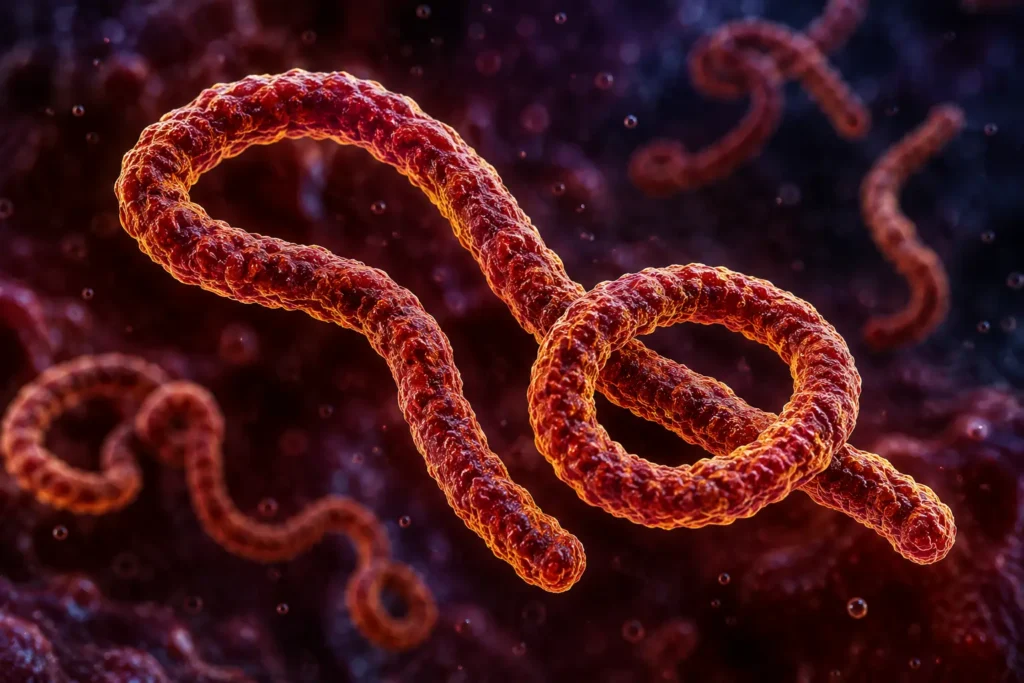
When the World Health Organization declared a global health emergency on May 17, 2026, the world woke up to a name most people had never heard before — Bundibugyo Ebola virus. With over 336 suspected cases, 88 deaths, and cases already crossing international borders from the Democratic Republic of Congo (DRC) into Uganda, health officials around the world are alarmed.
But here is the question that millions are Googling right now: Is the Bundibugyo Ebola virus more dangerous than regular Ebola?
The short and deeply unsettling answer is — in several critical ways, yes. And understanding why could matter more than you think.
What Exactly Is the Bundibugyo Ebola Virus?
Before we dive into the comparison, let us establish what the Bundibugyo Ebola virus actually is — because it is not the same virus you may remember from news coverage of the 2014-2016 West Africa outbreak.
Ebola disease is not caused by a single virus. It is caused by a family of viruses called Orthoebolaviruses. There are four species that cause illness in humans:
- Ebola virus (Zaire strain) — the most well-known, responsible for the massive 2014-2016 outbreak
- Sudan virus — caused nine outbreaks since 1976
- Bundibugyo virus — extremely rare, only two previous outbreaks ever recorded
- Tai Forest virus — known to have infected only a single person in history
The Bundibugyo virus was first identified in Uganda’s Bundibugyo district in 2007. Before 2026, it had only caused two documented outbreaks — one in Uganda between 2007 and 2008, and another in the DRC in 2012. This makes it one of the least understood and least studied Ebola strains on the planet.
And that lack of knowledge is exactly what makes the 2026 outbreak so concerning.
7 Terrifying Facts That Make Bundibugyo Ebola Virus Worse Than Regular Ebola
1. There Is Absolutely No Approved Vaccine for Bundibugyo Virus
This is the single most alarming difference between the Bundibugyo strain and the more familiar Zaire Ebola virus. The widely used rVSV-ZEBOV (Ervebo) vaccine — the one deployed successfully during the 2018-2020 DRC outbreak — was specifically developed to target the Zaire strain.
It offers little to no protection against Bundibugyo.
According to the US Centers for Disease Control and Prevention (CDC), the FDA-approved Ebola vaccine is “not considered effective” for this 2026 outbreak. There is currently an experimental vaccine candidate being studied, but as of now it has only been tested on monkeys — with an efficacy rate of around 50% — and its potential in human patients has not yet been assessed.
This means health workers, frontline responders, and communities in the affected regions are going into this outbreak completely unprotected by vaccination. In past Zaire outbreaks, ring vaccination of contacts was one of the most powerful tools to stop the spread. That tool does not exist for Bundibugyo.
2. Standard Ebola Tests Cannot Detect It — Allowing It to Spread Undetected for Weeks
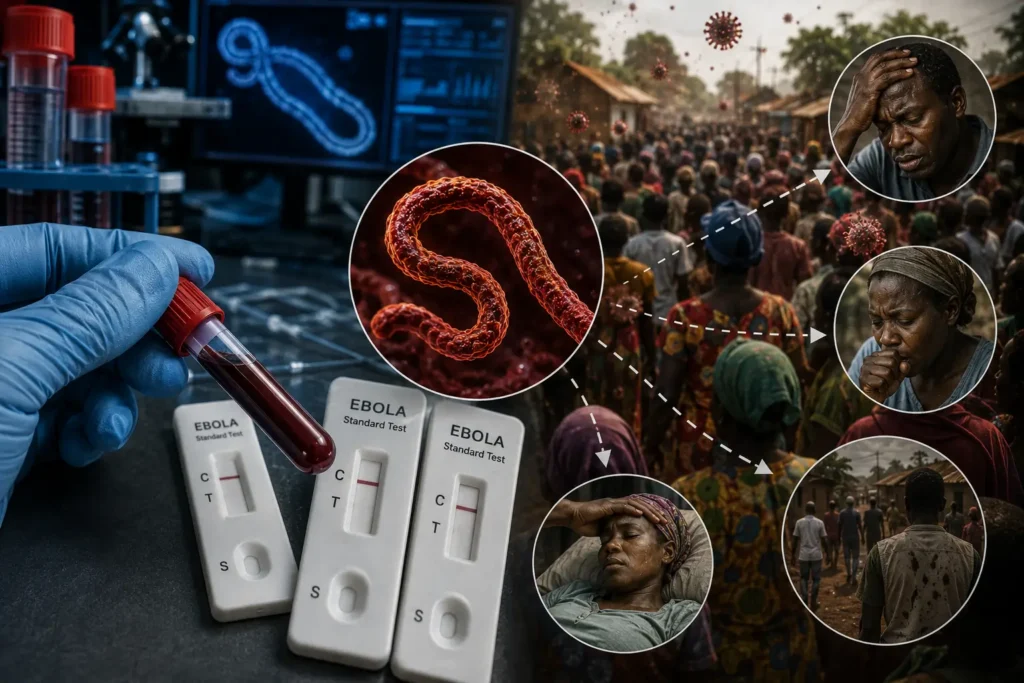
This is perhaps the most terrifying operational challenge of this outbreak. The rapid field tests commonly used to detect Ebola in outbreak settings are designed to detect the Zaire strain only — not Bundibugyo.
The 2026 outbreak confirmed this nightmare scenario in real time. When WHO was first alerted on May 5, 2026, initial samples tested negative for Ebola — because the tests were looking for the wrong strain. It was only when specific Bundibugyo tests were eventually used that 8 out of 13 samples came back positive on May 14.
That means the virus was spreading through communities, health facilities, and across borders for an estimated three weeks before it was detected. Infectious disease epidemiologist Jennifer Nuzzo noted that the delay in detection could be linked to cuts in global health programs — but regardless of the cause, the result was devastating: by the time the outbreak was confirmed, hundreds of suspected cases had already accumulated.
Read More: Why Do I Feel Tired Even After 8 Hours of Sleep: Possible Reasons Explained
3. No Approved Treatments Exist Either
With regular Zaire Ebola, doctors now have two FDA-approved treatments — monoclonal antibody therapies that have significantly improved survival rates in recent outbreaks. These drugs are targeted specifically at the Zaire strain.
For Bundibugyo virus disease, there are no approved antiviral treatments whatsoever. The only option available to doctors is supportive care — managing symptoms through rehydration, electrolyte balancing, and stabilising oxygen levels and blood pressure.
While supportive care can save lives when delivered early and well, it is far less effective than targeted therapies. In resource-limited settings like eastern DRC — where healthcare infrastructure is stretched, conflict is ongoing, and access to care is difficult — the absence of specific treatment dramatically increases the death toll.
4. It Was Spreading Silently in High-Traffic Areas Before Anyone Knew
The geography and demographics of this outbreak make it uniquely dangerous. The outbreak began in Mongbwalu Health Zone in Ituri Province — a high-traffic mining area with significant population movement. Mining workers, traders, and their families were moving constantly between Mongbwalu, nearby health zones, and urban centres.
The index case — a nurse — began experiencing symptoms including fever, severe weakness, vomiting, and bleeding as early as April 24, 2026 and died shortly after. By the time WHO was alerted on May 5, the virus had already quietly spread across multiple health zones. The Ituri province also shares borders with Uganda and South Sudan — two countries now on high alert.
This silent spread through a mobile population in a conflict-affected, resource-limited region creates what health experts describe as a “perfect storm” for a difficult-to-contain outbreak.
5. It Has Already Crossed International Borders
Within days of the outbreak being confirmed, Bundibugyo virus crossed into Uganda. A 59-year-old Congolese man who had travelled from DRC died in Kampala, Uganda’s capital, on May 14, 2026 — marking the first international death from this outbreak.
A second unrelated case was also confirmed in Kampala — two individuals from DRC, with no apparent link to each other, both arriving in Uganda’s capital city carrying the virus.
This cross-border spread is critical because it confirms the outbreak is not contained to a remote area. Kampala is an international hub with an airport handling thousands of passengers daily. The risk of further exportation to other countries, while currently assessed as low, is real and being actively monitored by health agencies worldwide.
6. It Is Extremely Infectious — Even a Single Virus Particle Can Kill
One of the most chilling scientific facts about Ebola — including the Bundibugyo strain — is just how infectious it is at the microscopic level. Laboratory experiments on non-human primates suggest that even a single Ebola virus particle may be enough to trigger a potentially fatal infection.
Bundibugyo virus spreads through direct contact with the bodily fluids of an infected person — blood, saliva, sweat, vomit, faeces, urine, breast milk, and semen. It can also spread through contact with contaminated surfaces, bedding, or medical equipment, and through handling the bodies of those who have died from the disease.
The good news is that Ebola is not airborne — it does not spread through the air like measles or COVID-19. The bad news is that in healthcare settings without strict infection control, it spreads efficiently. The 2026 outbreak has already killed health workers — a deeply concerning early indicator that protective protocols are being overwhelmed.
7. The Ebola death rate Is Significant and the True Scale Is Unknown
The Bundibugyo virus has a documented fatality rate of 25% to 50% — meaning between one in four and one in two infected people die. While this is lower than the Zaire strain (which can reach 90% in some outbreaks and averages around 50%), a 25-50% death rate is still catastrophically high compared to most diseases.
More alarming is the uncertainty about the true scale of the current outbreak. As of May 16, 2026, official numbers show 336 suspected cases and 88 deaths. But health experts warn these figures almost certainly undercount reality. Weeks of undetected spread, limited laboratory capacity, ongoing conflict in Ituri, and difficult terrain all mean many cases and deaths are likely going unrecorded.
As Dr Craig Spencer, a professor at Brown University School of Public Health who previously survived Zaire Ebola infection, wrote: the outbreak is “already large, even though health officials have only recently recognised it.”
How Is the World Responding?
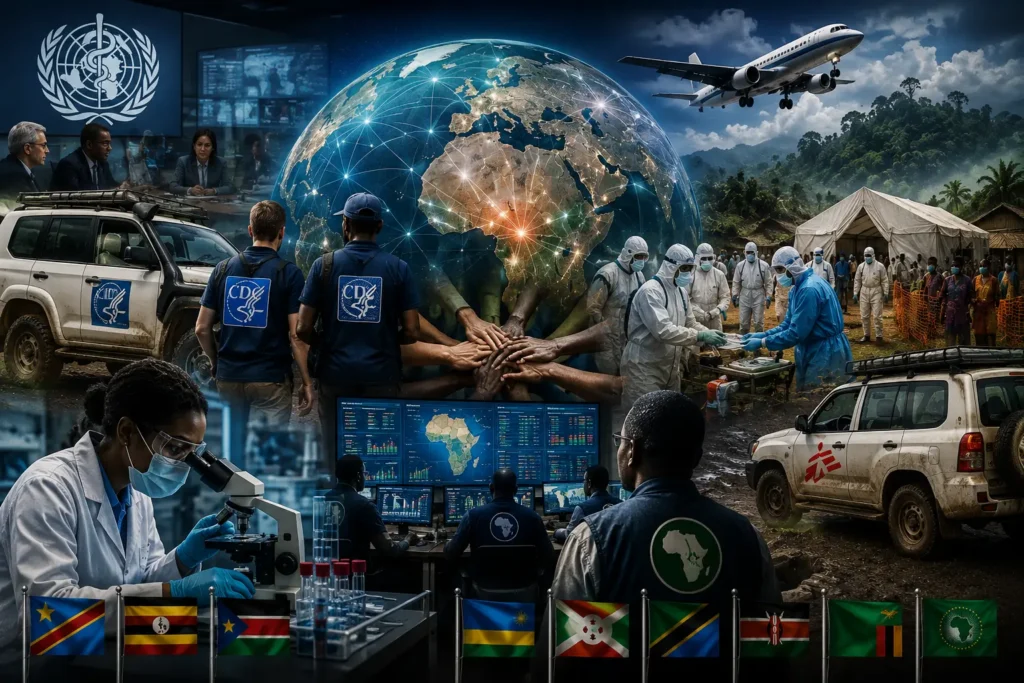
The international health response to the Bundibugyo outbreak has been swift but faces enormous challenges:
- WHO released $500,000 from its Contingency Fund for Emergencies and is deploying rapid response teams for surveillance, contact tracing, and clinical care
- CDC has deployed over 30 staff to its DRC country office with more workers being sent in the coming days
- Africa CDC is leading the regional response and coordinating cross-border surveillance with DRC, Uganda, and South Sudan
- MSF (Doctors Without Borders) is scaling up its response in Ituri province
- Countries sharing land borders with DRC have been placed on high alert
- WHO has advised against border closures, noting they would hinder response efforts without meaningfully reducing transmission risk
Should You Be Worried If You Live Outside Africa?
The honest answer for most people outside Africa is: right now, the risk is very low. The CDC has assessed the risk of Bundibugyo spreading to the United States as “low at this time.” Similar assessments have been made for Europe and other regions.
However, “low risk” is not “zero risk” — particularly for:
- Travellers to DRC or Uganda — CDC has issued Level 2 and Level 1 travel health notices respectively
- Healthcare workers who may encounter patients who have recently travelled from affected regions
- Diaspora communities with family connections in eastern DRC or Uganda
The key protective measures are straightforward: avoid contact with bodily fluids of sick individuals, follow standard hygiene practices, and seek immediate medical attention if you develop fever, severe weakness, vomiting, or bleeding after travelling to or from an affected region.
FAQs
Q1: What is Bundibugyo Ebola virus? It is one of four species of orthoebolavirus that cause Ebola disease in humans. It is extremely rare — the 2026 DRC outbreak is only the third documented outbreak ever. Unlike the common Zaire strain, it has no approved vaccine or treatment.
Q3: Can the Bundibugyo Ebola virus spread globally like COVID-19? Unlike COVID-19, Ebola does not spread through the air. It requires direct contact with bodily fluids. This makes global spread far less likely — but not impossible, particularly for travellers and healthcare workers.
Conclusion
The Bundibugyo Ebola virus is not just another Ebola outbreak. It is a rare, poorly understood, and uniquely challenging pathogen that is spreading in one of the world’s most difficult operating environments — with no approved vaccine, no approved treatment, and diagnostic tools that initially failed to detect it.
The 2026 outbreak is already the 7th largest Ebola outbreak in recorded history across all species, and experts warn it may be far larger than official figures currently suggest.
Read More: Hantavirus Cruise Ship Outbreak: What Happened on MV Hondius