
What’s Actually in Curd?
Benefits of Curd for Skin and Hair: Curd (also known as dahi or yogurt) is milk that’s been fermented by live bacteria, mainly strains of Lactobacillus. That fermentation process produces two things worth paying attention to:
- Lactic acid — a mild, food-grade exfoliating acid
- Probiotics — live, beneficial bacteria that support a healthy gut microbiome
Along with that, curd carries a decent nutritional profile: calcium, protein, zinc, phosphorus, and B vitamins — several of which show up repeatedly in conversations about skin repair and hair strength.
Read More: Ginger Tea for Nausea After Stomach Bug: Natural Remedies That Actually Help
Does Eating Curd Improve Skin Naturally?
This is the question most people actually want answered, and the short version is: yes, but indirectly — through your gut.
There’s a growing body of research around the “gut-skin axis,” which is essentially the idea that gut health and skin health are more connected than they look. Here’s the general chain of logic:
- Probiotic foods like curd support a balanced gut microbiome.
- A balanced microbiome is linked to lower overall inflammation in the body.
- Lower inflammation often shows up on the skin as fewer breakouts, less redness, and a calmer, more even complexion over time.
So eating curd daily isn’t a spot-treatment for acne, but consistently including probiotic-rich foods in your diet is something many nutritionists genuinely recommend for skin that tends to be reactive or inflamed. It’s a slow-build benefit, not an overnight fix.
Curd Face Mask Benefits for Glowing Skin
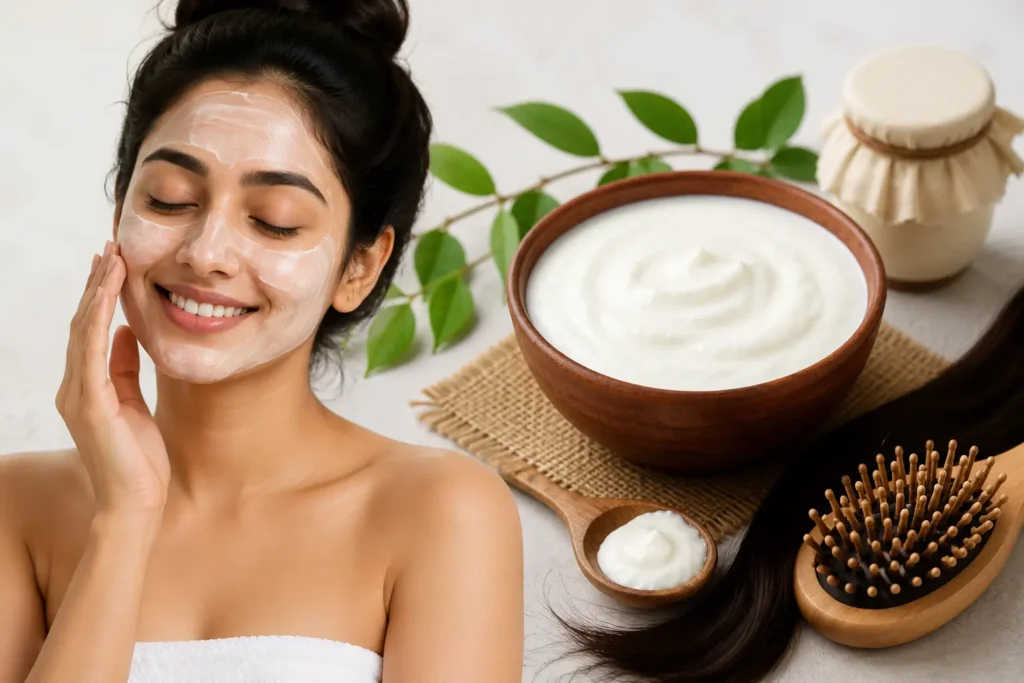
Applying curd directly to your skin is where the more immediate, visible Benefits of Curd for Skin and Hair tend to show up, since it works on the skin’s surface rather than through digestion.
Here’s what’s happening when curd is used topically:
- Lactic acid gently exfoliates. It belongs to the alpha-hydroxy acid (AHA) family — the same category found in many exfoliating skincare products, just in a much milder, natural form. This helps clear away dead skin cells and can leave skin looking brighter almost immediately.
- Milk fats hydrate. Full-fat, unfiltered curd contains lipids that act as natural emollients, softening dry or flaky skin.
- It may calm irritation. The probiotic content is often credited with a mild anti-inflammatory effect, which is part of why curd is a common home remedy for mild sunburn or general redness.
A basic Curd Face Mask Benefits for Glowing Skin couldn’t be simpler: plain, unsweetened curd applied to clean, dry skin, left on for 10–15 minutes, then rinsed with lukewarm water. Some people add a spoon of honey for extra moisture or a pinch of turmeric, which has its own separate reputation for calming skin.
Is Yogurt Good for Hair Growth?
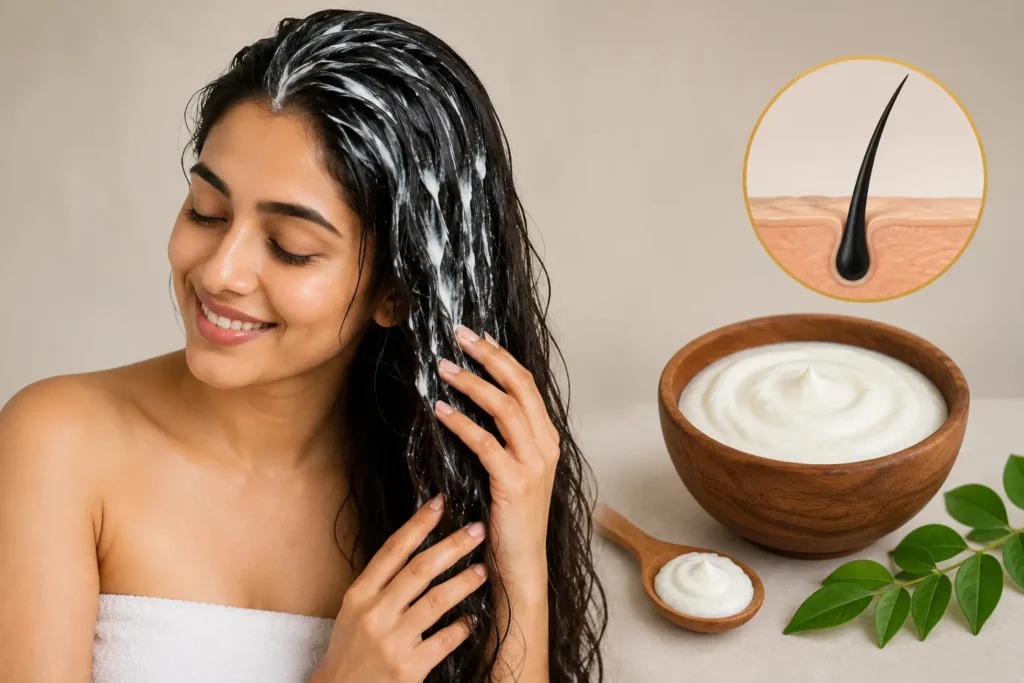
This is where expectations often outpace the evidence. There isn’t strong clinical research showing that curd directly triggers new Yogurt Good for Hair Growth. What curd does have decent support for is improving the health of your scalp and existing hair, which indirectly creates better conditions for hair growth over time:
- Anti-fungal effects. The lactic acid and probiotic content are frequently cited for helping control the yeast overgrowth associated with dandruff.
- Protein reinforcement. Curd contains casein and whey — proteins associated with strengthening hair strands and adding shine when used as a topical treatment.
- Scalp hydration. A dry, flaky scalp is a common but often overlooked cause of hair breakage, and curd’s moisturizing properties can help address that specific issue.
So a more accurate way to think about it: curd doesn’t “grow” hair, but it can build a healthier scalp environment — and healthier scalps generally support stronger, less brittle hair.
Natural Probiotic Foods for Healthy Skin Beyond Curd
Curd is a great entry point if you’re trying to eat more probiotic-rich foods, but it doesn’t have to be the only one. A few others worth adding into rotation:
- Kefir
- Traditionally fermented pickles (not the vinegar-based, shelf-stable kind)
- Kimchi
- Miso
- Kombucha
Mixing in a variety of these gives your gut microbiome more diversity, which many nutritionists consider more valuable long-term than relying on just one probiotic source.
The Harm Side: What Most Articles Leave Out
Curd is safe for the vast majority of people, but it’s not entirely risk-free — especially in excess or without a few sensible precautions.
Eating curd — things to watch for:
- Lactose sensitivity. Fermentation breaks down some of the lactose in milk, making curd easier to digest than plain milk, but it’s not lactose-free. People with intolerance may still experience bloating or discomfort.
- The “cooling” concern. In several traditional health systems, curd is considered cooling and is often avoided at night or during a cold or cough. This isn’t strongly backed by clinical research — it’s more of a long-standing cultural caution than a proven medical risk — but it’s worth knowing if you notice a pattern with your own body.
- Added sugar in flavored versions. Plain curd is where the real benefits live. Sweetened, flavored yogurts can quietly undo a lot of the good with added sugar.
Applying curd to skin or hair — things to watch for:
- Always patch test first. Dairy-based masks can occasionally trigger irritation or breakouts, especially in people with sensitive or dairy-reactive skin.
- It’s a support, not a cure. Curd may help with mild dryness or dandruff, but it isn’t a substitute for treating a diagnosed skin or scalp condition — like eczema, psoriasis, or a persistent fungal infection — that isn’t responding to home remedies.
- It’s messier than it sounds. Minor, but real — curd masks have a noticeable smell and can be messy to apply and rinse, especially if left on for extended periods.
The Bottom Line: Benefits of Curd for Skin and Hair
The benefits of curd for skin and hair are real, even if they’re not miracle-level dramatic. Eaten regularly, curd supports gut health, which has a genuine, if gradual, connection to calmer, clearer skin. Applied directly, its lactic acid and natural fats offer an accessible way to gently exfoliate and moisturize. For hair, the honest framing is that curd supports a healthier scalp rather than growing new strands out of nowhere.
Quick disclaimer: I’m not a doctor or dermatologist, and this article is meant for general information only. If you’re dealing with a persistent skin condition, scalp issue, or dairy allergy, it’s worth checking with a professional before building a routine around curd.
Read More: LDL Cholesterol Explained: What Your Numbers Actually Mean