
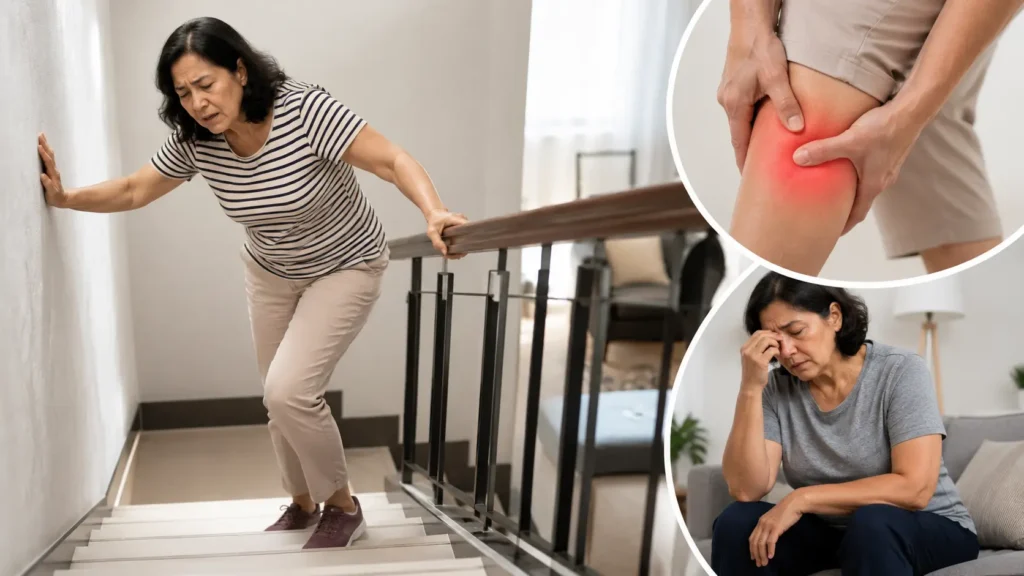
Introduction: Muscle Weakness Climbing Stairs
For most people, climbing a flight of stairs is such a routine part of daily life that it doesn’t even register as a physical task. You go up to your bedroom, down to the parking garage, up to your office — dozens of times a week without a second thought. But for millions of Americans, stairs have quietly become one of the hardest parts of the day. What used to be effortless now requires gripping the handrail, pausing halfway up to catch your breath, or bracing for the burning sensation in the thighs that sets in before you’ve even reached the third step.
Muscle weakness climbing stairs is one of the most common physical complaints reported to primary care doctors, physical therapists, and orthopedic specialists in the United States. It typically affects the muscles used to climb stairs, like the quadriceps, hamstrings, glutes, and calves. It can show up gradually, as a subtle loss of stamina over months or years, or suddenly, following an injury, surgery, or illness. Either way, difficulty climbing stairs is rarely “just aging.” It’s usually a signal that something specific is going on in the muscles, nerves, joints, or cardiovascular system — and in most cases, it’s treatable.
This article walks through what muscle weakness climbing stairs looks like, why it happens, and what can actually be done about it — so you know when it’s worth a trip to the doctor and what kind of treatment path might help.
Read More:Natural Foods for Instant Energy: Your Complete Guide to Boosting Energy Naturally
Why Stairs Are Such a Good “Test” of Muscle Strength
Before getting into Symptoms of Muscle Weakness and Causes of Muscle Weakness on Stairs, it helps to understand why stairs are so revealing in the first place. Walking on flat ground uses relatively little muscle power compared to climbing. Going up a single step requires your quadriceps and glutes to lift your entire body weight against gravity, while your calves and hip stabilizers keep you balanced. Going down is arguably harder on the joints, since the same muscles now have to control your descent, absorbing impact with every step (a process called eccentric loading).
Because of this, stairs often expose muscle weakness climbing stairs long before it shows up in simpler activities like standing or walking on a flat sidewalk. Physical therapists and physicians frequently use stair-climbing ability as a quick, informal gauge of lower-body strength and cardiovascular fitness — which is exactly why “I have trouble with stairs” is such a common and useful thing to mention to a doctor.
Common Symptoms of Muscle Weakness Related to Stair Climbing
Muscle Weakness Climbing Stairs doesn’t always feel the same from person to person, and the specific pattern of symptoms often gives clues about the underlying cause. Some of the most commonly reported Symptoms of Muscle Weakness include:
1. Heaviness or fatigue in the thighs and calves. Many people describe their legs as feeling “like lead” partway up a staircase, even if they aren’t in pain.
2. Needing to pull on the handrail. Relying on your arms to help pull your body weight upward is a classic sign that the leg muscles alone aren’t generating enough force.
3. Shortness of breath disproportionate to the effort. While some breathlessness on stairs is normal, especially at higher floors, feeling severely winded after just one flight can point to either deconditioning or an underlying heart or lung issue.
4. Trembling or shaking legs. This is often a sign of muscle fatigue or, in some cases, nerve-related weakness.
5. Pain that accompanies the weakness. Weakness paired with joint pain (especially in the knees or hips) often points to arthritis or a mechanical joint issue, while weakness paired with muscle aches may suggest a muscular or metabolic cause.
6. Needing to take stairs one at a time, leading with the same leg. This asymmetric pattern is common when one leg is significantly weaker than the other, often due to a prior injury, nerve compression, or stroke.
7. Difficulty specifically going down, rather than up. Because descending relies heavily on quadriceps control to prevent the knee from buckling, trouble specifically on the way down can point toward quadriceps weakness or knee joint instability.
8. Weakness that worsens throughout the day or with repeated activity. This pattern, where the first flight of stairs is manageable but each subsequent flight gets progressively harder, can be a sign of certain neuromuscular conditions.
If any of these Symptoms of Muscle Weakness are new, are getting worse over weeks or months, or are accompanied by other issues like numbness, unexplained weight loss, or chest pain, it’s worth having them evaluated rather than assuming it’s simply “getting older” or “being out of shape.”
Common Causes of Muscle Weakness on Stairs
There is a wide range of possible causes of muscle weakness on stairs, from very common and easily treatable to more serious underlying conditions. Below are the most frequent categories doctors consider.
1. Deconditioning and Sedentary Lifestyle
By far the most common cause in the general population is simple physical deconditioning — a loss of muscle strength and cardiovascular fitness from inactivity. Long periods of sitting, whether due to a desk job, recovery from illness, or lifestyle changes, cause the quadriceps and glutes to lose strength relatively quickly. The good news is that this type of weakness typically responds very well to a structured, gradual exercise program.
2. Aging and Sarcopenia
Sarcopenia is the medical term for the natural, progressive loss of muscle mass and strength that occurs with aging, typically becoming more noticeable after age 50. It’s estimated to affect a significant portion of older adults in the United States to some degree, and it disproportionately affects the large muscle groups used in stair climbing. Unlike simple deconditioning, sarcopenia involves actual structural changes in muscle tissue, though resistance exercise and adequate protein intake can meaningfully slow or partially reverse it.
3. Osteoarthritis and Joint Problems
Knee and hip osteoarthritis are extremely common Causes of Muscle Weakness on Stair difficulty in adults over 50. In these cases, the “weakness” is often partly protective — the body limits muscle force output around a painful, damaged joint to avoid further injury. This can create a cycle where joint pain leads to less use of the leg, which leads to muscle weakening, which further destabilizes the joint.
4. Peripheral Neuropathy
Nerve damage, often caused by diabetes, vitamin deficiencies (especially B12), alcohol use, or certain medications, can interfere with the signals that tell muscles to contract. This typically causes weakness paired with numbness, tingling, or a “pins and needles” sensation, often starting in the feet and moving upward.
5. Cardiovascular and Respiratory Conditions
Sometimes what feels like “muscle weakness” is actually the body’s response to insufficient oxygen delivery. Conditions such as coronary artery disease, heart failure, and chronic obstructive pulmonary disease (COPD) can all cause legs to feel heavy and fatigued on exertion, usually alongside breathlessness, chest tightness, or a rapid heartbeat.
6. Spinal Issues and Nerve Compression
Conditions like lumbar spinal stenosis or a herniated disc can compress the nerves that control leg muscles, leading to weakness that’s often one-sided or affects a specific muscle group (such as the ability to lift the foot, known as foot drop). This type of weakness frequently comes with lower back pain that radiates down the leg.
7. Muscle and Autoimmune Disorders
Less commonly, Muscle Weakness Climbing Stairs can stem from conditions such as polymyositis, myasthenia gravis, or muscular dystrophies. These conditions often cause weakness that is more pronounced in large, proximal muscle groups (like the thighs and hips) compared to smaller muscles, and stair climbing or rising from a chair is frequently one of the first activities affected.
8. Medication Side Effects
Certain medications, particularly statins (used to lower cholesterol), can cause muscle aches and weakness in some people. Long-term corticosteroid use is another well-known cause of proximal muscle weakness.
9. Vitamin D Deficiency
Vitamin D plays a direct role in muscle function, and deficiency — which is common in the U.S. population, especially in northern states and among people who spend little time outdoors — has been linked to generalized muscle weakness, including in the legs.
10. Post-Surgical or Post-Injury Weakness
After knee or hip surgery, or any period of immobilization following an injury, muscles can lose strength surprisingly quickly, sometimes within just a week or two of reduced use.
When to See a Doctor
While occasional tired legs after a long day are normal, certain signs warrant a medical evaluation sooner rather than later:
- Weakness that has developed suddenly (over hours or days) rather than gradually
- Weakness on only one side of the body
- Associated numbness, tingling, or loss of sensation
- Chest pain, palpitations, or significant shortness of breath with exertion
- Unexplained weight loss alongside the weakness
- Difficulty with other daily tasks, such as rising from a chair or lifting the arms overhead
- Weakness accompanied by vision changes, slurred speech, or facial drooping (which could indicate a stroke and requires emergency care)
A primary care physician is usually the right starting point. Depending on the findings, they may refer you to a physical therapist, orthopedist, neurologist, or cardiologist for further evaluation, which might include blood tests, imaging (X-ray or MRI), nerve conduction studies, or a cardiac stress test.
Treatment Options
Treating muscle weakness climbing stairs depends heavily on the underlying cause, but here are the most common and effective approaches used in the U.S. healthcare system today.
Physical Therapy and Targeted Strength Training
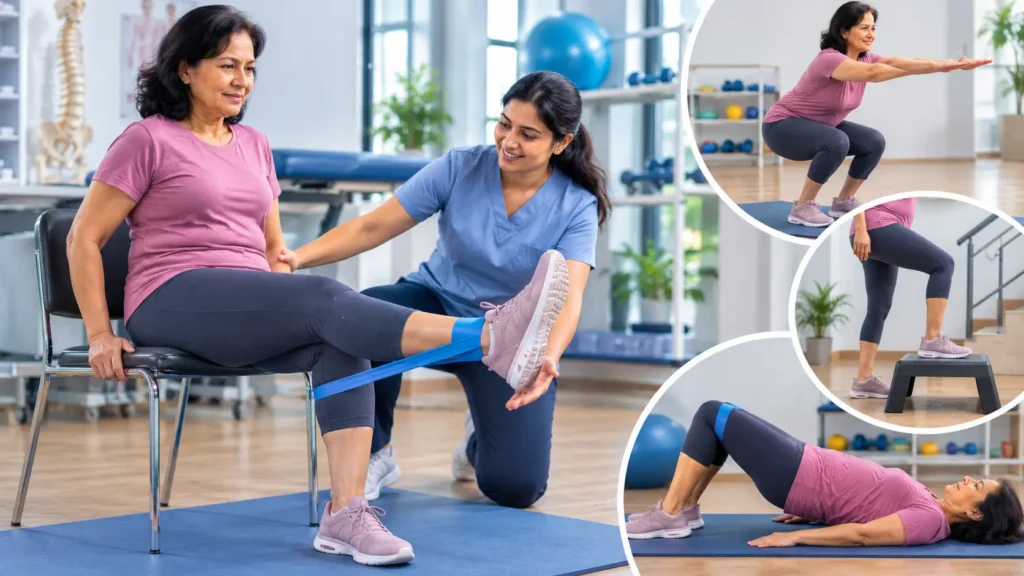
For the majority of people — especially those with deconditioning, sarcopenia, or post-surgical weakness — a structured strength-training program is the single most effective treatment. Physical therapists typically focus on:
- Quadriceps strengthening, through exercises like sit-to-stands, step-ups, and leg presses
- Glute activation, using bridges and lateral band walks
- Balance training, to reduce fall risk while strength improves
- Progressive overload, gradually increasing resistance or repetitions over weeks
Even short daily routines, such as sit-to-stand exercises from a chair, can produce measurable improvements within a few weeks for many people.
Managing Underlying Joint Disease
For osteoarthritis-related weakness, treatment often combines physical therapy with pain management strategies — anti-inflammatory medications, weight management to reduce joint load, and in some cases corticosteroid injections. When arthritis is advanced, joint replacement surgery can dramatically restore both strength and stair-climbing ability.
Treating the Root Medical Condition
Where weakness stems from an underlying condition, treatment addresses that condition directly:
- Diabetes-related neuropathy is managed through blood sugar control and, in some cases, nerve pain medications.
- Vitamin B12 or vitamin D deficiencies are corrected with supplementation, often producing noticeable strength improvement within weeks to months.
- Cardiovascular or respiratory causes are treated according to the specific diagnosis, which may include medication, cardiac rehabilitation, or pulmonary rehabilitation programs.
- Spinal nerve compression may be treated with physical therapy, epidural injections, or, in more severe cases, surgical decompression.
- Autoimmune muscle conditions are typically managed by a rheumatologist or neurologist, often with immunosuppressive medications.
The Bottom Line: Muscle Weakness Climbing Stairs
Muscle weakness climbing stairs is a common complaint, but it’s rarely something to simply accept as an unavoidable part of getting older. In most cases, it points to a specific, identifiable cause — often something as manageable as deconditioning, a vitamin deficiency, or early arthritis — and responds well to the right combination of exercise, medical treatment, and lifestyle changes. Paying attention to the pattern of symptoms, and bringing them up with a healthcare provider rather than dismissing them, is the first step toward getting back to climbing stairs without a second thought.
This article is for general educational purposes and isn’t a substitute for personalized medical advice. Anyone experiencing new, worsening, or concerning symptoms of muscle weakness should consult a licensed healthcare provider for evaluation.
FAQs: Muscle Weakness Climbing Stairs
Is it normal to feel wobbly after climbing a lot of stairs? Mostly, yes — especially if you’re not used to regular exercise. What’s worth flagging is weakness after just one short flight, or weakness that keeps getting worse.
Can something as small as a vitamin D deficiency really cause this? Surprisingly, yes. Low Vitamin D and B12 are two of the most common — and easiest to fix — reasons behind unexplained leg weakness.
What’s the quickest way to build leg strength for stairs? Consistency beats intensity here. Step-ups, sit-to-stands, and calf raises done a few times a week tend to show real improvement within 4 to 6 weeks.
Should I just avoid stairs if my legs feel weak? Not necessarily, unless a doctor’s told you otherwise. Gentle, controlled stair use can actually help rebuild strength — avoiding it completely often makes things worse over time.
Read More: Best Exercises for Back Pain Relief: A Simple At-Home Guide