
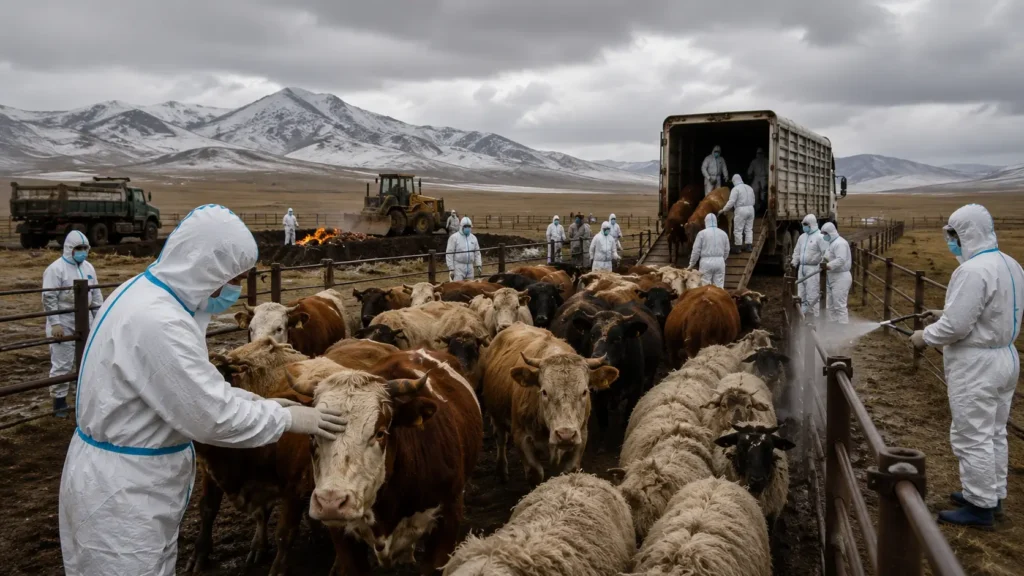
Foot and Mouth Disease Mongolia Livestock Cull 2026
A dangerous and highly contagious animal disease is spreading fast across Mongolia right now — and it is carrying a strain that has never been seen inside this country’s borders before. As of June 11, 2026, Mongolian authorities have confirmed the slaughter of over 1,230 livestock animals in the western provinces of Bayan-Ulgii and Khovd following a rapidly expanding foot-and-mouth disease (FMD) outbreak. The virus has now been detected in at least nine of Mongolia’s 21 provinces — and it shows no signs of slowing down.
For most Americans, foot-and-mouth disease feels like a distant foreign problem. But this outbreak is different — and the FMD Mongolia cattle cull food supply impact USA 2026 is a question that farmers, beef industry insiders, and public health experts are already asking. Here is the full breakdown.
Read More: Nipah Virus Alert June 2026 — What You Should Know
What Is Foot and Mouth Disease? Why It Terrifies Livestock Industries Worldwide
Foot-and-mouth disease is a severe, highly contagious viral infection caused by an Aphthovirus of the Picornaviridae family. It infects all cloven-hoofed animals — cattle, pigs, sheep, goats, deer, and bison.
Here is why governments and agricultural agencies treat it as one of the most economically devastating animal diseases in the world:
- Speed of spread is extraordinary. FMD can travel through airborne particles, contaminated vehicles, equipment, clothing, and even wild animals. A single infected herd can trigger a region-wide emergency within days.
- It is not fatal to animals in most cases — but it causes painful blisters on feet and in mouths, making animals unable to eat or walk. Milk production collapses. Breeding fails. Productivity crashes.
- The economic damage is catastrophic. The 2001 UK outbreak cost over $16 billion. A single confirmed U.S. case would immediately shut down American beef and pork exports — an industry worth over $19 billion annually.
- The U.S. has been FMD-free since 1929 — nearly a century of protection maintained through strict biosecurity, import controls, and USDA monitoring. That streak is what makes every international outbreak worth watching closely.
The Mongolia Outbreak June 2026 — What Is Actually Happening on the Ground
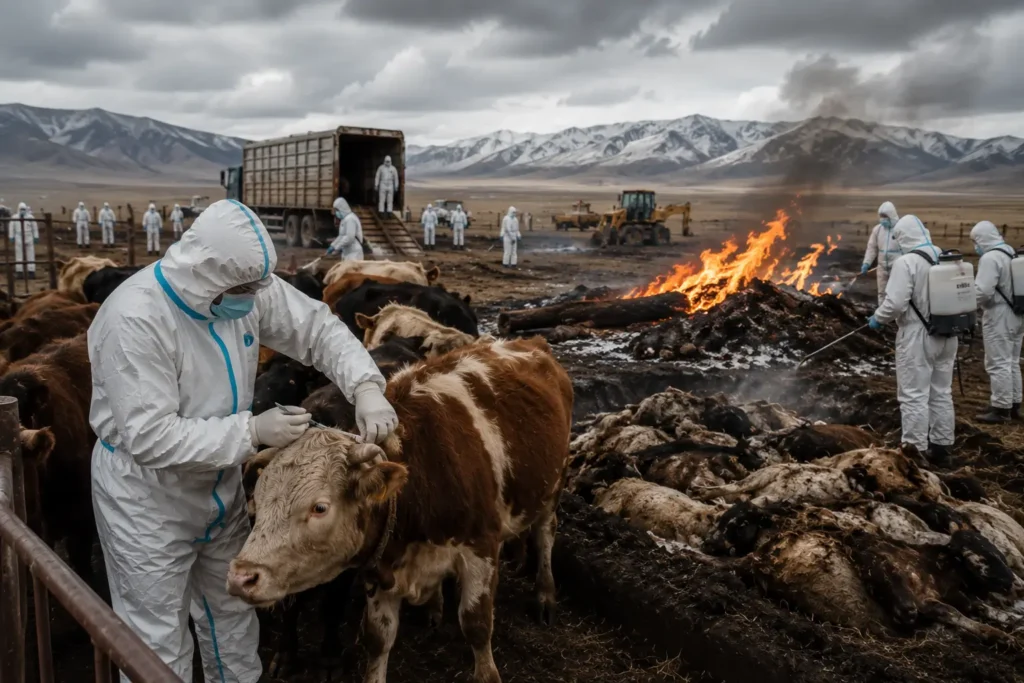
The foot mouth disease outbreak June 2026 global livestock risk from Mongolia is more serious than most international headlines suggest. Here is the timeline:
- Late May 2026: FMD first confirmed in Bulgan soum, Khovd province. Laboratory tests identified 35 infected cattle across seven herder households. Emergency quarantine imposed.
- June 7, 2026: A fresh outbreak confirmed in Dundgovi province — southern Mongolia — spreading the disease into a third region. Vaccination campaigns launched.
- June 10, 2026: Mongolia’s General Authority for Veterinary Services (GAVS) confirmed at least 1,230 livestock culled in Bayan-Ulgii and Khovd provinces.
- June 11, 2026: The O serotype — responsible for the majority of FMD outbreaks worldwide — reported in six provinces. Total affected provinces now stand at nine.
What makes this outbreak especially alarming for veterinary experts is the SAT-1 serotype — an African-lineage strain detected in Mongolia for the very first time. Because local herds have no natural immunity or vaccine protection against SAT-1, the virus has the potential to spread rapidly, and veterinary officials are working around the clock to track its source and prevent it from moving into central regions during the peak summer grazing season — a time when livestock mobility hits its yearly high.
Mongolia is home to 58.1 million head of livestock — nearly 20 animals for every person in the country. Livestock herding is the economic and cultural backbone of the nation. This outbreak directly threatens not just animals, but the livelihoods of hundreds of thousands of nomadic herding families.
Can Foot and Mouth Disease Spread to Humans Risk 2026?
This is the most-searched question about FMD right now — and the answer deserves a straight, clear explanation.
The direct answer: FMD poses virtually no health risk to humans.
According to the USDA, FDA, CDC, and WHO, FMD is not a threat to food safety or human health. FMD only affects animals with cloven hooves — it does not affect dogs, cats, birds, or humans.
A few key clarifications on can foot and mouth disease spread to humans risk 2026:
- FMD is not the same as Hand, Foot, and Mouth Disease (HFMD). HFMD is a completely different viral illness caused by enteroviruses like Coxsackievirus A16, which does affect humans — particularly young children. The two diseases share a similar name but have no biological connection.
- Extremely rare human cases have been documented historically — a handful of laboratory workers and farmers with very high-level direct exposure. These cases were mild and self-limiting. There is no evidence of human-to-human transmission.
- Meat and dairy from FMD-affected regions remain safe to eat when properly processed. Heat treatment effectively inactivates the virus.
- The real danger is to livestock, trade, and agricultural economies — not human health.
FMD Mongolia Cattle Cull Food Supply Impact USA 2026 — The Real Stakes for Americans
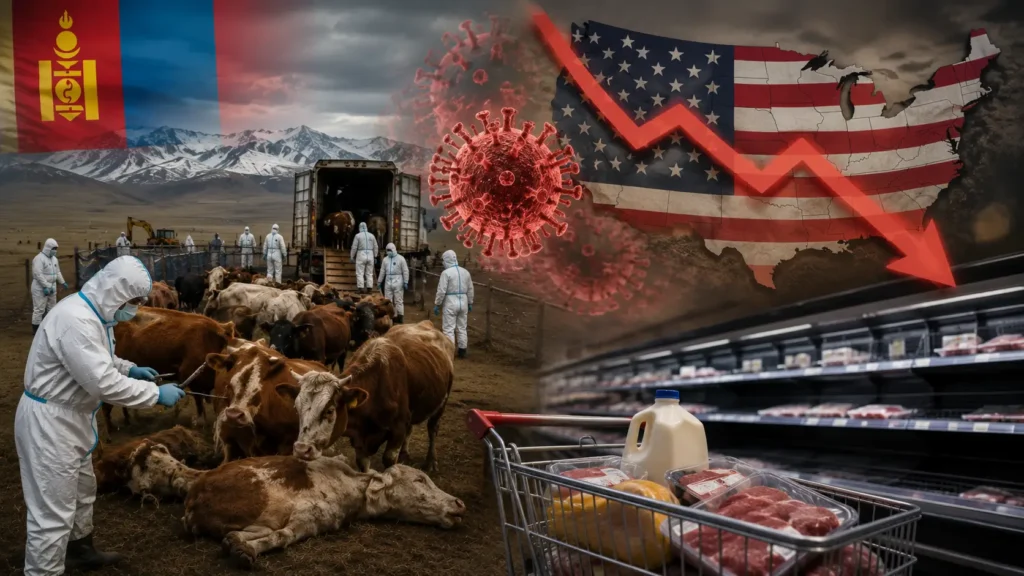
While FMD itself does not threaten human health, the FMD Mongolia cattle cull food supply impact USA 2026 represents a real, measurable economic risk — one that the USDA and American agricultural industry monitor with extreme vigilance.
Here is why Americans have a genuine stake in this outbreak:
1. The U.S. vaccine stockpile is dangerously insufficient. A Government Accountability Office (GAO) report found that the North American FMD vaccine bank stockpile could only vaccinate about 14% of cattle in Texas or 4% of pigs in Iowa — far below national needs in the event of a domestic outbreak.
2. A single U.S. FMD case would cost billions instantly. U.S. beef exports were over $10 billion in 2023, adding approximately $425 of value per fed steer or heifer. One confirmed FMD case in the U.S. would shut down the export market entirely and cut profits for all cattle producers nationwide.
3. The SAT-1 strain now circulating in Mongolia originates from Africa. The same SAT-1 serotype was confirmed in Zimbabwe’s Matabeleland South province in January 2026. Its sudden appearance in Central Asia — a continent away — raises serious questions about how it traveled and what other regions may be at risk.
4. USDA is already tracking the situation. USDA’s APHIS updates global animal disease import restrictions regularly, and FMD restrictions currently apply to a complex web of countries. Cyprus, Greece, Hungary, and Slovakia are currently under temporary restrictions for FMD, signaling fresh outbreak activity in parts of Europe in addition to Asia.
5. Contaminated equipment and travelers pose a genuine pathway. FMD virus can survive on contaminated soil, clothing, and vehicle tires for weeks. International travelers returning from affected regions — including hunters and agricultural workers — have historically been documented pathways for FMD introduction into FMD-free countries.
6. Climate change is accelerating outbreak frequency. Research published in the International Journal of Environmental Research and Public Health found that rising temperatures in Mongolia Outbreak are directly associated with increased FMD outbreak frequency. With climate projections showing continued warming across Central Asia, the pattern of recurring outbreaks is likely to intensify through the late 2020s.
What Is the USA Doing to Stay Protected?
USDA’s APHIS continuously monitors for FMD worldwide, with veterinarians stationed overseas helping other countries control and eradicate the disease — directly reducing the risk of it spreading to the United States. At ports of entry, APHIS works with U.S. Customs and Border Protection to screen cargo and prevent travelers from bringing products of concern into the country. Animals and animal byproducts from FMD-affected regions face strict restrictions or outright import bans.
For American travelers visiting or returning from FMD-affected regions:
- Declare all food items at U.S. ports of entry — including meat, dairy, and plant products.
- Do not bring back any animal products — fresh, dried, or packaged — from countries with active FMD outbreaks.
- Clean and disinfect footwear and equipment thoroughly if you have been in contact with livestock or farms abroad.
- Report any suspicious animal illness to the USDA at 1-866-536-7593.
The Bottom Line
The foot and mouth disease Mongolia livestock cull 2026 is a fast-moving agricultural crisis that has already killed over 1,200 animals and is spreading across nine provinces. A never-before-seen strain in Mongolia Outbreak — SAT-1 — combined with the peak summer grazing season creates serious conditions for further spread.
Read More: Olive Oil Pancreatic Cancer Risk Oleic Acid Study 2026 — What the Research Found