
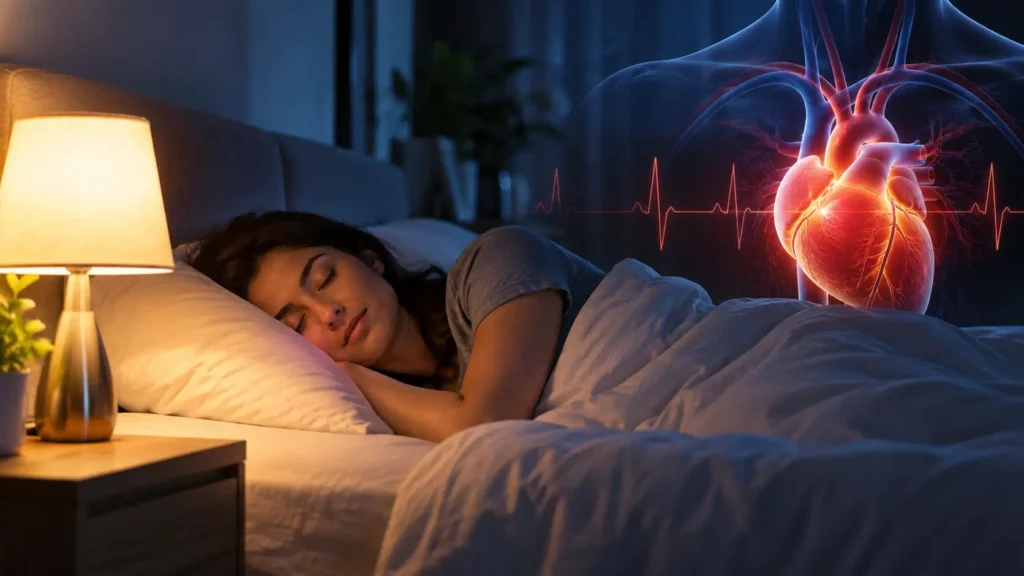
Does Night Light Affect Heart Health
What the New 2026 Study Found
The study was published in early September 2026 in the European Heart Journal and was led by researchers from Tulane University’s Obesity Research Center. It’s one of the largest studies to date connecting bedroom lighting with heart structure, and it used real biological data instead of self-reported habits.
Here’s how the research was designed:
- Researchers analyzed data from more than 11,000 adults Does Night Light Affect Heart Health in the UK Biobank, a long-term health database, none of whom had cardiovascular disease at the start of the study.
- Every participant wore a wrist sensor for seven nights to measure how much light reached them while they slept.
- About three years later, each participant underwent a cardiac MRI scan to examine the structure and function of their heart.
The results showed a clear pattern. People who were exposed to more than 3 lux of light at night — while they were asleep — had measurable differences in their heart compared to people who slept in near-total darkness. Specifically, researchers observed:
- A greater left ventricular mass, meaning the main pumping chamber of the heart was slightly heavier than expected.
- Thicker heart walls, which reduces the amount of space inside the chamber.
- A lower myocardial contraction fraction, a measure of how efficiently the heart squeezes with each beat.
- Subtle structural changes in the right ventricle and left atrium as well.
The researchers describe this pattern as early “cardiac remodeling” — a gradual reshaping of the heart muscle that, over time, is associated with a higher risk of conditions like heart failure and atrial fibrillation (AFib).
It’s worth noting that these changes were small and did not, on their own, indicate existing heart disease. But they represent an early biological signal, and that’s exactly why the study is getting attention from cardiologists.
Disclaimer: I am not a doctor. This post is for general informational purposes only and is not a substitute for professional medical advice. Please talk to your healthcare provider about any concerns related to your heart health or sleep habits.
Read More: Best Berries for Blood Sugar: What U.S. Adults Should Know in 2026
How Does Night Light Affect Heart Health?
It might seem strange that something as simple as a glowing alarm clock could influence something as important as your heart. But there are a few plausible explanations researchers point to.
1. Disrupted sleep quality Light — even low levels of it — can interfere with how deeply and consistently you sleep. Poor sleep is already a well-established risk factor for high blood pressure, obesity, and cardiovascular disease.
2. Shorter sleep duration Interestingly, the researchers found that reduced sleep duration explained roughly 24% to 49% of the heart changes observed. In other words, part of the reason nighttime light seems to affect the heart is that it’s cutting sleep time short, not just making sleep lighter.
3. Circadian rhythm and hormone disruption Light exposure at night can suppress melatonin production and confuse the body’s internal clock. This can affect blood pressure regulation, inflammation, and the nervous system’s control over the heart while you sleep — all of which play a role in long-term cardiovascular health.
4. Sustained low-grade stress on the body Some researchers describe nighttime light as a subtle, chronic stressor. Unlike a single bad night’s sleep, this kind of exposure often happens every single night, for years, which may allow small effects to accumulate over time.
What Counts as “Light” During Sleep? (Bedroom Light Exposure and Heart Thickening)
This is the part that surprises most people. The study didn’t look at bright lights — it focused on a threshold of just 3 lux, which is an extremely low level of illumination.
To put that in perspective:
| Light Source | Approximate Lux Level |
|---|---|
| Moonlight or light bleeding under a closed door | ~3 lux |
| A face-up smartphone screen on a nightstand | 3–10+ lux |
| A digital alarm clock display | 1–5 lux |
| Streetlight glow through thin curtains | 3–10 lux |
| A pitch-dark, blackout-curtained room | Less than 1 lux |
Researchers found that the extent of heart changes appeared to increase as bedroom brightness increased — meaning this isn’t an all-or-nothing effect. Even small, everyday sources of nighttime light, the kind most people don’t think twice about, may be contributing to the bedroom light exposure and heart thickening pattern described in the study.
Sleeping With Light On Heart Risk: Should You Be Worried?
It’s easy to read headlines like this and panic, but context matters here.
The heart changes identified in the study were small in magnitude and were measured at a population level across thousands of people. They do not mean that one night with a lamp on will damage your heart, and they don’t mean you already have heart disease if your room isn’t pitch black.
Cardiologists who reviewed the findings — but weren’t involved in the study — note that this type of gradual “remodeling” is exactly the kind of change doctors want to catch early, before it progresses. As one cardiovascular prevention specialist put it, doctors generally don’t want heart muscle to get thicker, stiffer, or enlarged over time, since that pattern is linked to reduced heart function down the road.
So the sleeping with light on heart risk isn’t about a single night — it’s about a long-term habit, repeated for months or years, the same way diet or smoking habits accumulate risk gradually rather than all at once.
How Dark Should Your Bedroom Be for Sleep?
Based on this study and existing sleep research, most experts consider under 1 lux to be an ideal target for a bedroom at night — essentially, dark enough that you can barely see your hand in front of your face.
Here are practical, low-effort ways to get closer to that target:
- Use blackout curtains or blinds to block outside light from streetlights, cars, or early sunrise.
- Turn your phone face-down or put it in another room to eliminate notification glow.
- Cover or unplug small LED lights from chargers, routers, TVs, or alarm clocks — a small strip of electrical tape works well.
- Switch to a red or amber night-light if you need one for safety, since warm-spectrum light is less disruptive than blue-white light.
- Consider a comfortable sleep mask if you can’t fully control light in your bedroom (for example, in a shared space or while traveling).
- Ask about motion-activated or shielded outdoor lighting if streetlights or porch lights are the main issue.
These changes are inexpensive, don’t require medical intervention, and align with the same environment researchers are now linking to healthier long-term heart structure.
Other Heart-Healthy Sleep Habits Worth Combining With a Dark Room
A dark bedroom is one piece of the puzzle, not the whole picture. Alongside reducing nighttime light exposure, general heart-health guidance still applies:
- Aim for a consistent sleep and wake schedule, even on weekends.
- Prioritize 7–9 hours of sleep for most adults.
- Eat a heart-healthy diet that’s lower in sodium and saturated fat.
- Stay physically active during the day, which also improves sleep quality at night.
- Maintain a healthy weight and avoid tobacco or excessive alcohol, both of which independently strain the cardiovascular system.
Darkness alone isn’t a cure-all, but combined with these habits, it becomes one more low-cost, low-effort tool for supporting long-term health. Does Night Light Affect Heart Health
.
Red Light vs White Light for Sleep: Does Color Matter?
If you’re comparing red light vs white light for sleep and heart health, the color of the light matters almost as much as the brightness. Blue-white light — the kind emitted by phone screens, LED bulbs, and most digital clocks — is more likely to suppress melatonin and disrupt your circadian rhythm than warm-toned light of the same brightness.
That’s why many sleep experts now recommend the following when picking the best night light color for sleep:
- Choose red or amber-toned bulbs for any light you need to keep on (hallway lights, bathroom night-lights, etc.).
- Avoid blue-white or “daylight” LED bulbs in the bedroom altogether.
- Dim smart bulbs to their warmest color temperature setting after sunset.
Switching bulb color won’t undo the effect of leaving a bright light on all night, but it’s a simple, low-cost tweak alongside reducing overall brightness.
Blackout Curtains and Heart Health Benefits: Do They Actually Help?
Blackout curtains have always been sold as a sleep-quality product — but based on the 2026 study, they may offer blackout curtains and heart health benefits too, simply by keeping your bedroom below that 3-lux threshold researchers identified as the tipping point for heart changes.
Here’s why blackout curtains matter more than most people realize:
- They block the exact light sources flagged in the study. Streetlights, passing headlights, early sunrise, and neighboring building lights are common contributors to nighttime bedroom brightness above 3 lux — and blackout curtains are one of the most effective ways to stop all of them at once.
- They support longer, uninterrupted sleep. Since the study found that shorter sleep duration accounted for 24% to 49% of the observed heart changes, anything that helps you sleep longer and more deeply — including a darker room — indirectly supports Does Night Light Affect Heart Health, not just sleep quality.
- They require no ongoing effort or cost. Unlike apps, supplements, or devices, blackout curtains are a one-time purchase that passively keeps your bedroom dark every single night.
- They work alongside other fixes. Curtains handle outside light, while covering LED lights and keeping phones face-down handles indoor sources — together, these habits get a bedroom much closer to the ideal under-1-lux target.
What to look for when choosing blackout curtains:
- Triple-weave or foam-backed fabric, which blocks more light than standard “room-darkening” curtains.
- Ceiling-to-floor length with side panels or wraparound rods, since light gaps at the edges are one of the most common reasons blackout curtains still let light through.
- A dark, matte liner rather than a light-colored one, which further reduces light bleed around the frame.
FAQs: Does Night Light Affect Heart Health
Does night light affect heart health? According to a large 2026 study, yes — nighttime light exposure above just 3 lux was linked to subtle structural changes in the heart, including thicker heart walls and reduced pumping efficiency, over a multi-year period.
How much light is actually risky while sleeping? The study used 3 lux as its threshold, which is roughly equivalent to moonlight or light leaking in under a door. Experts recommend keeping bedrooms under 1 lux for optimal sleep and Does Night Light Affect Heart Health.
How dark should a bedroom be for sleep? Most sleep and cardiology experts recommend a bedroom lighting level under 1 lux — dark enough that very little detail is visible without adjusting to the dark first.
The Bottom Line: Does Night Light Affect Heart Health
Does Night Light Affect Heart Health the idea that something as small as a phone screen or a hallway light could quietly reshape your heart over the years is a compelling reason to rethink your bedroom setup. While the changes identified in this 2026 study were modest, they add to a growing body of evidence that a dark, quiet bedroom isn’t just good for sleep quality — it may also be a simple, low-cost habit that supports long-term Does Night Light Affect Heart Health.
Read More: Wildfire Smoke Health Effects 2026: What People in the USA Should Know

