
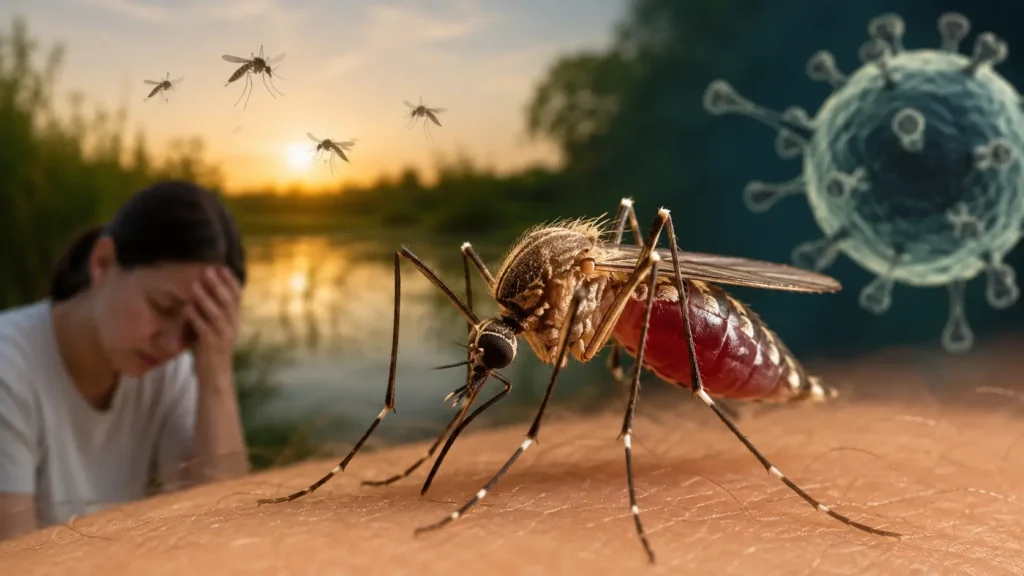
West Nile Virus Symptoms 2026 USA
If it feels like you’re hearing more about West Nile virus this summer than usual, that’s not just algorithm noise — it’s the data. The 2026 season has started earlier and more aggressively than any year since 2004, and public health officials are asking Americans to take mosquito prevention seriously well before the traditional late-summer peak arrives.
Here’s what’s actually happening this year, what the early symptoms look like in adults, and the mosquito prevention habits that make the biggest difference.
Disclaimer: This article is for general informational purposes only and is not medical advice. If you suspect West Nile virus infection, contact a doctor or healthcare provider, and check your state or local health department for the most current case data in your area.
What Is West Nile Virus, and How Do Mosquito Bites Spread It?
West Nile virus (WNV) is a virus spread mainly through the bite of an infected Culex mosquito — the common species that breeds in stagnant water like clogged gutters, old tires, birdbaths, and unused kiddie pools. The virus cycles naturally between birds and mosquitoes; a mosquito picks up the virus by biting an infected bird, then passes it to a person (or another animal) on its next bite.
This is the core of the mosquito bites and West Nile risk relationship — you can’t catch West Nile from another person, and there’s no food or water source involved. It comes down almost entirely to whether an infected mosquito bites you, which is exactly why prevention focuses so heavily on avoiding bites in the first place rather than treating the virus after the fact.
West Nile has been present in the continental U.S. since 1999 and is now the most commonly reported mosquito-borne disease in the country, with activity confirmed in nearly every state at some point each season
Read More: Raw Milk Food Poisoning Risk in 2026: Symptoms & Safety Guide
Early West Nile Virus Symptoms in Adults
This is the part most people search for, and it’s worth understanding the full picture, because West Nile virus doesn’t behave like a typical illness.
About 8 in 10 infected people never develop any symptoms at all. That’s the most important — and most underappreciated — fact about this virus. Most people who get bitten by an infected mosquito simply never know it happened.
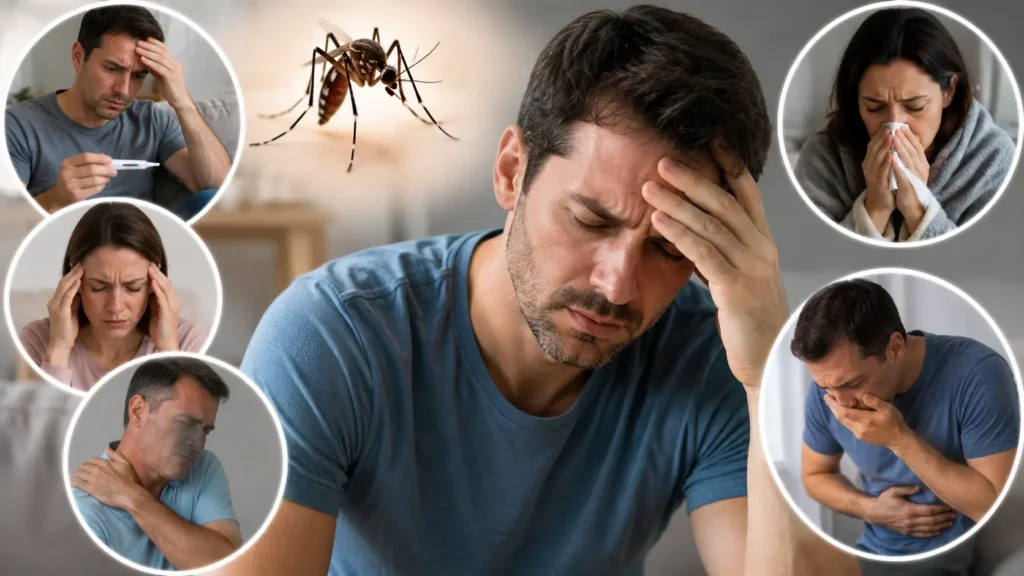
For the roughly 1 in 5 people who do get sick, symptoms typically begin 2 to 6 days after the bite, though the full incubation window can stretch from 2 to 14 days (longer in people with weakened immune systems). Early West Nile virus symptoms in adults commonly include:
- Sudden fever
- Headache
- Body aches and joint pain
- Fatigue and malaise
- Nausea, vomiting, or diarrhea
- A skin rash, often on the chest, back, or stomach
- Swollen lymph glands
This milder presentation is sometimes called “West Nile fever.” It tends to resemble a bad flu or a summer virus, which is part of the problem — most people never connect a rough few days in July to a mosquito bite from the week before. Symptoms usually last three to six days, though fatigue and general weakness can linger for weeks, and in some documented cases, for months after the fever itself has resolved.
When It Turns Serious: West Nile Neuroinvasive Disease
Less than 1% of infected people — roughly 1 in 150 — develop the severe form of the illness, called West Nile Neuroinvasive Disease, where the virus crosses into the brain or spinal cord. This can show up as:
- High fever with a stiff neck
- Severe headache
- Disorientation or confusion
- Tremors, seizures, or muscle weakness
- Partial paralysis
- Coma, in the most serious cases
West Nile Neuroinvasive Disease is a medical emergency. Roughly 1 in 10 people who develop this severe form of the illness die, and survivors can face long-term neurological effects, including permanent weakness or cognitive changes.
Who’s at Highest Risk?
West Nile virus can make anyone sick, but risk of severe disease climbs sharply with certain factors:
- Age 65 and older — about three times more likely to develop neuroinvasive disease than younger adults
- Weakened immune systems, including cancer patients, transplant recipients, and people on immunosuppressive medications
- Chronic health conditions such as diabetes, high blood pressure, or kidney disease
- People who spend significant time outdoors during peak mosquito activity hours
If you fall into one of these groups, mosquito prevention isn’t just a nice-to-have this summer — it’s genuinely one of the most useful health decisions you can make between now and the first hard frost.
West Nile Virus Symptoms 2026 USA: What the Current Season Looks Like
The 2026 season is being described by health officials as the most active early start in more than two decades, and the numbers back that up:
- The CDC confirmed 48 human West Nile virus cases across 23 states as of June 30, 2026 — nearly five times the historical average of about 10 cases by that point in the year.
- 38 of those 48 cases (nearly 80%) were classified as West Nile Neuroinvasive Disease, a notably high proportion this early in the season.
- Arizona’s Maricopa County — covering Phoenix, Scottsdale, Mesa, Tempe, and Chandler — has emerged as the clear epicenter, with dozens of confirmed cases and multiple deaths recorded before the traditional peak transmission window even began.
- Health officials have pointed to 2004 as the closest historical comparison — a season that also started unusually early and ended with more than 2,500 cases and roughly 100 deaths nationwide.
- August and September remain the historically highest-risk months, driven by peak mosquito populations and the accumulated spread of the virus between birds and mosquitoes over the summer.
It’s worth noting that confirmed case counts likely understate the real scope of infection. CDC researchers estimate that confirmed clinical cases may represent only a small fraction of actual infections, since most people never develop symptoms or get tested.
Because surveillance data is updated regularly through the CDC’s ArboNET system, it’s worth checking your state health department’s current numbers rather than relying on any single snapshot in time — especially as the season moves deeper into its peak window.
West Nile Mosquito Prevention Tips That Actually Work
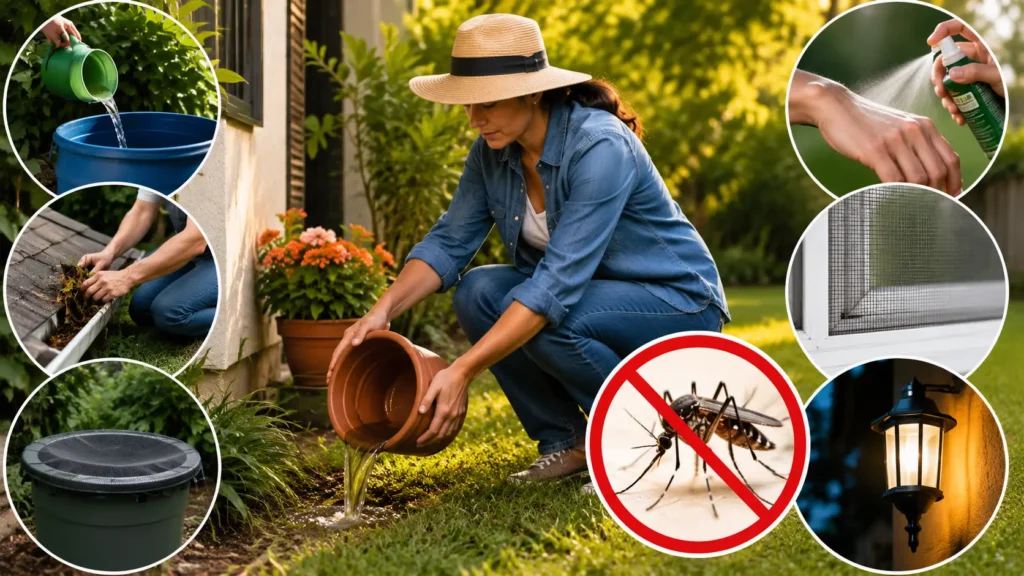
There is no vaccine and no specific antiviral treatment for West Nile virus in humans, which makes prevention the only real tool available. The good news is that the most effective West Nile mosquito prevention tips are simple, low-cost, and backed by decades of public health guidance:
- Use an EPA-registered insect repellent containing DEET, picaridin, IR3535, or oil of lemon eucalyptus, and reapply as directed
- Avoid peak mosquito hours — dusk and dawn are when Culex mosquitoes are most active
- Wear long sleeves and pants during outdoor activity in mosquito-heavy areas, especially in the early morning or evening
- Eliminate standing water around your home at least once a week — check flowerpots, gutters, bird baths, tires, buckets, and children’s toys
- Repair or install window and door screens, and use air conditioning when possible to keep mosquitoes outside
- Use a fan on porches or patios — mosquitoes are weak fliers and struggle in even light, moving air
- Treat clothing and gear with permethrin if you spend a lot of time outdoors, such as camping or yard work
- Support local mosquito control efforts by reporting standing water complaints or dead birds to your local health department, since bird die-offs can signal virus activity in an area
None of these steps require special equipment or expense — they’re mostly habit changes, which is exactly why public health messaging keeps repeating them every summer.
Is There a Vaccine or Treatment for West Nile Virus?
No. As of 2026, there is still no approved human vaccine for West Nile virus, and no antiviral medication targets it specifically. Treatment for mild cases focuses on rest, fluids, and over-the-counter pain relief, while severe neuroinvasive cases typically require hospitalization for supportive care — managing symptoms like fever, seizures, or breathing difficulty while the body fights the infection. This is precisely why avoiding the bite in the first place carries so much weight compared to most other seasonal illnesses.
When to See a Doctor
Contact a healthcare provider promptly if, after a period of mosquito exposure, you or a loved one develops:
- A sudden high fever, especially with a stiff neck or severe headache
- Confusion, disorientation, or difficulty staying awake
- Muscle weakness or difficulty moving a limb
- Tremors or seizures
- Any West Nile-like symptoms in someone over 65 or with a weakened immune system
Mention recent mosquito exposure specifically, since it helps guide testing — West Nile virus is confirmed through blood or spinal fluid testing, and standard illness panels won’t automatically catch it.
FAQs: West Nile Virus Symptoms 2026 USA
Can you get West Nile virus more than once? It’s rare, but not impossible. Most people who recover develop lasting immunity, though reinfection has occasionally been documented, particularly in immunocompromised individuals.
Does one mosquito bite mean you’ll get West Nile virus? No. Only a fraction of mosquitoes in any given area carry the virus, and most people who are bitten by an infected mosquito never develop symptoms at all.
Is West Nile virus contagious between people? No. It spreads through mosquito bites, not person-to-person contact, though rare cases have been linked to blood transfusions or organ transplants.
Are certain U.S. states more affected in 2026? Yes — Arizona, and Maricopa County specifically, has reported the largest share of cases and deaths so far this season, though the CDC has confirmed activity across 23 states as of late June, with more states typically added as the season progresses.
The Bottom Line
The 2026 season is shaping up to be one of the most active in over 20 years, and the core message from public health officials hasn’t changed: prevention is everything. Knowing the early West Nile virus symptoms in adults, understanding how mosquito bites and West Nile risk actually connect, and building a few consistent West Nile Mosquito Prevention Tips habits into your routine — repellent, standing water checks, and avoiding dusk-to-dawn exposure — remain the most effective tools available, especially heading into the historically riskiest weeks of August and September.
Read More: Moringa Drumstick Benefits: Nutrition, Uses & Side Effects (Complete Guide)