
Wearables for Nervous System Tracking
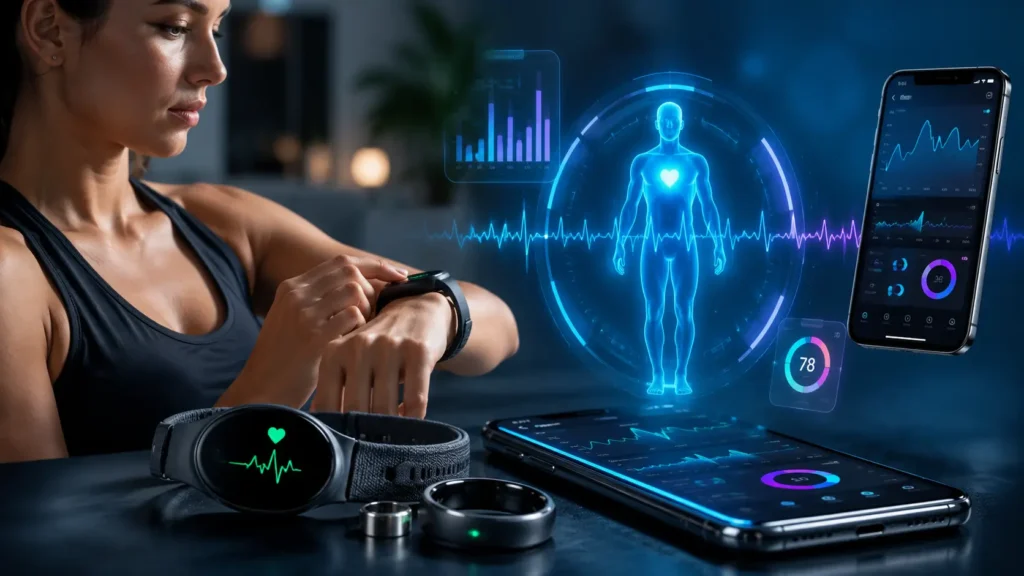
Wearables for nervous system tracking have exploded in 2026. Millions of Americans now check their HRV score before getting out of bed. But most people don’t fully understand what the numbers mean, whether they’re accurate, or how to actually use them to feel better.
What Is HRV and Why Does It Measure Nervous System Health?
HRV stands for Heart Rate Variability — and it’s the single most important metric your wearable tracks for nervous system health.
Here’s what it means: your heart doesn’t beat like a metronome. Even at rest, there are tiny millisecond variations between each beat. A higher HRV means more variation — and that’s a good thing. It signals that your autonomic nervous system is flexible and responsive. A lower HRV means your heart is beating more rigidly — often a sign that your nervous system is under stress, fatigued, or stuck in sympathetic overdrive (fight-or-flight mode).
Think of HRV as a daily report card for your nervous system:
- High HRV → parasympathetic system active → body in recovery mode → good
- Low HRV → sympathetic system dominant → body under stress → needs attention
HRV tracking for stress works because it’s not measuring how you feel — it’s measuring what your body is actually doing at a physiological level. You might feel “fine” while your nervous system is quietly running on empty. HRV can catch that before you crash.
One important note: HRV varies significantly from person to person. A “good” score for a 45-year-old is very different from a “good” score for a 25-year-old athlete. What matters most is your personal baseline and how your score trends over time — not a number on a chart.
Read More: Nervous System Reset Morning Routine: 7 Habits That Actually Work in 2026
Best Wearables for Nervous System and Stress Tracking in 2026
Here’s an honest, research-informed breakdown of the four major devices — what they’re good at, and who they’re best for.
Oura Ring 5 — HRV + Readiness Score
Best for: Sleep-focused users and Wearables for Nervous System Tracking overall
The Oura Ring leads in raw HRV accuracy. A landmark 2025 validation study published in The Physiological Society tested five wearable devices against ECG across 536 nights, and Oura Ring Gen 4 achieved a correlation coefficient of 0.99 — near-perfect agreement with medical-grade ECG for overnight HRV measurement.
In 2026, Oura introduced Cumulative Stress — a long-term biomarker that blends heart response, sleep continuity, temperature variation, and movement to show how the body accumulates and clears stress over roughly a month. This makes it one of the most sophisticated nervous system recovery wearables available to consumers right now.
What it gives you:
- Morning Readiness Score (0–100)
- Overnight HRV (your most accurate daily nervous system snapshot)
- Daytime Stress and Resilience scores
- Cumulative Stress tracking (new in 2026)
Limitation: Subscription required for full features. Ring form factor doesn’t suit everyone.
Whoop 5 — Strain vs. Recovery Tracking
Best for: Athletes and people with demanding physical or mental workloads
Whoop takes a different angle. Instead of asking how ready are you today, it asks how much stress did you put on your system, and did you recover from it? Its strain-to-recovery loop is one of the most behavior-changing features in the wearable space.
Whoop calculates your daily Recovery score using HRV (measured during your last slow-wave sleep cycle), resting heart rate, respiratory rate, blood oxygen, and skin temperature. The result is a percentage that tells you whether to push hard or pull back.
For HRV tracking for stress, Whoop shows strong heart rate accuracy (0.3 bpm deviation from ECG in sleep studies) and excels at helping you understand the relationship between your training load and nervous system recovery wearables.
Limitation: Mandatory subscription with no screen — some users find the lack of real-time display frustrating.
Apple Watch — Stress Notifications and Real-Time Monitoring
Best for: iPhone users who want one device for everything
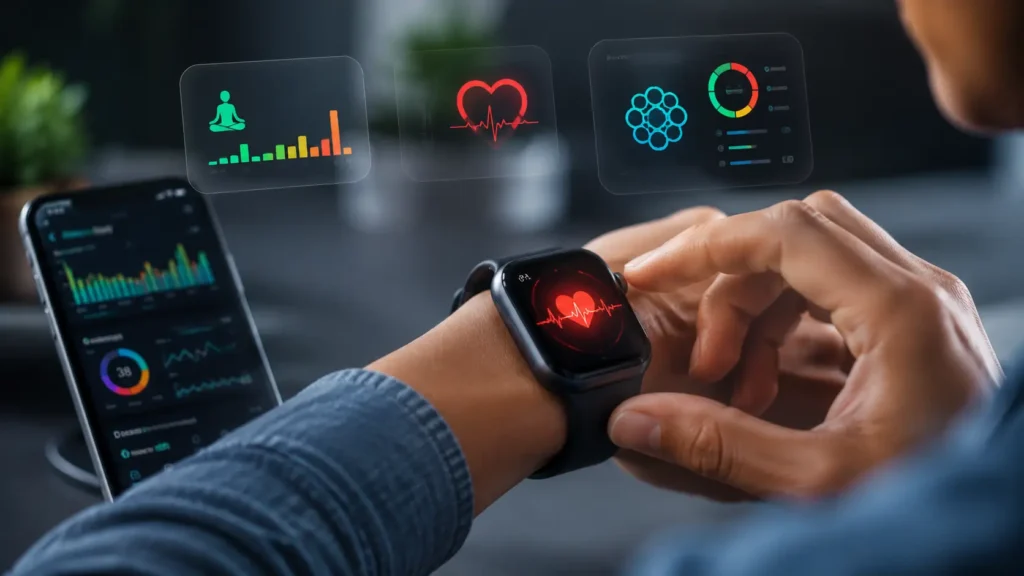
Apple Watch handles stress tracking differently. Rather than continuous overnight HRV measurement, it takes spot-check readings at intervals during sleep — using SDNN-based measurements rather than the rMSSD that Oura and Whoop use. This makes direct comparison difficult.
What Apple Watch does well: real-time stress and mindfulness notifications during the day, ECG app (FDA-cleared for atrial fibrillation detection), and seamless HealthKit integration that connects your data across all health apps.
What it gives you:
- Mindfulness and breathing reminders
- Stress notifications
- Heart rate trends
- Sleep tracking (improving, though less validated than Oura)
Limitation: Not the best choice if overnight HRV accuracy is your primary goal for Wearables for Nervous System Tracking.
Garmin — Body Battery Feature
Best for: Endurance athletes and users who want no subscription fees
Garmin’s Body Battery (0–100) is one of the most intuitive nervous system tools available. Think of it as a fuel gauge for your autonomic nervous system — it drains with activity and stress, then recharges during rest and sleep.
Its Training Readiness score combines six inputs: sleep quality, recovery time, HRV Status (a 7-day rolling average), stress history, short-term training load, and Body Battery. That 7-day HRV rolling average makes Garmin’s scores less reactive to single bad nights — which can be an advantage for people who want a more stable, long-term picture.
Limitation: Garmin’s HRV measurement showed lower agreement with ECG in some validation studies compared to Oura, partly because older models measured HRV during a manual 3-minute waking test rather than continuously overnight.
How to Use Wearable Data to Actually Reset Your Nervous System
Here’s where most people go wrong: they check their score, feel bad about it, and then do nothing differently.
Wearable data is only useful if it changes your behavior. Here’s a simple framework for using your device as a genuine nervous system reset tool:
When your score is LOW (stressed/depleted):
- Prioritize sleep above everything else that day
- Swap intense exercise for a 10-minute walk
- Do 5 minutes of diaphragmatic breathing in the morning
- Avoid caffeine in the first 90 minutes after waking
- Reduce screen time in the evening
When your score is HIGH (recovered/regulated):
- This is your window to take on challenging tasks
- Higher-intensity exercise is appropriate
- Creative work and problem-solving will feel easier
- Your nervous system is in a flexible, responsive state
Track trends, not single days. A single low HRV morning doesn’t mean your nervous system is broken. Look for patterns: Is your HRV declining over 5–7 days? That’s a signal. Is it consistently low every Monday? That’s a stress pattern worth addressing.
Limitations — What Wearables Can’t Tell You
It’s important to be honest about what these devices cannot do.
- They estimate, they don’t diagnose. Consumer wearables are wellness tools, not medical devices. HRV scores from Oura and Whoop are not equivalent to clinical ECG readings.
- Scores aren’t standardized across devices. A score of 65 on Oura does not mean the same as 65 on Whoop — each platform uses its own algorithm and weightings.
- They can’t identify the cause of stress. Your HRV doesn’t know if your nervous system is dysregulated due to poor sleep, emotional stress, illness, or overtraining. You still need to interpret the data with context.
- Obsessing over scores can increase anxiety. Some users report that constantly checking nervous system recovery wearables metrics creates new stress. If you notice your mood becoming tied to your daily score, it may help to check less frequently.
Wearable + Daily Reset Routine: A Practical Combination
Using wearables for nervous system tracking is most powerful when combined with active reset habits — not used in isolation.
Here’s a simple daily combination:
| Morning Score | What to Do |
|---|---|
| High (80–100) | Full routine, normal intensity day |
| Medium (50–79) | Breathwork + gentle movement, moderate workload |
| Low (0–49) | Prioritize sleep, vagus nerve breathing, no intense exercise |
Pair your wearable data with the habits from our nervous system reset morning routine — breathwork, sunlight, protein-first breakfast, intention setting — and you have a complete, data-informed system for nervous system regulation.
FAQs: Wearables for Nervous System Tracking
Can Oura Ring detect nervous system stress? Oura Ring tracks HRV, resting heart rate, skin temperature, and sleep quality — all of which reflect the state of your autonomic nervous system. Its Daytime Stress and Cumulative Stress features in 2026 give a more complete picture than simple HRV alone. However, it estimates nervous system state — it does not diagnose stress disorders or medical conditions.
What is a good HRV score for nervous system health? There is no universal “good” HRV number — it varies significantly by age, fitness level, and individual biology. What matters most is your personal baseline. Track your HRV tracking for stress 2–4 weeks to establish your normal range, then watch for deviations. A drop of 15–20% from your personal baseline is generally considered a meaningful signal worth paying attention to.
Disclaimer: I am not a doctor or licensed medical professional. This article is for informational and educational purposes only. Please consult a qualified healthcare provider before making health decisions based on wearable data.
Read More: How to Reset Your Nervous System After Burnout: A Science-Backed Guide (2026)