
Screen Time Effects on Children’s Mental Health
Researchers analyzing data from 50,231 American children and adolescents ages 6 to 17 found that the screen time effects on children’s mental health are far more serious than most parents realize. Published in Humanities and Social Sciences Communications (January 2026), the study used data from the U.S. National Survey of Children’s Health and found that daily screen exposure of four or more hours was linked to:
- 45% higher risk of anxiety
- 61% higher risk of depression
- 24% higher risk of behavior and conduct problems
- 21% higher risk of ADHD
These numbers didn’t budge even after researchers controlled for age, gender, and demographics. The 4 hours screen time kids anxiety depression study results are some of the most alarming pediatric mental health findings published this decade — and every American parent deserves to know about them.
Read More: Deadly Tapeworm Spreads to Pacific Northwest — What to Know (2026)
Why Is Screen Time Hurting Kids So Badly?
The study didn’t just document the problem — it explained the how. Two key factors were found to mediate the relationship between screens and poor mental health: disrupted sleep and reduced physical activity.
When kids spend four-plus hours on screens, they sleep less. When they sleep less, their brains can’t regulate emotions properly — making anxiety and higher risk of depression significantly worse. At the same time, screen time replaces outdoor play, sports, and face-to-face socializing — all activities that naturally reduce stress hormones in developing brains.
Dr. Jason Nagata, MD, associate professor at UCSF Benioff Children’s Hospital, has noted in related research that “screen use may replace time spent engaging in physical activity, sleep, socializing in-person and other behaviors that reduce depression and anxiety.”
In short: it’s not just the screen. It’s everything the screen replaces.
How Much Screen Time Is Too Much for Kids? An Age-by-Age Guide
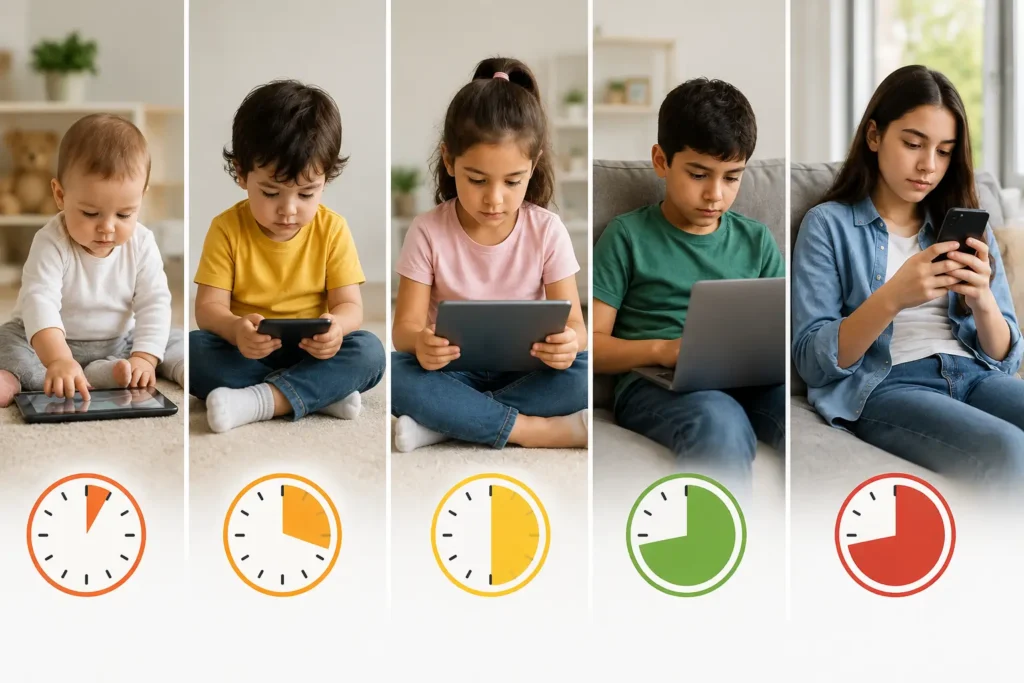
This is the question every American parent is Googling. The American Academy of Pediatrics (AAP) released updated 2026 screen time guidelines that made a significant shift — moving away from strict time-only rules toward a more balanced, context-driven approach. Here’s what pediatricians now recommend by age:
Ages 0–18 Months
No screens — except video chatting with family. The developing brain at this stage needs real-world sensory input, not pixel stimulation. This is one of the few guidelines every major health body agrees on without reservation.
Ages 18 Months – 2 Years
If you introduce screens, make it high-quality content only (like PBS Kids) and watch it together with your child. Passive solo viewing at this age is linked to language delays.
Ages 2–5 Years
Maximum 1 hour per day of high-quality, age-appropriate content. Co-viewing is strongly encouraged. The AAP recommends parents talk about what they’re watching to reinforce learning.
Ages 6–12 Years
No single hard number — but most pediatricians suggest keeping recreational screen time under 2 hours on school days. The bigger rule: screens should never cut into sleep, homework, physical activity, or face-to-face time.
Ages 13–17 Years
The focus shifts from limits to digital literacy and self-regulation. Teens need guidance on social media, privacy, and recognizing manipulative content — not just a timer. That said, the 2026 study clearly shows that 4+ hours daily puts teens at serious mental health risk.
The New AAP “5 C’s” Framework for Screen Time limits for kids
One of the biggest shifts in the screen time limits for kids recommended by pediatricians in 2026 is the AAP’s “5 C’s” framework — a parent-friendly model that goes beyond clock-watching:
- Child — What are your child’s individual needs, temperament, and developmental stage?
- Content — Is what they’re watching educational, age-appropriate, and positive?
- Calm — Are screens being used to avoid boredom or manage emotions? That’s a warning sign.
- Crowding out — Is screen time replacing sleep, play, homework, or family time?
- Communication — Are you talking with your child about what they’re seeing online?
This framework acknowledges what millions of parents already know: it’s not just how long kids are on screens — it’s what they’re doing and how you’re involved.
7 Proven Ways to Reduce Screen Time for Children Without Conflict

The hardest part of managing screen time isn’t knowing the rules — it’s enforcing them without daily battles. Here are research-backed strategies that actually work:
1. Make the rules together, not for them. Sit down as a family and build your household media plan collaboratively. When kids have a voice in setting limits, they’re far more likely to respect them. The AAP calls this co-creation — and it’s consistently shown to reduce conflict.
2. Reduce gradually — don’t go cold turkey. Cutting screen time by 10–15 minutes per day is far more effective than a sudden ban. Celebrate small milestones with non-screen rewards like a family game night or a trip to the park.
3. Create device-free zones and times. Bedrooms and dining tables are the most important. No screens during meals or within one hour of bedtime. This single change can measurably improve sleep quality within one week.
4. Replace screens — don’t just remove them. Boredom is healthy. But you need alternatives ready: board games, craft kits, outdoor gear, library books, neighborhood sports. Kids don’t fight screen limits as much when they’re genuinely excited about what’s next.
5. Use built-in parental controls. Every major device — Apple, Android, Amazon Fire — has built-in screen time effects on children mental health anxiety 2026 management. Set daily limits, schedule downtime, and review app usage weekly. Apps like Google Family Link and Apple Screen Time make this easy and conflict-free.
6. Model what you want to see. The AAP’s 2026 guidelines specifically note that parents modeling good digital behavior is one of the most powerful influences on kids’ screen habits. If you’re scrolling at dinner, your child notices.
7. Explain the “why” — in age-appropriate terms. screen time limits for kids, especially older ones, respond better to rules they understand. You don’t need to cite the full study — just say: “When you’re on screens too long, your brain has a harder time feeling calm and happy. Let’s make sure we’re giving your brain what it needs.”
Warning Signs Your Child’s Screen Time Has Become a Problem
Watch for these red flags, especially in school-age children and teens:
- Moodiness, irritability, or meltdowns when screens are turned off
- Declining grades or loss of interest in hobbies they used to love
- Difficulty falling asleep or staying asleep
- Withdrawing from family dinners or social activities
- Sneaking devices after bedtime
- Complaining of eye strain, headaches, or neck pain regularly
If you notice three or more of these signs persisting for two or more weeks, speak with your child’s pediatrician. The 4 hours screen time effects on children mental health anxiety 2026 depression study results underscore that these symptoms are real, measurable, and worth taking seriously.
The Bottom Line for American Parents
The 2026 research on screen time effects on children’s mental health is unambiguous: four or more hours daily puts your child at significant risk for anxiety, depression, ADHD, and behavioral problems. But the solution isn’t panic — it’s a plan.
Start small. Pick one change from this list this week. Talk to your kids. Set up one device-free zone. Reduce by 15 minutes a day. Over 30 days, those small changes add up to a genuinely healthier, happier child.
Read More: Foot and Mouth Disease Mongolia Livestock Cull 2026 — What’s Happening