
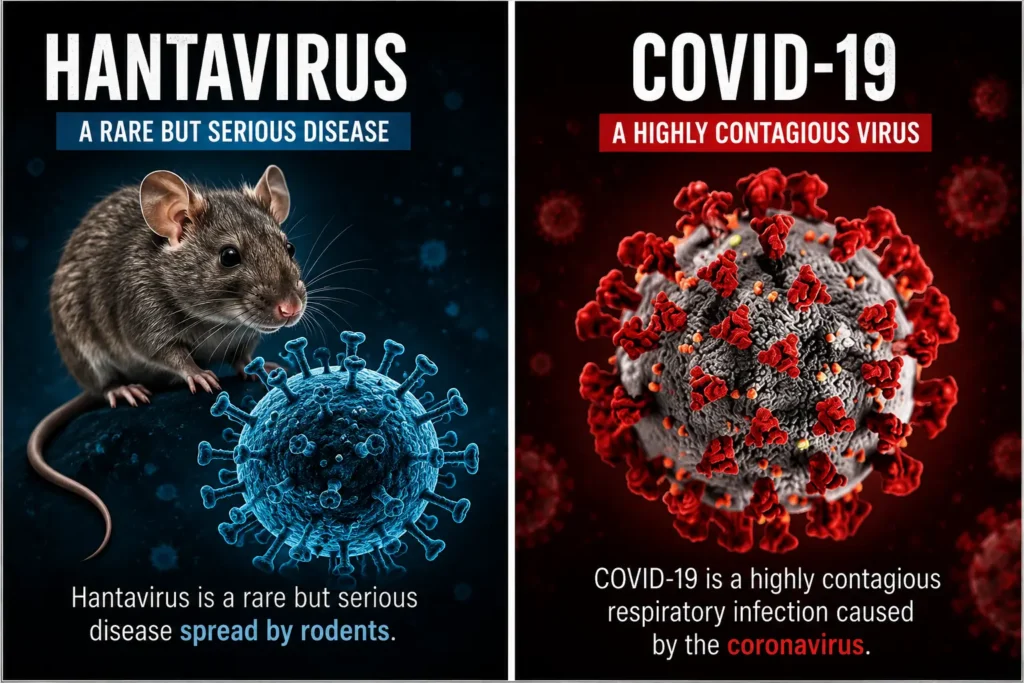
Hantavirus vs COVID-19
What Is Hantavirus? A Quick Explainer
Hantavirus is not one virus — it is a family of over 50 viruses carried by rodents. Infected rats, mice, and other small animals shed the virus through their urine, feces, and saliva. Humans typically become infected by breathing in aerosolized particles from rodent droppings — not through person-to-person contact in most cases.
The disease it causes depends on the strain and the region:
- In the Americas (including the Andes virus): Hantavirus Pulmonary Syndrome (HPS) — attacks the lungs and cardiovascular system
- In Europe and Asia: Hemorrhagic Fever with Renal Syndrome (HFRS) — attacks the kidneys, with lower mortality but higher case numbers
Hantavirus is not new. It was first formally identified in the United States in 1993 during a cluster of deaths in the American Southwest. But the 2026 cruise ship outbreak has given the virus global attention it has rarely received before.
The 2026 Cruise Ship Outbreak: What Happened?
On April 1, 2026, the expedition ship MV Hondius departed Ushuaia, Argentina, carrying 147 passengers and crew from 23 countries. Before boarding, a Dutch couple had spent weeks birdwatching across Argentina, Chile, and Uruguay — visiting remote regions where rodents carrying the Andes virus are known to live.
3 Deaths confirmed on MV Hondius
9+ Confirmed & suspected cases across 5+ countries
23 Nationalities on board the ship
12 Countries now tracking passengers
By May 2026, infected passengers had been hospitalized across South Africa, the Netherlands, Germany, Switzerland, and Saint Helena. Health officials in the UK, US, Canada, France, and Singapore were all monitoring individuals for symptoms.
Read More:- Ozempic and GLP-1 Drugs for Weight Loss: Everything You Need to Know in 2026
Hantavirus vs COVID-19: The Key Differences
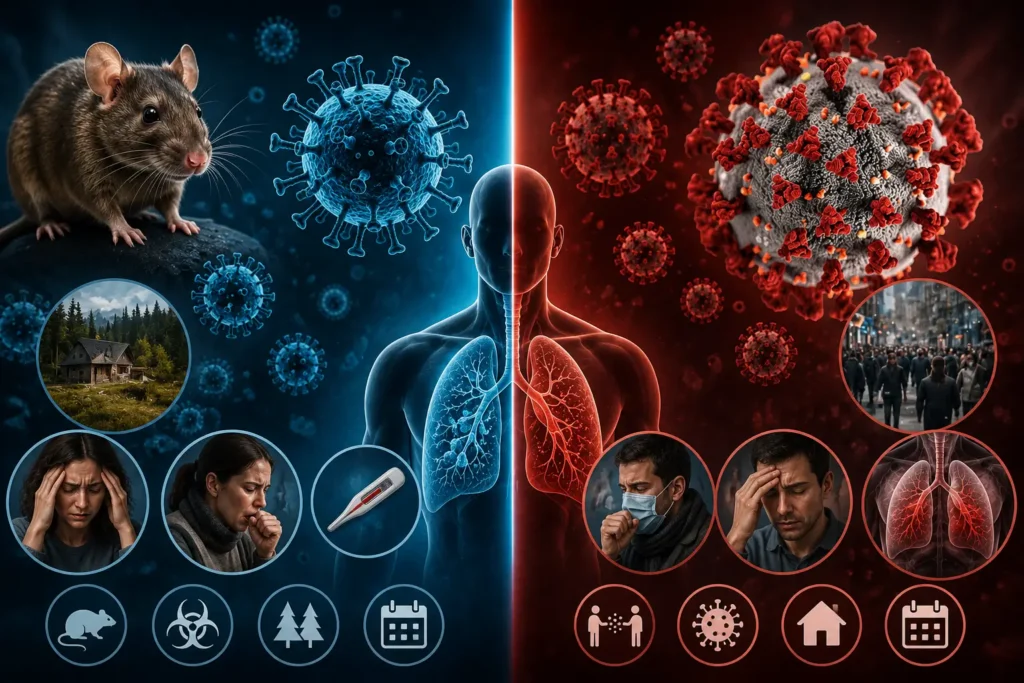
This is the comparison most people are looking for — and the answer is nuanced. These two viruses are dangerous in very different ways.
Hantavirus (Andes Strain)
- Spread: Rodent contact (rare human-to-human)
- Fatality rate (HPS): 30–40%
- Incubation: 1–6 weeks
- No vaccine, no antiviral cure
- Very rare — 229 cases in Americas in 2025
- R0 (Andes): Less than 1 person on average
COVID-19 (SARS-CoV-2)
- Spread: Airborne, person-to-person easily
- Fatality rate: ~1–2% (higher early pandemic)
- Incubation: 2–14 days
- Vaccines & antivirals available
- Infected hundreds of millions globally
- R0 (Omicron): 15–20 people per case
The critical difference: COVID-19 is far more contagious. Hantavirus is far more lethal per case. An infected COVID-19 patient (Omicron) could infect 15–20 others on average. An Andes virus patient typically infects fewer than one other person.
“This is not the next COVID, but it is a serious infectious disease. Most people will never be exposed to this.” — Maria Van Kerkhove, WHO Director of Epidemic & Pandemic Preparedness
How Does Hantavirus Spread — And Can It Go Airborne?
Understanding hantavirus transmission is key to understanding why experts are not sounding a COVID-level alarm.
Primary Route: Rodent-to-Human
The vast majority of hantavirus cases occur when people inhale microscopic particles from infected rodent waste in enclosed spaces — barns, sheds, rural cabins, and — in the 2026 case — potentially remote South American wilderness areas.
Human-to-Human: The Andes Exception
The Andes virus is the only hantavirus confirmed to spread between humans — but this remains rare. Transmission requires close, prolonged contact: household members, intimate partners, or healthcare workers treating severe cases. It spreads through respiratory droplets, not true airborne transmission like COVID-19.
Why the Cruise Ship Was a Risk Factor
A confined cabin environment with close family contact created higher-than-normal conditions for the rare human-to-human Andes transmission. Outside of such environments, the risk drops significantly.
Symptoms of Hantavirus: What to Watch For

Hantavirus Pulmonary Syndrome (HPS) — the form caused by the Andes virus — is especially dangerous because early symptoms mimic common illnesses:
- Early stage (days 1–5): Fever, fatigue, muscle aches, headache, nausea, diarrhea
- Late stage (days 5–10): Rapid progression to coughing, shortness of breath, pneumonia, acute respiratory distress syndrome (ARDS), and shock
- Critical window: The transition from mild to life-threatening can happen within hours
Important: There is currently no specific antiviral treatment for hantavirus. Survival depends on early hospitalization and intensive supportive care — oxygen therapy, fluid management, and in severe cases, mechanical ventilation.
Should You Be Worried? The Honest Risk Assessment
The WHO’s official position is clear: the global public health risk from the current hantavirus outbreak is low. Here is why:
- Hantavirus does not spread easily in everyday settings like offices, schools, or public transport
- The outbreak traces to a single point of exposure in a rodent-endemic region of South America
- No widespread community transmission has been detected in any country
- In 2025, the entire Americas reported only 229 hantavirus cases — compared to millions of COVID-19 cases in the same period
The people at genuine risk are those with direct rodent exposure — rural workers, campers, farm laborers, or travelers visiting areas where infected rodents are known to live. Urban residents face minimal risk.
Hantavirus vs COVID-19: The Pandemic Potential Question
For a virus to cause a pandemic, it needs two things: easy person-to-person transmission and a large susceptible population. COVID-19 had both. The Andes hantavirus has neither.
COVID-19’s Omicron variant carried an R0 of 15–20, meaning one person could infect up to 20 others in an unprotected population. The Andes virus’s R0 in human transmission remains well below 1 — meaning it does not sustain chains of spread in normal conditions.
Without a pathway to efficient human-to-human transmission, hantavirus cannot replicate the explosive spread of COVID-19 — even in the most cautious projections.
Bottom Line: Dangerous, But Not the Next Pandemic
Hantavirus — especially the Andes strain — is genuinely deadly. A 30–40% fatality rate in severe cases is among the highest of any known virus. But deadliness without transmissibility does not make a pandemic. The 2026 cruise ship outbreak is a serious public health event requiring careful contact tracing and international coordination.
It is not, however, a repeat of 2020. If you were not on the MV Hondius, did not visit rodent-endemic regions of South America recently, and have not been in prolonged close contact with a confirmed case — your personal risk is extremely low.
Stay informed, not panicked. That is the correct response to hantavirus in 2026.
Read More: Gut Health & Late-Night Eating: How It Affects Your Body After Dark