
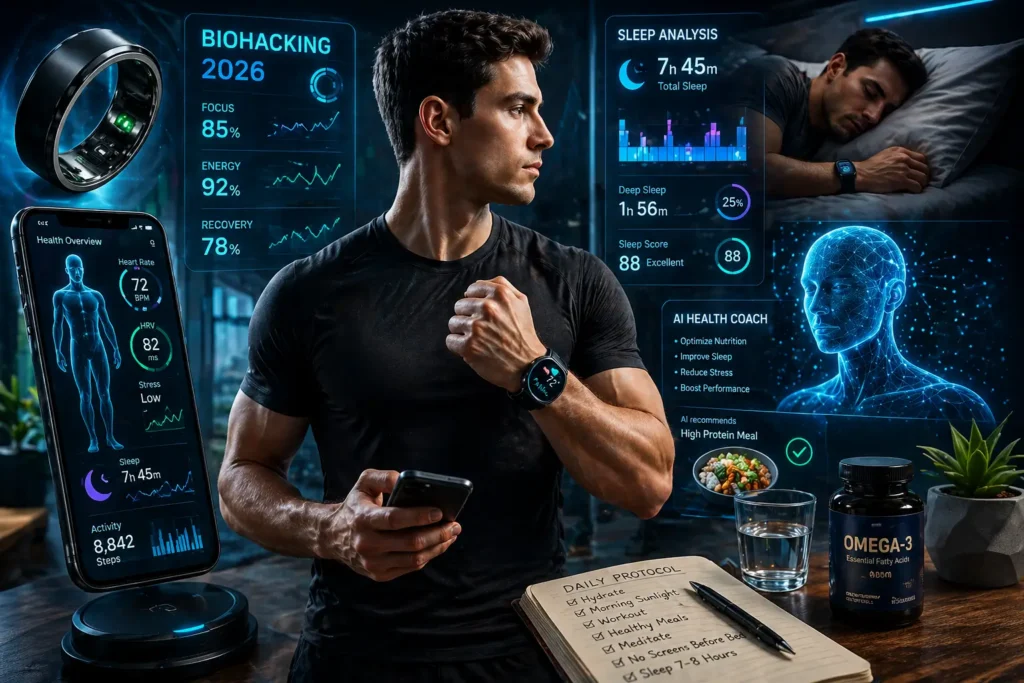
Introduction: biohacking in 2026
Biohacking has gone mainstream — and it is no longer about extreme experiments or implanting microchips. It is about using the best available science, technology, and data to take full control of your health before disease takes control of you.
Whether you want more energy in the morning, deeper sleep at night, sharper mental focus, or simply a longer and healthier life — biohacking in 2026 gives you the tools to make it happen.
What Is Biohacking in 2026 — And Why Does It Matter?
Biohacking, at its core, is the practice of making deliberate, data-driven changes to your biology in order to optimize how you feel, perform, and age.
The term can sound intimidating, but the concept is beautifully simple: you are not stuck with the body or the health you were born with. Your daily habits, environment, nutrition, sleep, and mindset all influence how your genes express themselves — a field known as epigenetics.
The biohacking health trend in 2026 spans a wide range of approaches, from simple habits like sleep optimization to advanced experimental therapies.
This means you do not need to start with anything extreme. The most powerful biohacks available right now are also the most accessible: better sleep, smarter nutrition, consistent movement, and real-time data from wearable devices.
The global biohacking market is projected to grow from $22.51 billion in 2026 to $56.31 billion by 2034 — a number that tells you everything about where the world of health is heading.
The shift is clear: people are done waiting to get sick. They want to optimize now.
The Power of Wearables — Your 24/7 Personal Health Monitor
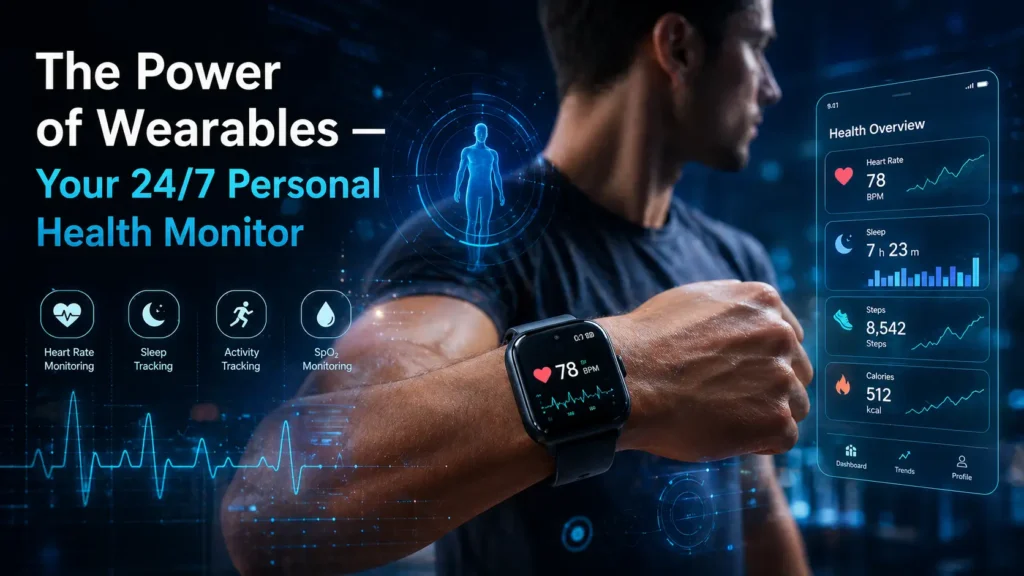
The single biggest revolution in biohacking over the last three years has not been a drug or a therapy. It has been the wearable device strapped to your wrist, finger, or chest — quietly collecting data that would have required a hospital visit just a decade ago.
Wearables and AI biohacking tools like smartwatches, glucose monitors, and sleep trackers provide real-time insights without invasive procedures.
Here is what the best wearables in 2026 can track for you right now:
- Heart Rate Variability (HRV) — one of the most powerful indicators of your nervous system health and recovery readiness
- Resting Heart Rate — a key marker of cardiovascular health that changes long before symptoms appear
- Blood Oxygen Levels (SpO2) — critical for monitoring breathing quality during sleep and exercise
- Skin Temperature Variation — an early warning signal for illness, hormonal shifts, and recovery quality
- Continuous Glucose Monitoring (CGM) — shows in real time how your blood sugar responds to different foods, stress, and sleep
Top Wearables Worth Knowing in 2026:
Oura Ring Gen 5 — the gold standard for sleep and recovery tracking. Slim, discreet, and packed with sensors that rival clinical-grade monitoring equipment.
Whoop 6.0 — preferred by professional athletes for its detailed recovery and strain scoring. Tells you not just how hard you trained, but whether your body is actually ready to train again.
Apple Watch Ultra 2 — the most accessible entry point for mainstream users, now with advanced ECG, temperature, and mental health tracking features.
CGM Patches (Dexcom, Libre) — no longer just for diabetics. Healthy individuals are now using continuous glucose monitors to understand exactly how their bodies respond to every meal.
Pro Tip: Do not buy every device at once. Start with one wearable that measures sleep and HRV. The data you get from just those two metrics will already transform how you approach your health.
Read More:- https://vitalmindflow.com/glp-1-drugs-beyond-weight-loss-ozempic-heart-health-longevity-2026/
Sleep Science in 2026 — Why “8 Hours” Is Not Enough
Here is the most underrated biohacking tool in the world: sleep.
Not just any sleep. Quality sleep. And in 2026, the science of sleep has advanced so far beyond “just get eight hours” that most people are still optimizing for the wrong thing entirely.
The cutting edge of sleep science now focuses on sleep architecture — the specific stages of sleep your body moves through each night, and how much time you spend in each one.
The two stages that matter most for performance and longevity are:
Slow-Wave Sleep (SWS) — Your Body’s Repair Mode
Slow-wave sleep, also called deep sleep, is when your body releases growth hormone, repairs muscle tissue, consolidates memories, and activates the glymphatic system — your brain’s waste-clearance mechanism that flushes out beta-amyloid, a protein linked to Alzheimer’s disease.
Most adults get far less deep sleep than they need — and most do not even know it because they are not tracking it.
REM Sleep — Your Brain’s Creative Reset
REM (Rapid Eye Movement) sleep is where emotional processing, creative thinking, and long-term memory consolidation happen. Disrupted REM sleep is directly linked to increased anxiety, poor decision-making, and reduced learning capacity.
How to Optimize Your Sleep in 2026:
- Control your light environment — block blue light (480nm wavelength) at least 90 minutes before bed. This is not optional; it is biology. Blue light suppresses melatonin production and delays sleep onset.
- Use thermal regulation — your body needs to drop its core temperature by 1–2°F to initiate deep sleep. Keep your bedroom between 65–68°F (18–20°C) for optimal results.
- Time your caffeine correctly — caffeine has a half-life of 5–6 hours. A 3pm coffee still has half its caffeine in your system at 9pm, actively blocking adenosine and reducing your deep sleep by up to 20%.
- Track your sleep stages — use an Oura Ring or Whoop to measure your actual SWS and REM percentages nightly. What gets measured gets managed.
- Maintain a consistent sleep schedule — even on weekends. Your circadian rhythm does not take days off, and neither should your sleep timing.
AI Health Tools — Personalized Wellness at Scale
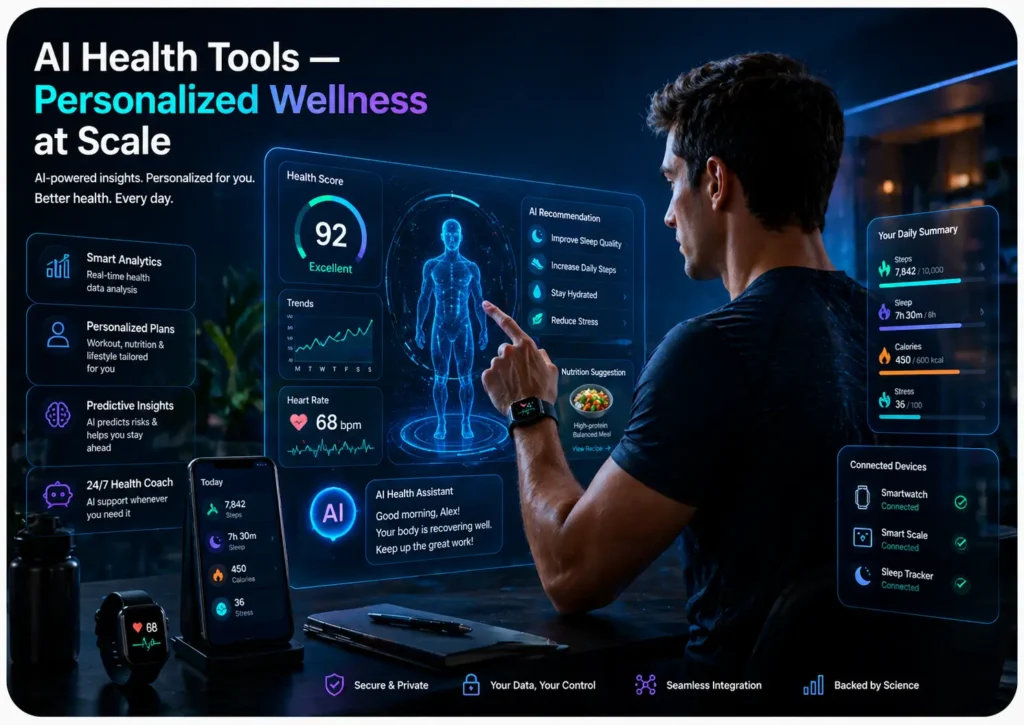
The third pillar of biohacking in 2026 is artificial intelligence — and it is changing health optimization in ways that were science fiction just five years ago.
Personalized nutrition via AI uses genetic testing to customize diets and optimize nutrient absorption.
Today’s AI health tools do not give you generic advice. They analyze your unique biology — your genetics, gut microbiome, blood biomarkers, sleep data, and activity patterns — and deliver recommendations built specifically for you.
Key AI Health Applications Transforming Biohacking in 2026
AI-Powered Nutrition Coaches Apps like Zoe and Viome analyze your gut microbiome through at-home test kits and then tell you exactly which foods improve your energy, digestion, and inflammation markers — and which ones are quietly harming you, even if they are considered “healthy” for the general population.
AI Biomarker Analysis Companies like Function Health and Superpower now offer comprehensive blood panels — testing 100+ biomarkers — with AI-driven interpretation that goes far beyond what a standard annual physical covers. You get actionable insights, not just numbers.
AI Mental Health & Emotional Fitness Tools Emotional fitness focuses on recognizing emotional signals early and responding with structured regulation techniques such as mindfulness, journaling, breathwork, or mood tracking. AI-powered mental health platforms now integrate with wearables to detect stress patterns before they escalate — alerting you when your HRV data suggests you are entering a high-stress state, even before you consciously feel it.
AI Sleep Coaching Smart apps now combine your wearable data with lifestyle inputs — your diet, alcohol intake, exercise timing, screen usage — to generate personalized sleep improvement protocols that evolve with your data week by week.
Personalized Nutrition — Eating for Your Biology, Not the Average Human
One of the most powerful shifts in biohacking nutrition is the move away from universal dietary advice and toward precision nutrition — eating based on your specific genetics, gut health, and metabolic response.
The science is now unambiguous: two people can eat the exact same meal and have completely different blood sugar, energy, and inflammatory responses. What works for one person can actively harm another.
Here is what the data-driven approach to nutrition looks like in 2026:
- Genetic testing (e.g., 23andMe, Genova Diagnostics) — reveals how your body metabolizes specific nutrients, whether you carry genes that affect folate processing, caffeine sensitivity, saturated fat tolerance, or vitamin D absorption
- Gut microbiome testing — identifies which beneficial bacteria are thriving or depleted in your gut, and how your microbial profile affects mood, immunity, weight, and inflammation
- CGM-guided eating — eating with a continuous glucose monitor for 2–4 weeks shows you exactly which meals spike your blood sugar and which keep it stable — information that transforms how you structure your diet
The simplest nutrition biohacks you can implement today, without any testing:
- Eat protein first at every meal — blunts glucose spikes
- Walk for 10 minutes after eating — dramatically improves post-meal blood sugar
- Add fermented foods daily — kefir, kimchi, sauerkraut — to support microbiome diversity
- Time-restrict your eating to a 8–10 hour window — gives your digestive system adequate rest
What to Avoid — Biohacking Hype vs. Real Science
Not everything trending in the biohacking world is worth your time or money. As the field grows, so does the noise.
Clinicians stress that legitimate medical devices undergo regulatory review, clinical trials, and post-market surveillance — standards most consumer biohacking products do not meet.
Here is what to avoid in 2026:
- Extreme detox programs — your liver and kidneys already detox your body continuously. Juice cleanses and “detox teas” have no scientific basis and can actually disrupt your electrolyte balance.
- Unregulated supplements with bold claims — if a supplement promises dramatic results without peer-reviewed studies behind it, put it back on the shelf.
- Biohacking before mastering the basics — no wearable, peptide, or AI tool will compensate for chronic sleep deprivation, a poor diet, and a sedentary lifestyle. Fundamentals always come first.
- Chasing every new trend — the biohacking space moves fast. Build a sustainable system that works for your life before adding complexity.
Your 30-Day Biohacking Starter Plan
You do not need to overhaul your entire life to start seeing results. Here is a simple, evidence-based 30-day plan to begin your biohacking journey:
Week 1 — Measure Everything Track your sleep, steps, resting heart rate, and what you eat. Do not change anything yet. Just observe. Data first, decisions second.
Week 2 — Fix Your Sleep Implement consistent sleep and wake times, block blue light after 8pm, and drop your bedroom temperature. Measure the difference in your deep sleep percentage.
Week 3 — Optimize Your Nutrition Add protein to every meal, eliminate processed snacks, eat within a 10-hour window, and walk after your largest meal of the day.
Week 4 — Add One AI Tool Choose one AI health app — whether for nutrition, sleep coaching, or mental wellness — and let it analyze your first three weeks of data. Let the personalization begin.
FAQs
Q1. Is biohacking safe for beginners?
Yes, when you start with evidence-based practices like sleep optimization, nutrition adjustments, and wearable tracking. Always consult a healthcare professional before trying advanced interventions like peptides or supplements.
Q2. What is the best wearable for biohacking beginners in 2026?
The Oura Ring Gen 5 is widely regarded as the best starting point for sleep and recovery data. For fitness-focused tracking, Whoop 6.0 is excellent.
Final Thoughts
Biohacking in 2026 is not about becoming superhuman. It is about becoming the healthiest version of yourself — using data, science, and technology that is more accessible today than at any point in history.
Read More:- https://vitalmindflow.com/heart-attack-warning-signs/