

Inhaled Insulin for Type 1 Diabetes
In May 2026, the FDA officially expanded approval of inhaled insulin for type 1 diabetes to include children and teenagers ages 6 and older — making it the first needle-free insulin option ever approved for pediatric patients in the United States. For millions of American families managing Type 1 diabetes every single day, this is not just a medical update. It’s a life-changing development.
What Is Inhaled Insulin and How Does It Work for Type 1 Diabetes?
The inhaled insulin you’re hearing about is called Afrezza (pronounced uh-FREZ-uh), made by MannKind Corporation. It was first FDA-approved for adults back in 2014, but the May 2026 decision is what’s making headlines — because it now covers kids ages 6 and up.
So how does inhaled insulin for type 1 diabetes actually work?
Afrezza uses MannKind’s proprietary Technosphere® technology. Here’s the simple breakdown:
- Step 1: Afrezza comes as an inhalation powder inside small, color-coded cartridges (4, 8, or 12 units)
- Step 2: The patient uses a small, pocket-sized inhaler device at the beginning of a meal — the breath takes just 2 seconds
- Step 3: Ultra-small particles carry human insulin deep into the lungs
- Step 4: Insulin dissolves rapidly and enters the bloodstream in approximately 1 minute
- Step 5: Peak effect occurs 35 to 45 minutes after dosing, returning to baseline within 1.5 to 3 hours
This ultra-rapid action closely mirrors how a healthy pancreas naturally releases insulin in response to food — something traditional injected rapid-acting insulin can’t quite match.
Important: For Type 1 diabetes, Afrezza must always be used alongside a long-acting (basal) insulin. It replaces mealtime injections — not the full insulin regimen.
Read More: Screen Time Effects on Children’s Mental Health: What a 2026 Study Found
Inhaled Insulin vs Injection Pros and Cons Every Patient Should Know
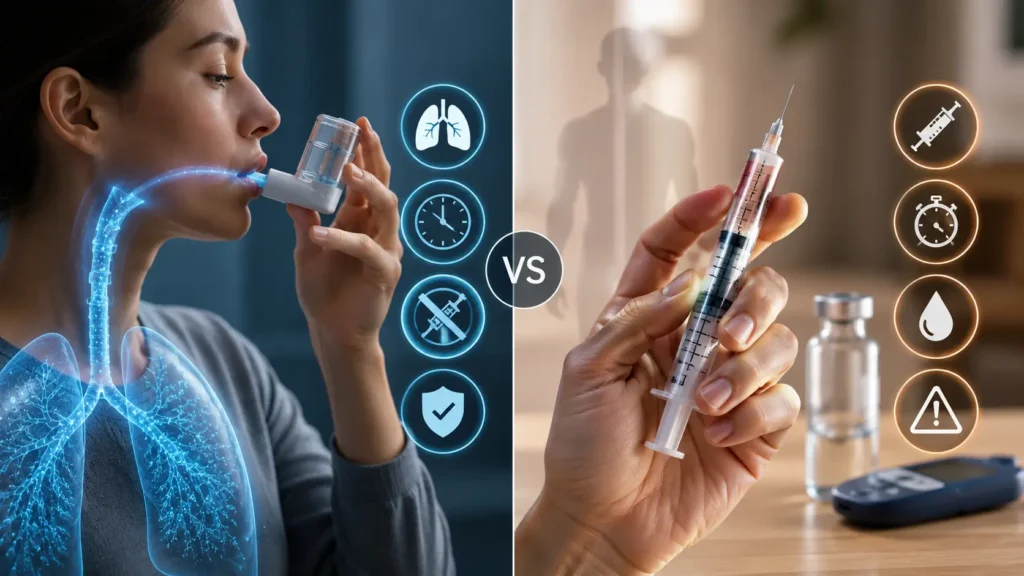
Before you call your doctor and ask for a switch, here’s an honest look at the inhaled insulin vs injection pros and cons — because this option isn’t perfect for everyone.
Pros of Inhaled Insulin
- No needles at mealtime — a major quality-of-life improvement for people with needle anxiety or injection fatigue
- Faster absorption — enters the bloodstream faster than subcutaneous rapid-acting insulin
- Shorter duration — reduces risk of insulin “stacking” and post-meal hypoglycemia
- Portable and discreet — the inhaler is small and easy to use in public (school, restaurants, work)
- Better postprandial control — 2026 ADA data showed optimized Afrezza dosing outperformed subcutaneous analogs for post-meal glucose management in T1D patients
- Comparable A1C outcomes — the INHALE-1 trial showed non-inferior HbA1c results vs. injected insulin in youth with well-controlled diabetes
Cons and Limitations
- Not for smokers — Afrezza is contraindicated in anyone who currently smokes or has quit within the last 6 months
- Not safe with lung disease — people with asthma or COPD cannot use it due to risk of acute bronchospasm
- Requires spirometry (lung test) before starting — an extra medical appointment is needed
- Still needs basal insulin injection — it replaces mealtime shots, not all shots
- Can cause a temporary cough — the most commonly reported side effect in trials
- Insurance hurdles — prior authorization is often required, which can delay access
Is Inhaled Insulin Safe for Teenagers? What the FDA Trial Found
This is the question every parent of a diabetic teen is asking — and the clinical data is reassuring.
The FDA’s May 2026 approval was based on results from the INHALE-1 clinical trial (NCT04974528), a Phase 3 study that specifically evaluated the safety and effectiveness of Afrezza in children and adolescents with Type 1 diabetes.
Here’s what the trial found:
| Safety Measure | Result |
|---|---|
| Pulmonary (lung) function at 52 weeks | Stable — no safety signals detected |
| Serious adverse events | None reported related to the drug |
| Blood sugar control (HbA1c) | Non-inferior vs. injected insulin |
| Most common side effect | Temporary low blood sugar and mild cough |
| Treatment satisfaction (teens + parents) | Statistically higher with Afrezza vs. injections |
One of the lead investigators, Dr. Jamie Wood, endocrinologist and medical director of pediatric diabetes at Rainbow Babies and Children’s Hospital in Cleveland, Ohio, summarized the findings clearly: the trial demonstrated that inhaled insulin performed comparably to injected insulin, with no lung function deterioration over a full year of monitoring.
For teenagers especially, the freedom from mealtime injections — at school, at sports, at social events — made a meaningful difference in daily life and treatment satisfaction.
Who should NOT use Afrezza, even as a teen:
- Anyone with asthma or other chronic lung conditions
- Active smokers or recent quitters (within 6 months)
- Those who cannot perform spirometry testing
FDA Approved Inhaled Insulin 2026: What’s the Real Cost?

Cost is where things get complicated — but there are real options to make Afrezza affordable.
List price (without insurance): The retail cash price for Afrezza ranges from approximately $450 to $1,500 per month, depending on dose and quantity. That’s a wide range, and for most Americans paying out of pocket, that’s simply not realistic.
But here are the programs that bring that cost way down:
| Program | Who Qualifies | Cost |
|---|---|---|
| Afrezza Savings Card | Commercially insured patients | As little as $35/month |
| Medicare (Inflation Reduction Act) | Medicare recipients | No more than $35/month copay |
| Direct Purchase Program (MannKind) | Uninsured / uncovered patients | As little as $99/month |
| GoodRx / SingleCare coupons | Anyone | From ~$433–$478 per 90-cartridge kit |
To access the savings card or direct purchase program, call MannKind’s patient support line: 1-844-323-7399, Monday–Friday, 8am–8pm ET.
Insurance tip: Many plans require prior authorization for Afrezza. If you’re denied initially, appeal with your doctor’s support — MannKind’s patient advocacy team can help guide you through the process.
5 Key Takeaways About Inhaled Insulin in 2026
- FDA expanded Afrezza’s approval in May 2026 to include children ages 6 and older with Type 1 diabetes — a historic first
- It works in 2 seconds — ultra-rapid absorption through the lungs reaches the bloodstream in about 1 minute
- Inhaled vs. injected insulin — inhaled is faster and needle-free for meals, but still needs a basal insulin injection; not right for everyone
- Safe for teenagers — the INHALE-1 trial showed stable lung function and non-inferior blood sugar control over 52 weeks
- Cost can be as low as $35/month with the Afrezza Savings Card or Medicare coverage
FAQs: Inhaled Insulin for Type 1 Diabetes
Q: Can my child use only inhaled insulin, with no injections at all? No. For Type 1 diabetes, Afrezza handles mealtime insulin but must be combined with a long-acting basal insulin injection. It significantly reduces daily needle use, but does not eliminate it entirely.
Q: Is Afrezza FDA approved for Type 2 diabetes as well? Yes. The May 2026 pediatric expansion covers both Type 1 and Type 2 diabetes in patients ages 6 and older who require insulin.
Final Thoughts: Inhaled Insulin for Type 1 Diabetes
The FDA’s 2026 approval of inhaled insulin for children and teens is one of the most meaningful diabetes milestones in decades. After more than 100 years of needles, American families finally have a clinically proven, FDA-approved mealtime alternative.
It won’t work for everyone — people with lung conditions, smokers, and those who need only basal insulin aren’t candidates. But for the right patient, Afrezza FDA approved offers something genuinely valuable: freedom, flexibility, and fewer needles at a time in life when those things matter enormously.
Read More: Deadly Tapeworm Spreads to Pacific Northwest — What to Know (2026)