
Olive Oil Pancreatic Cancer Risk Oleic Acid Study 2026
For decades, Olive Oil Pancreatic Cancer Risk Oleic Acid has been treated as the gold standard of healthy fats — a cornerstone of the Mediterranean diet, recommended by cardiologists, nutritionists, and health coaches alike. So when a new Yale University study published in Cancer Discovery revealed that olive oil pancreatic cancer risk oleic acid study 2026 findings are raising serious questions, the health world paid attention.
The headline is stark: oleic acid — the primary fat in olive oil — accelerated Why Does Oleic Acid Fuel Tumor Growth in mice predisposed to pancreatic cancer. At the same time, omega-3 fats from fish oil cut disease development by a dramatic 50%. This fat type and cancer growth risk new research June 2026 finding does not mean you should throw out your Olive Oil Pancreatic Cancer Risk Oleic Acid tonight. But it does mean every American who cares about cancer prevention needs to understand exactly what this study found — and what it didn’t.
What the Yale Study Actually Found
The study, titled “Diet-induced phospholipid remodeling dictates ferroptosis sensitivity and tumorigenesis in the pancreas,” was published April 29, 2026 in Cancer Discovery, a journal of the American Association for Cancer Research. It was led by Dr. Christian Felipe Ruiz and a team of researchers at Yale School of Medicine.
Here are the core findings, explained clearly:
- Mice carrying a genetic mutation that closely mirrors human pancreatic ductal adenocarcinoma (PDAC) were fed different high-fat diets for up to 12 weeks.
- Mice fed diets rich in oleic acid — the monounsaturated fat (MUFA) found in olive oil, high-oleic sunflower oil, peanuts, and lard — developed tumors significantly faster.
- Mice fed diets rich in omega-3 fatty acids from fish oil showed roughly a 50% reduction in disease compared to mice on a standard fat diet.
- The researchers also analyzed human data from the UK Biobank, which showed a consistent pattern: higher levels of circulating polyunsaturated fats in the blood were linked to lower pancreatic cancer risk in people.
“It’s really the type of fat that you’re consuming, not just total fat content,” lead researcher Dr. Ruiz explained. “Depending on the type of fat that you consume, it can go completely different ways.”
Read More: Tea Longevity Heart Disease Prevention 2026 — What the Research Shows
Why Does Oleic Acid Fuel Tumor Growth? The Science Behind It
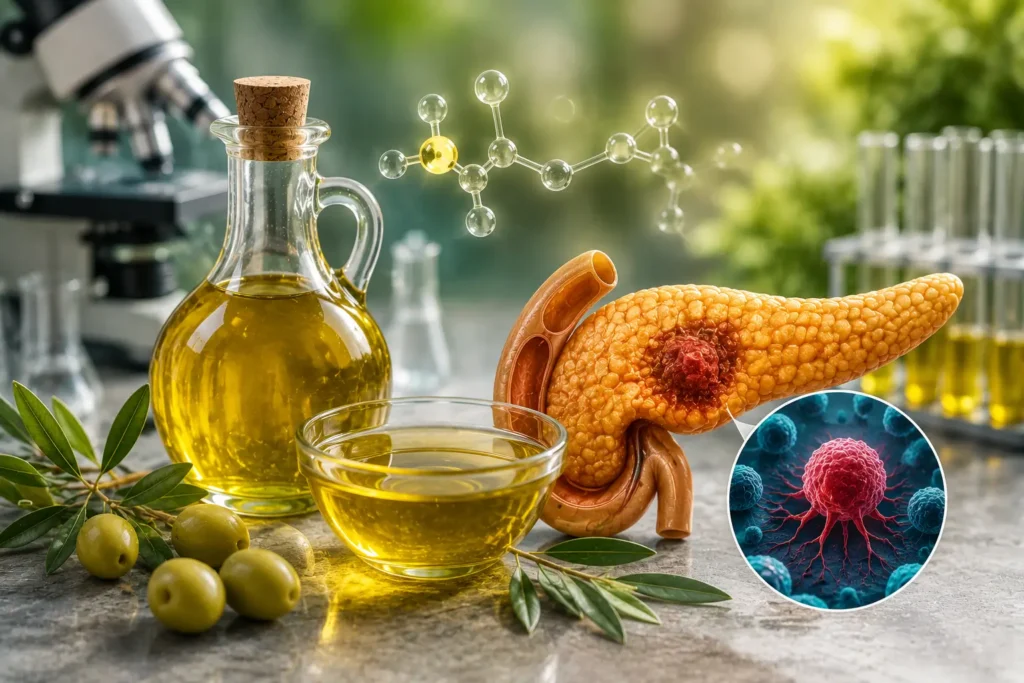
The biological explanation involves a cellular process called ferroptosis — a form of programmed cell death triggered by lipid oxidation. Here is why it matters for cancer:
- When dietary fats are absorbed, they become incorporated into cell membranes throughout the body, including pancreatic cells.
- Polyunsaturated fats (PUFAs) — like omega-3s — make cell membranes chemically more vulnerable to oxidation. This oxidation triggers ferroptosis, essentially forcing damaged and cancerous cells to self-destruct.
- Monounsaturated fats (MUFAs) — like oleic acid — do the opposite. They make cell membranes more resistant to oxidation, which means cancer cells effectively wrap themselves in a protective shield that blocks ferroptosis.
“Monounsaturated fats really protect the cancer cells from lipid oxidation,” Dr. Ruiz noted. “Because oxidation is reduced, they’re less likely to undergo ferroptosis.” In other words, a diet heavy in oleic acid may be making your pancreatic cells more cancer-resistant to natural death — the exact opposite of what you want.
Is Olive Oil Bad for Pancreatic Cancer Patients?
This is the question millions of Americans are asking right now — and the honest answer is: it is complicated, and the science is not yet definitive for humans.
Here is what the researchers themselves say:
- This study was conducted in mice, not humans. The mouse model closely mimics human PDAC, but human metabolism, diet patterns, and cancer biology are considerably more complex.
- The UK Biobank human data supports the pattern — but it is observational evidence, not a clinical trial.
- Dr. Ruiz’s team explicitly states it is “too early to make firm dietary recommendations” based on this research alone.
- Pancreatic cancer has multiple risk factors — genetics, smoking, obesity, diabetes, age — and diet is just one piece of a very complex puzzle.
That said, is olive oil bad for pancreatic cancer patients? If you or a family member has already been diagnosed with pancreatic cancer or carries known PDAC risk factors, this research is worth discussing with your oncologist. It would be premature — and irresponsible — to ignore it entirely.
What Fats to Avoid Pancreatic Cancer Diet 2026 Guide
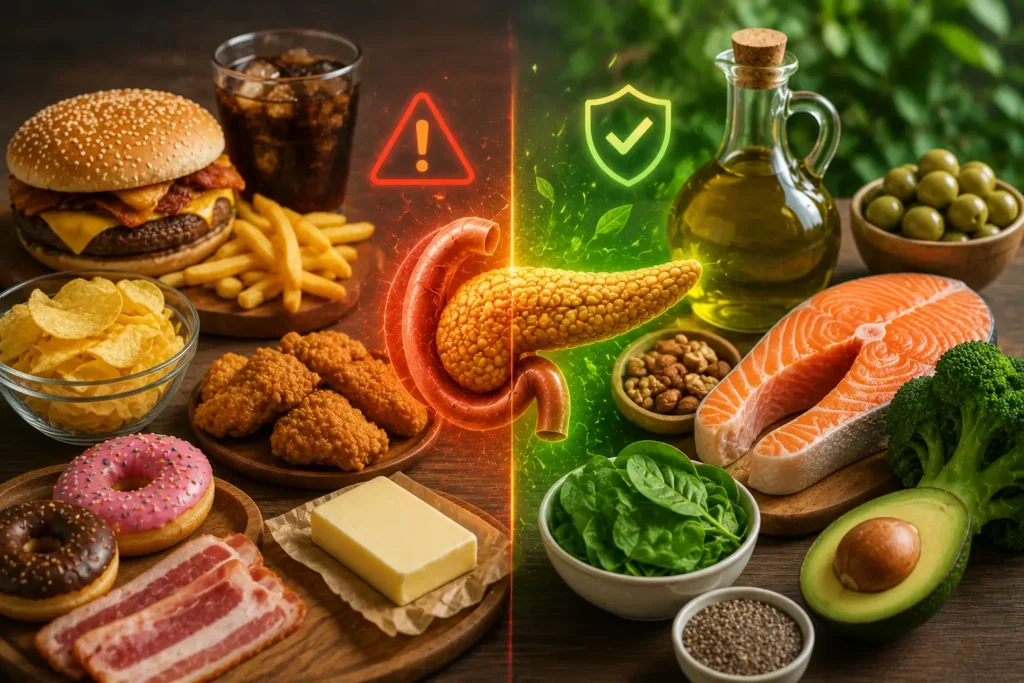
Based on the Yale findings and supporting data, here is a practical what fats to avoid pancreatic cancer diet 2026 guide for health-conscious Americans:
Fats to approach with caution (high in oleic acid / MUFAs):
- Extra virgin olive oil and regular olive oil
- High-oleic safflower oil
- High-oleic sunflower oil
- Peanut oil and peanuts
- Lard
- Avocado oil (also high in oleic acid)
Fats associated with protective effects (high in omega-3 PUFAs):
- Fish oil supplements (EPA and DHA)
- Fatty fish: salmon, sardines, mackerel, herring, anchovies
- Flaxseed and flaxseed oil (ALA omega-3)
- Chia seeds
- Walnuts
Important context for your diet decisions:
- This does not mean Olive Oil Pancreatic Cancer Risk Oleic Acid causes pancreatic cancer in healthy people. The study used mice with an active cancer-driving genetic mutation.
- The research suggests that shifting the ratio of MUFAs to PUFAs in your diet may matter — not cutting all healthy fats entirely.
- A diet already rich in omega-3 fatty acids from whole fish and seeds may offer a meaningful layer of protection, based on current evidence.
- Always consult a registered dietitian or oncologist before making major dietary changes, especially if you have a personal or family history of pancreatic cancer.
Why Pancreatic Cancer Makes This Research So Important
The stakes here are enormous. Only about 13% of patients diagnosed with PDAC survive five years. More than 65,000 people are expected to be diagnosed with PDAC in the U.S. this year, with over 50,000 deaths. Effective treatment options remain critically limited — making prevention the single most powerful tool available.
Researchers now plan to study whether changing dietary fat composition could help patients with existing tumors and whether the balance of MUFAs to PUFAs in blood could eventually serve as an early warning sign for pancreatic cancer risk. That means a simple blood test checking your fat ratios may one day help doctors identify who is at elevated risk — years before a tumor develops.
The Bottom Line: What Should You Actually Do?
Here is a grounded, practical takeaway from this landmark 2026 research:
- Do not panic about olive oil. One study in mice is not grounds for eliminating a food with decades of cardiovascular health evidence behind it.
- Do increase your omega-3 intake. The evidence for omega-3 fatty acids being protective across multiple cancers — including pancreatic — is growing consistently. Aim for at least 2–3 servings of fatty fish per week.
- Talk to your doctor if you have a family history of pancreatic cancer, carry KRAS gene mutations, or have risk factors like chronic pancreatitis or type 2 diabetes.
- Watch this space. Human clinical trials on dietary fat ratios and PDAC are expected to follow. This study opens a door — it does not close one.