
Why Thyroid Problems in Women Health Crisis Nobody Talks About
Here is a statistic that will genuinely shock you: Women are 5 to 8 times more likely to develop thyroid disorders than men. In India alone, an estimated 42 million people suffer from Thyroid Disease Diagnosed — and the overwhelming majority of them are women.
Yet thyroid problems remain one of the most under-diagnosed and misunderstood health conditions in the country. thyroid symptoms in women are routinely dismissed as “just stress” or “normal aging.” Women spend years — sometimes decades — feeling unwell without a proper diagnosis, simply because nobody thought to check their thyroid.
This ends today. In this article, we’re going to break down everything you need to know about thyroid problems in women — the symptoms, the root causes, and most importantly, the Thyroid Problems Natural Solutions that can genuinely make a difference.
What Is the Thyroid and Why Does It Matter So Much?
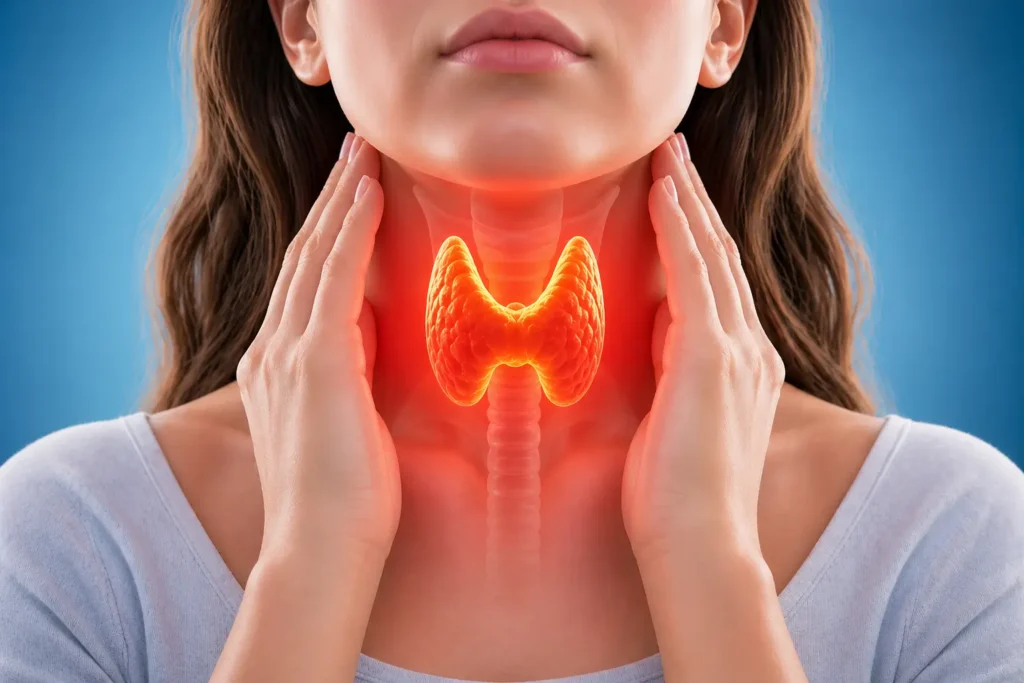
The thyroid is a small, butterfly-shaped gland located at the base of your neck. Despite its tiny size, it controls an enormous amount of your body’s day-to-day functioning. Think of it as the master regulator of your metabolism.
The thyroid produces two key hormones — T3 (triiodothyronine) and T4 (thyroxine) — which travel through the bloodstream and affect virtually every cell in your body. These hormones regulate:
- Metabolism — how fast or slow your body burns energy
- Body temperature — why you always feel cold or too hot
- Heart rate — the pace at which your heart beats
- Mood and brain function — focus, memory, and emotional balance
- Digestive speed — constipation or loose motions
- Menstrual cycle — regularity, flow, and fertility
- Weight — gaining or losing without explanation
- Hair and skin health — dryness, thinning, or brittleness
When the thyroid doesn’t work properly, everything goes out of balance — and the effects ripple across your entire body.
The Two Main Types of Thyroid Problems in Women

1. Hypothyroidism (Underactive Thyroid)
This is by far the most common thyroid problem in Indian women. In hypothyroidism, the thyroid gland does not produce enough hormones, causing the body’s metabolism to slow down dramatically.
Hypothyroidism Symptoms in Women:
- Persistent fatigue and sluggishness, even after adequate rest
- Unexplained weight gain despite normal eating
- Feeling cold all the time, even in warm weather
- Dry, rough, or pale skin
- Brittle nails and excessive hair loss
- Constipation and bloating
- Puffy face, especially around the eyes
- Heavy, irregular, or painful periods
- Depression, low mood, and brain fog
- Difficulty concentrating or remembering things
- Muscle weakness and joint pain
- Slowed heart rate
The most common cause of hypothyroidism worldwide is Hashimoto’s Thyroiditis — an autoimmune condition where the body’s immune system mistakenly attacks the thyroid gland.
Read More:- Alzheimers Blood Test: What to Know Before Symptoms Appear
2. Hyperthyroidism (Overactive Thyroid)
In hyperthyroidism, the thyroid produces too much hormone, causing the body’s metabolism to race out of control.
Hyperthyroidism Symptoms in Women:
- Unexplained weight loss despite eating normally or more
- Rapid or irregular heartbeat (palpitations)
- Nervousness, anxiety, and irritability
- Excessive sweating and heat intolerance
- Trembling hands and fingers
- Frequent bowel movements or diarrhea
- Enlarged thyroid gland (visible swelling in the neck — called a goitre)
- Light or missed periods
- Difficulty sleeping
- Bulging eyes (in Graves’ disease)
The most common cause of hyperthyroidism is Graves’ Disease — another autoimmune condition — where the immune system overstimulates the thyroid into producing excess hormones.
Why Are Women So Much More Vulnerable?
This is a question worth understanding deeply — because the answer has direct implications for how you protect yourself.
Hormonal Fluctuations Across Life Stages
Women go through dramatic hormonal shifts throughout their lives — puberty, pregnancy, postpartum, perimenopause, and menopause. Each of these transitions creates a window of vulnerability for thyroid disruption. In fact, postpartum thyroiditis — thyroid inflammation after childbirth — affects approximately 5-10% of new mothers.
Autoimmune Susceptibility
The thyroid conditions most common in women (Hashimoto’s and Graves’ Disease) are autoimmune in nature. Women are inherently more susceptible to autoimmune conditions — their immune systems are naturally more active, which is protective in many ways but can also lead to the immune system turning on the body’s own tissues.
Estrogen-Thyroid Interaction
Estrogen and thyroid hormones are deeply interconnected. Fluctuations in estrogen levels — during menstrual cycles, pregnancy, or menopause — can directly interfere with thyroid hormone production and absorption.
Iodine Deficiency
India has a historically high rate of iodine deficiency — especially in inland states like Madhya Pradesh, Uttar Pradesh, and Bihar — and iodine is the single most critical nutrient the thyroid needs to produce its hormones.
Chronic Stress and Cortisol
Chronic psychological stress raises cortisol levels, which directly suppresses thyroid hormone conversion in the body. Given the enormous pressures Indian women face — managing careers, families, and social expectations simultaneously — it is no surprise that stress-linked thyroid issues are on the rise.
How Is Thyroid Disease Diagnosed?
If you suspect a thyroid problem, here is exactly what to ask your doctor for:
Step 1 — TSH Test (Thyroid Stimulating Hormone) This is the gold standard screening test. TSH is produced by the pituitary gland to signal the thyroid to produce more or less hormone.
- Normal TSH range: 0.4 to 4.0 mIU/L
- High TSH = Hypothyroidism (thyroid not producing enough)
- Low TSH = Hyperthyroidism (thyroid overproducing)
Step 2 — Free T3 and Free T4 Tests These measure the actual thyroid hormones circulating in your blood, giving a more complete picture.
Step 3 — Thyroid Antibody Tests TPO antibodies (anti-TPO) and TgAb antibodies confirm autoimmune tThyroid Disease Diagnosed — Hashimoto’s or Graves’.
Step 4 — Thyroid Ultrasound To check for nodules, swelling, or structural abnormalities in the gland itself.
One critical note: Always ask for a full thyroid panel, not just TSH. Many women have TSH within the “normal” range but still have symptoms — because their Free T3 conversion is impaired. A good doctor looks at the complete picture.
Thyroid Problems Natural Solutions That Actually Work

While medical treatment (such as levothyroxine for hypothyroidism) is sometimes necessary and should never be replaced without a doctor’s guidance, there is strong scientific evidence that natural lifestyle interventions can significantly improve Thyroid Problems function — and in early-stage cases, even reverse the condition.
1. Eat for Your Thyroid
Foods to ADD:
- Iodine-rich foods: Iodized salt, seaweed, fish, dairy, eggs
- Selenium-rich foods: Brazil nuts (just 2 per day!), sunflower seeds, brown rice, mushrooms — selenium is essential for converting T4 to the active T3 hormone
- Zinc-rich foods: Pumpkin seeds, chickpeas, lentils, cashews
- Anti-inflammatory foods: Turmeric, ginger, berries, leafy greens, omega-3 fatty acids from walnuts and flaxseed
Foods to REDUCE or AVOID:
- Gluten — strongly linked to Hashimoto’s flare-ups in many women
- Soy products — can interfere with thyroid hormone absorption when eaten in excess
- Raw cruciferous vegetables (cabbage, broccoli, cauliflower) — eat cooked, not raw, as raw forms contain goitrogens that can suppress thyroid function
- Processed sugar and refined carbohydrates — worsen inflammation and insulin resistance, both of which impair thyroid function
- Fluoride and chlorine in tap water — use a water filter where possible
2. Prioritize Sleep Like Your Health Depends on It (Because It Does)
The thyroid does most of its hormone regulation during deep sleep. Women who consistently sleep fewer than 6-7 hours show measurably higher TSH levels and lower T3 conversion rates. Set a sleep schedule, reduce screen time after 9 PM, and treat sleep as medicine — not a luxury.
3. Manage Stress With Specific Practices
General “stress less” advice is useless. Here is what actually works for thyroid health:
- Yoga: Studies show that regular yoga practice — particularly forward bends, shoulder stands (Sarvangasana), and the fish pose (Matsyasana) — directly stimulate thyroid circulation
- Pranayama: Ujjayi breathing and Bhramari pranayama calm the HPA (hypothalamic-pituitary-adrenal) axis, reducing cortisol’s suppressive effect on the thyroid
- Ashwagandha: This Ayurvedic adaptogen has shown in clinical studies to significantly increase T3 and T4 levels in subclinical hypothyroid patients. Consult your doctor before starting.
- Journaling and digital detox — chronic low-grade anxiety from social media and information overload is a real Thyroid Problems in Women disruptor
4. Exercise — But Not Too Much
Moderate, consistent exercise improves thyroid sensitivity and metabolic function. Brisk walking, swimming, cycling, or yoga for 30 to 45 minutes daily is ideal for thyroid patients.
Warning: Over-exercising, particularly intense cardio for extended periods, can RAISE cortisol and suppress Thyroid Problems function. More is not always better.
5. Check Your Nutrient Levels Regularly
Many Indian women are deficient in:
- Vitamin D — deficiency is directly linked to Hashimoto’s severity
- Vitamin B12 — often low in vegetarians and linked to fatigue that worsensthyroid symptoms in women
- Magnesium — essential for over 300 enzymatic reactions including thyroid hormone regulation
- Iron — iron deficiency anemia impairs the enzyme (thyroid peroxidase) needed to make thyroid hormones
Get these tested annually. Supplement under medical guidance when needed.
The Connection Between Thyroid Health and Fertility
This is a topic every woman of reproductive age needs to understand. Thyroid hormones play a direct role in regulating ovulation, implantation, and early pregnancy. Untreated hypothyroidism is one of the leading — and most overlooked — causes of:
- Irregular or absent periods
- Difficulty conceiving
- Recurrent miscarriages
- Premature birth and low birth weight
If you have been struggling to conceive, always ask your doctor to check your thyroid first. A simple TSH test and the right treatment could make all the difference.
Warning Signs You Should Never Ignore
Please consult a doctor without delay if you notice:
- A visible lump or swelling at the base of your neck
- Sudden, unexplained weight change (gain or loss)
- Heart palpitations or racing heartbeat
- Complete loss of energy lasting more than two weeks
- Hair falling out in large amounts
- Extreme sensitivity to cold or heat
- Periods that have completely stopped (without pregnancy)
Final Thoughts: Your Thyroid Is Not the Enemy
Thyroid problems feel overwhelming — especially when you have been suffering without a diagnosis for months or years. But here is the truth: thyroid disease is one of the most manageable and treatable chronic conditions that exists today.
With the right diagnosis, the right nutrition, consistent lifestyle habits, and good medical support, millions of women are living full, energetic, healthy lives with Thyroid Problems conditions.
You deserve to feel well. You deserve energy, clarity, and balance. And it starts with taking your symptoms seriously — not dismissing them, not waiting, not accepting “normal results” when your body is clearly telling you otherwise.
Listen to your body. Get tested. And take back control.
Read More: PCOD vs PCOS: What Every Woman Should Know