
Introduction: PCOD vs PCOS
What Is PCOD? (Polycystic Ovarian Disease)
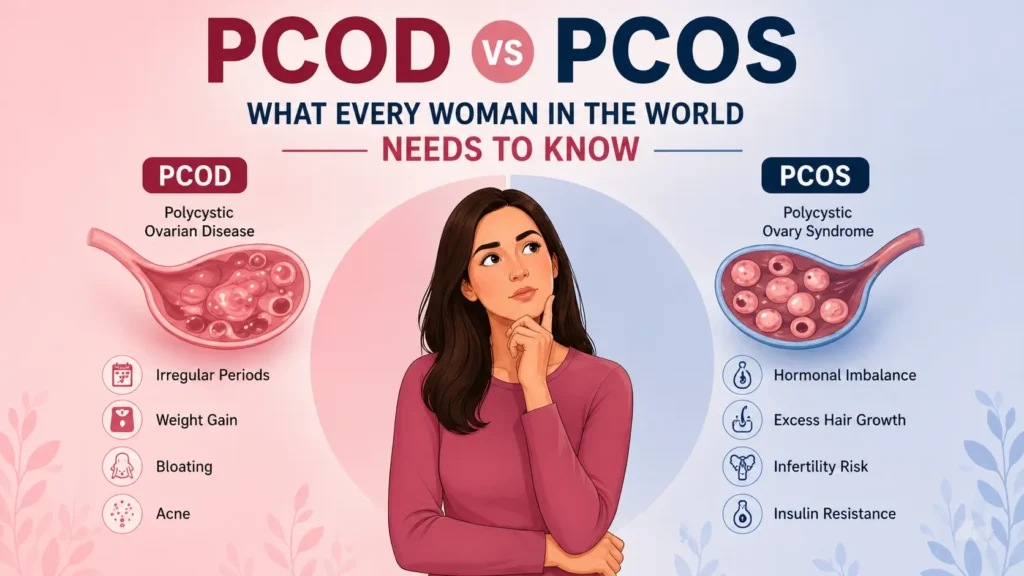
The disorder known as PCOD, or polycystic ovarian disease, causes the ovaries to generate a lot of immature or partially developed eggs. These eggs eventually develop into tiny cysts inside the ovaries, which causes the ovaries to swell and release more androgens, or male hormones, which triggers a series of symptoms.
The main causes of PCOD are hormonal and lifestyle factors. The good news? Compared to PCOS, it is substantially more prevalent and much easier to treat.
Common PCOD symptoms:
- Irregular or delayed periods
- Mild weight gain, especially around the abdomen
- Bloating and water retention
- Acne and oily skin
- Hair thinning or mild hair loss
- Mild mood swings and fatigue
PCOD does not typically affect a woman’s ability to conceive. With the right diet, exercise, and medical support, most women with PCOD can get pregnant naturally and lead completely normal lives.
What Is PCOS? (Polycystic Ovary Syndrome)
Polycystic Ovary Syndrome, or PCOS, is a much more dangerous endocrine and metabolic condition. The ovaries are not the only issue. The entire hormonal system of the body is impacted by PCOS, including the pituitary gland, adrenal glands, and insulin regulation.
The body creates excessively high amounts of androgens, or male hormones, in PCOS, which throws off the entire ovulation cycle. It is much more difficult for women with PCOS to conceive without medical assistance because they frequently ovulate very seldom or not at all.
PCOS symptoms:
- Absent or very infrequent periods (fewer than 8 per year)
- Severe acne across the face, chest, and back
- Significant, unexplained weight gain
- Hirsutism — heavy facial hair growth on chin, upper lip, and jaw
- Severe hair loss / male-pattern baldness
- Darkening of skin around the neck, underarms, and groin (Acanthosis Nigricans)
- Insulin resistance and high blood sugar levels
- Difficulty conceiving
- Higher risk of depression and anxiety
PCOS is a lifelong condition that requires consistent medical management. Left untreated, it significantly raises the risk of Type 2 diabetes, cardiovascular disease, endometrial cancer, and infertility.
The Shocking Reality: How Common Is This in the World ?

This statistic should stop you in your tracks: 1 in 5 women worldwide suffer from PCOD vs PCOS. That amounts to about 100 million women, many of whom are unaware that they have it.
Period irregularities are attributed to “stress.” Food is blamed for unexplained weight gain. It is assumed that having too much facial hair is inherited. And acne?People say, “It’s just hormones,” without comprehending that, yes, it is hormones, and that hormones are giving out a very precise warning signal that your body is urgently trying to get through to you.
PCOS and PCOD are two different conditions. These phrases are not synonymous. And one of the most crucial things you can do for your long-term health may be to recognize the difference.
Read More: Alzheimers Blood Test: What to Know Before Symptoms Appear
PCOD vs PCOS: The Key Differences at a Glance
| Feature | PCOD | PCOS |
|---|---|---|
| Full Form | Polycystic Ovarian Disease | Polycystic Ovary Syndrome |
| Nature | Lifestyle/hormonal disorder | Metabolic + endocrine disorder |
| How Common | Very common | Less common but more serious |
| Ovulation | Irregular but present | Often completely absent |
| Fertility Impact | Mild — can conceive naturally | Significant — may need IVF/IUI |
| Insulin Resistance | Rare | Very common |
| Long-term Risks | Manageable | Diabetes, heart disease, cancer risk |
| Reversible? | Yes, with lifestyle changes | Manageable but not fully reversible |
Why Are There So Many Women in the World? Having PCOD vs PCOS?
The majority of doctors don’t spend enough time responding to this question. It is not coincidental that PCOD and PCOS rates are rising globally, particularly among women between the ages of 15 and 35. This epidemic is being driven by a number of variables that are specific to the world:
1. Diet High in Refined Carbohydrates
The typical global diet is full of high-glycemic foods that raise insulin levels, such as white rice, rotis made from maida, cookies, packaged snacks, and sugary tea. One of the main causes of PCOD vs PCOS is persistent insulin surges.
2. Sedentary Lifestyle
Physical activity has drastically decreased due to the development of desk occupations, long commutes, and screen-based entertainment, particularly among metropolitan women worldwide. Hormonal imbalance is directly made worse by a sedentary lifestyle.
3. Chronic Stress
A chronic stress epidemic has been brought on by the fast-paced metropolitan lifestyle, work pressure, family expectations, and social media comparison culture. Progesterone and estrogen equilibrium are directly upset by high cortisol levels brought on by prolonged stress.
4. Late Nights and Poor Sleep
Sleep deprivation is now scientifically linked to hormonal disruption. Research consistently shows that women who sleep less than 6 hours per night have significantly higher rates of menstrual irregularity.
5. Environmental Factors
Hormonal abnormalities in women worldwide are increasingly associated with exposure to endocrine-disrupting chemicals, which can be found in plastic containers, processed food, pesticides, and even some cosmetics.
How Is PCOD vs PCOS Diagnosed?
If you suspect you have PCOD vs PCOS, here is what your doctor will typically check:
Step 1 — Medical History Your doctor will ask about your menstrual cycle history, weight changes, skin and hair changes, and family history of diabetes or hormonal disorders.
Step 2 — Physical Examination Checking for signs of excess androgen — facial hair, acne, skin darkening, and body weight distribution.
Step 3 — Blood Tests
- Hormone panel: LH, FSH, Testosterone, Prolactin, TSH
- Fasting blood sugar and insulin levels
- Lipid profile
Step 4 — Pelvic Ultrasound An ultrasound will show the ovaries. If 12 or more follicles (small cysts) are visible in each ovary, it is a strong indicator of PCOD vs PCOS. In PCOS, the ovaries also tend to be enlarged.
A diagnosis of PCOS is typically made using the Rotterdam Criteria, which requires at least 2 of the following 3 conditions to be present:
- Irregular or absent ovulation
- Clinical or biochemical signs of excess androgens
- Polycystic ovaries on ultrasound
PCOD vs PCOS treatment Options: What Actually Works

For PCOD:
PCOD is largely reversible with consistent lifestyle changes. Most women see dramatic improvement within 3 to 6 months of:
- Diet overhaul: Switching to a low-GI diet rich in whole grains, vegetables, lean protein, and healthy fats. Reducing sugar, maida, and processed foods.
- Regular exercise: Even 30 minutes of brisk walking daily can significantly improve insulin sensitivity and hormone balance.
- Stress management: Yoga, meditation, and adequate sleep (7-9 hours) are non-negotiable.
- Weight loss: Losing just 5-10% of body weight can restore regular periods in many PCOD cases.
- Medication (if needed): Your doctor may prescribe oral contraceptive pills to regulate cycles, or metformin if insulin resistance is detected.
For PCOS:
PCOS requires a more structured, long-term management plan:
- Metformin: frequently recommended to increase insulin sensitivity, which is a key component of PCOS treatment worldwide.
- Hormonal therapy: Birth control pills to regulate periods and reduce androgen levels.
- Clomiphene or Letrozole: Prescribed when fertility is the goal — these medications stimulate ovulation.
- Anti-androgen medications: To control excess facial hair and acne (e.g., Spironolactone).
- IVF or IUI: For women with PCOS who do not respond to oral fertility medications.
- Lifestyle changes: Identical to PCOD — diet, exercise, sleep, and stress management are absolutely essential.
Can You Get Pregnant With PCOD vs PCOS?
This is the question most women are most afraid to ask — and the answer is more hopeful than you might think.
With PCOD: Yes, most women with PCOD can conceive naturally. Since ovulation still occurs (even if irregularly), timed intercourse combined with lifestyle changes and mild medication is often enough.
With PCOS: It is more challenging but absolutely possible. Many women with PCOS conceive with the help of ovulation-inducing medications. IVF and IUI have very good success rates for PCOS patients today. Modern reproductive medicine has made motherhood a real possibility for the vast majority of women with PCOS.
The key is early diagnosis and consistent management. The longer PCOS goes unmanaged, the harder fertility treatment becomes.
Warning Signs You Should NEVER Ignore
See a gynecologist immediately if you experience:
- Periods that are more than 35 days apart — consistently
- No period for 3 or more consecutive months (and you are not pregnant)
- Heavy, painful periods that disrupt daily life
- Sudden, rapid weight gain with no dietary change
- Thick, dark hair growing on your face, chest, or back
- Skin patches that are darkening around your neck or armpits
- Difficulty conceiving after 6-12 months of trying
Final Thoughts: Knowledge Is Your Greatest Power
PCOD vs PCOS are not a death sentence. They are not your fault. And they are absolutely not something you should silently suffer through because “every woman deals with irregular periods.”
The topic of women’s hormonal health still receives far too little attention worldwide. Many women go years or even decades without receiving a thorough diagnosis since periods are forbidden to discuss at the dinner table.
That ends with awareness.
If something feels off with your body — trust that feeling. Get tested. Get informed. And get the support you deserve. Whether it is PCOD vs PCOS, with the right knowledge, the right doctor, and the right lifestyle — you can take full control of your health.
Read More: Women ADHD Diagnosis: Why It Often Comes Years Later Than Men