
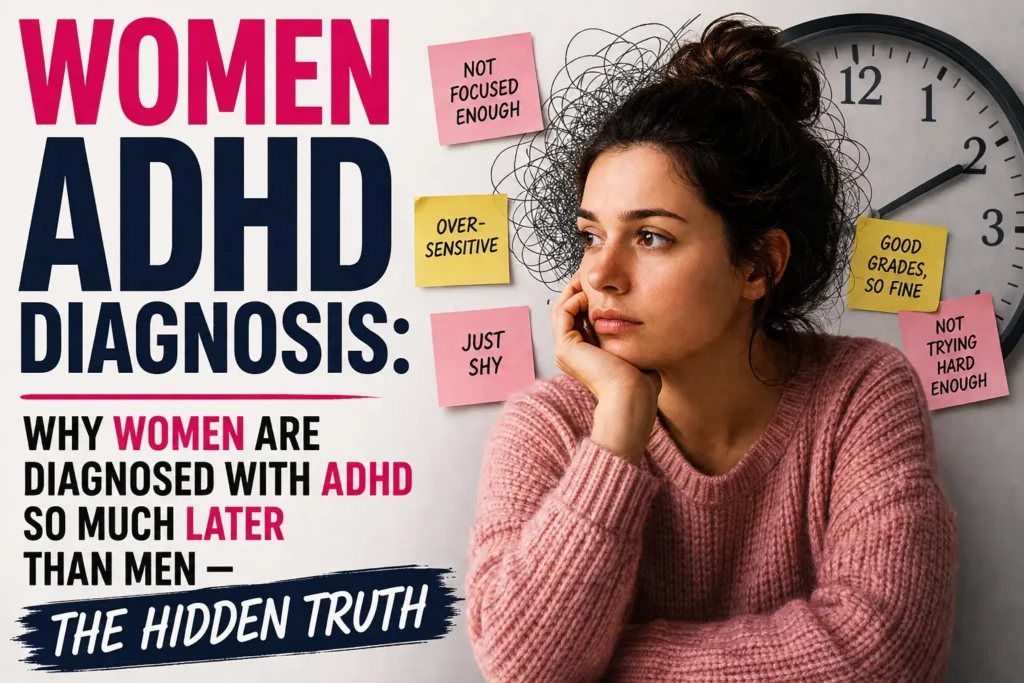
Women ADHD Diagnosis
Imagine spending your entire childhood being called “daydreamer,” “too sensitive,” or “just not trying hard enough.” Imagine struggling in silence for decades — battling anxiety, depression, and a constant feeling that something is fundamentally wrong with you — only to finally receive an ADHD diagnosis at the age of 35. For millions of women around the world, this is not a hypothetical. This is their reality.
The question is: Why? Why are women with ADHD so consistently missed, dismissed, and diagnosed years — sometimes decades — after their male counterparts?
The Shocking Numbers You Need to Know
Before we get into the “why,” let’s look at the data — because the numbers alone tell a disturbing story.
- Boys are twice as likely to be diagnosed with ADHD as girls during childhood.
- A landmark 2025 study presented at the European College of Neuropsychopharmacology Congress in Amsterdam, analyzing 900 adults, found that women with ADHD receive their diagnosis approximately 5 years later than men — despite showing symptoms at the exact same age.
- By adulthood, the male-to-female ratio in ADHD diagnoses narrows to nearly 2:1 or even 1:1, suggesting the condition is just as common in women — it’s just being caught far too late.
- A 2026 study from Cardiff University, published in the British Journal of Psychiatry, found that girls who received a late Women ADHD diagnosis were significantly more likely to experience depression, self-harm, teenage pregnancy, school absences, and repeated hospital visits compared to those diagnosed earlier.
These are not small statistics. They represent real lives being derailed by a systemic failure in how we understand and diagnose ADHD in women.
ADHD in Women Looks Completely Different
This is perhaps the most fundamental reason for the diagnosis gap, and it starts with a simple biological truth: ADHD does not present the same way in females as it does in males.
The “classic” image of ADHD — the hyperactive, disruptive boy who can’t sit still in class, talks over everyone, and bounces off walls — is almost entirely male-coded. And that’s because the original research and diagnostic criteria for ADHD were built almost exclusively on studies of boys.
Girls and women with ADHD are far more likely to exhibit inattentive symptoms rather than hyperactive ones. These include:
- Daydreaming frequently and losing track of time
- Difficulty organizing tasks and following through on commitments
- Forgetting important dates, appointments, and conversations
- Struggling with emotional regulation — feeling things intensely
- Chronic self-doubt and low self-esteem
- Difficulty concentrating, especially in quiet or unstimulating environments
These symptoms are quiet. They are internal. They do not disrupt the classroom. And so they are missed — by teachers, by parents, and by doctors.
As research published in The Lancet Psychiatry notes, females are more likely to present with inattentive ADHD symptoms that are less visible to others, making them far easier to overlook.
Read More:- https://vitalmindflow.com/biohacking-in-2026-sleep-science-ai-health/
Girls Are Better at Masking
There is a concept in neurodevelopmental research called “masking” — the act of consciously or unconsciously hiding or compensating for symptoms in order to fit in socially. And girls are significantly better at it than boys.
From a very young age, girls are socialized to be quiet, compliant, and socially perceptive. When a girl struggles to pay attention in class, she learns to compensate — she works harder, stays up later to finish homework, watches how other girls behave and mimics them, develops elaborate coping strategies.
To the outside world, she seems fine. She might even seem like a high achiever. Internally, however, she is exhausting herself every single day just to appear “normal.”
This masking is incredibly effective at hiding ADHD symptoms — so effective that it fools everyone, including medical professionals. And by the time the coping mechanisms collapse — often during major life transitions like university, a new job, or becoming a mother — the woman is already in her 20s, 30s, or beyond.
Diagnostic Criteria Were Built for Boys

Let’s be honest about medical history: ADHD was discovered, studied, and defined using male subjects. The diagnostic criteria in the DSM (Diagnostic and Statistical Manual of Mental Disorders) were shaped by decades of research that largely excluded or underrepresented girls.
This means that the very tools used to identify ADHD are calibrated for male presentations. When a woman sits across from a clinician and describes her symptoms — difficulty focusing, emotional overwhelm, chronic disorganization — those symptoms may not “look” like textbook ADHD. And so the clinician reaches for a different diagnosis.
Research confirms this. Studies have shown that clinicians are demonstrably less likely to consider ADHD when evaluating female patients, even when the symptom profiles are identical. One study found that professionals shown identical case studies were less likely to diagnose ADHD in a girl than in a boy with the same symptoms.
This is diagnostic bias. And it has real consequences.
ADHD Symptoms in Women Are Misdiagnosed as Something Else
When women with ADHD finally do seek help, they are far more likely to be told they have:
- Anxiety
- Depression
- Borderline Personality Disorder
- Bipolar Disorder
- Chronic fatigue
And here’s the truly tragic part — many of them do have these conditions. But they have them because untreated ADHD has worn them down over years of struggling without support.
According to research published in ScienceDaily (2026), women with late ADHD diagnoses show significantly higher rates of depression and anxiety compared to men diagnosed at the same age. The women mental health fallout of missed ADHD in women is severe — and it compounds with every passing year of no treatment.
The conditions born from untreated ADHD then become the focus of treatment, while the underlying ADHD continues to go unrecognized. It’s a devastating cycle.
Hormones Make It Even More Complicated
Here’s something that almost never gets discussed in mainstream conversations about ADHD: female hormones directly affect ADHD symptoms.
Estrogen plays a significant role in regulating dopamine — the neurotransmitter that is central to ADHD. As estrogen levels fluctuate throughout a woman’s life — during puberty, the menstrual cycle, pregnancy, perimenopause, and menopause — ADHD symptoms can dramatically intensify.
Many women report that their ADHD symptoms spike significantly during the week before their period, during postpartum recovery, or at the onset of perimenopause. These fluctuations can make symptoms appear inconsistent, which further confuses clinicians and contributes to misdiagnosis.
This hormonal dimension of female ADHD is a massive, largely under-researched area of medicine — one that urgently needs more scientific attention.
The Real-World Consequences of Late Diagnosis
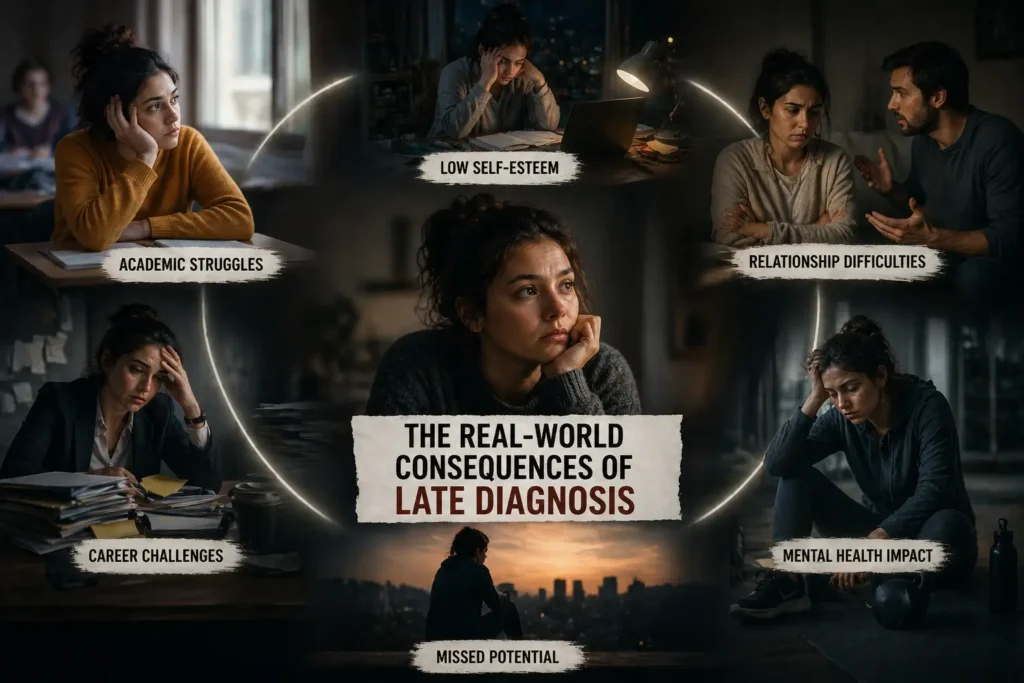
A late Women ADHD diagnosis is not just an inconvenience. For women, it carries a heavy price:
- Years of unnecessary suffering — struggling with symptoms that could have been managed with proper support
- Mental health consequences — higher rates of depression, ADHD and anxiety women, self-harm, and burnout
- Academic and career setbacks — unrealized potential due to unmanaged attention difficulties
- Relationship difficulties — emotional dysregulation and communication challenges straining personal relationships
- Financial instability — difficulty maintaining jobs or managing money
- Loss of identity — years spent believing you are lazy, stupid, or broken, when you were simply undiagnosed
The Cardiff University study (2026) was particularly stark in its findings: girls with later ADHD diagnoses faced far greater rates of mental health struggles during adolescence, highlighting exactly how much damage accumulates during the diagnostic gap.
What Needs to Change — Right Now
The ADHD diagnosis gap is not inevitable. It is fixable. Here is what experts are calling for:
1. Update Diagnostic Tools
Current diagnostic criteria need to be revised to reflect female presentations of ADHD — inattentive symptoms, emotional dysregulation, and internal hyperactivity rather than external disruptive behavior.
2. Train Clinicians on Gender Differences
Healthcare providers at every level need training on how ADHD presents differently across genders. Diagnostic bias is a trained behavior — and it can be retrained.
3. Raise Public Awareness
Women who recognize themselves in the symptoms of ADHD need to feel empowered to seek evaluation. Public awareness campaigns, like this article, play a crucial role in closing the knowledge gap.
4. Research Female-Specific ADHD
More research needs to focus specifically on women and girls — their unique hormonal influences, their masking behaviors, and the long-term outcomes of delayed diagnosis.
5. Listen to Women
Ultimately, the most powerful change is also the simplest: believe women when they describe their struggles. Stop attributing internal chaos to personality flaws. Start asking better questions.
Signs That You Might Have Undiagnosed ADHD
If this article has stirred something in you, here are some common signs of ADHD in adult women that are frequently missed:
- You feel constantly overwhelmed despite being “high-functioning”
- You have been treated for anxiety or depression but it has never quite resolved
- You start many projects but rarely finish them
- You have always felt like you have to work twice as hard as everyone else
- You are highly sensitive to criticism and rejection
- Your mind races constantly, even when you are trying to relax
- You frequently forget conversations, appointments, or where you put things
- You feel like you have a brilliant mind but can’t seem to access it consistently
If these resonate with you, please speak to a healthcare provider. You deserve answers — and support.
Final Thoughts — It Is Never Too Late
If you have spent years wondering what is “wrong” with you — if you have been diagnosed with anxiety, depression, or told you are “too emotional” — and nothing has ever quite explained how you feel inside, please know this:
You are not broken. You may simply be undiagnosed.
ADHD in women is real, it is common, and it is treatable. The diagnosis gap is a failure of the medical system — not a failure of the women it missed. And with growing awareness, better research, and improved clinical tools, that gap is finally beginning to close.
Read More:- https://vitalmindflow.com/