Introduction: AI in Healthcare
There was an instance with my friend a year ago. She got a mammogram done – the type you keep postponing for two years due to life’s busyness. Almost everything was good for her until the artificial intelligence tool detected something really small in the upper-left quadrant during the routine exam. Another exam. Biopsy. Stage one breast cancer. Detected. Treated. She’s perfectly fine now.
“Actually? If it was another day, I would have missed that,” said her doctor. “The AI did not.”
Now, don’t take me wrong. It’s not about trying to scare you or make it sound like AI is something magical. That’s not the case here at all. The reason behind sharing that story is that more and more people have such experiences every single week in different hospitals around the world. Without any publicity or fanfare whatsoever.
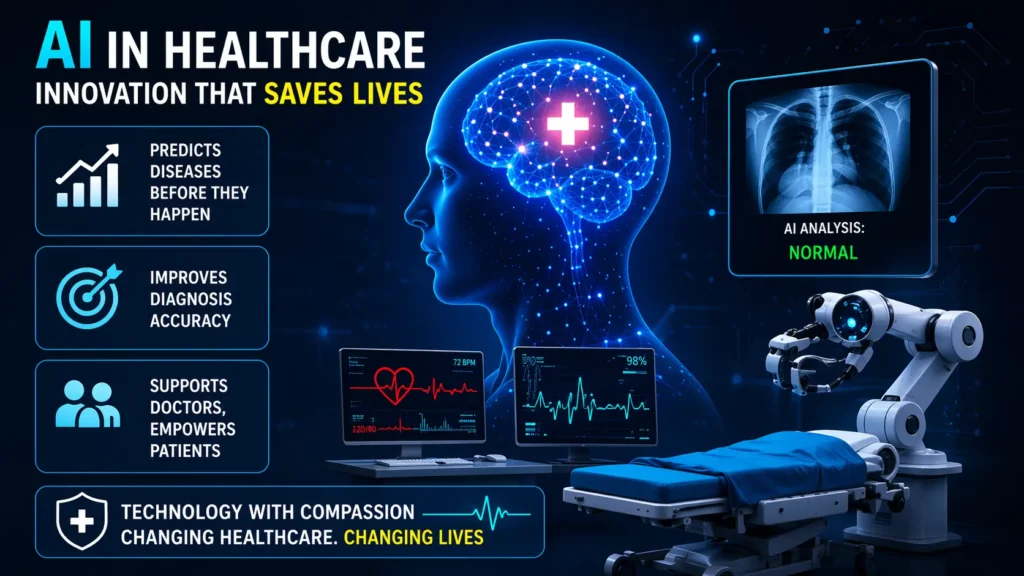
That’s why let’s discuss things honestly, just like we were talking to each other. What does AI do in healthcare? What works well? What doesn’t? Why should you care at all?
40%
Better early cancer detection through AI-based screening
6 hrs
Earlier detection of sepsis using AI technology in ICUs
2M+
Number of patients affected by AI diagnostics 2026 per year
First Things First
When hearing of using artificial intelligence in healthcare, one usually gets an image of a robotic doctor performing a surgery or delivering a deadly diagnosis to a patient with a machine-like voice: “you only have six months to live”. These are typical representations from Hollywood films. The reality, however, looks slightly different and even more fascinating.
Modern artificial intelligence in healthcare doesn’t look fancy at all. In most cases, it performs in the backstage of the application that your doctor uses during his work with patients. It analyzes your scan results in the time between your physician sipping his coffee to analyzing the next patient’s scans.
That’s because of that.
“Before, I would spend three hours analyzing my patients’ CTs before making morning rounds. Since AI joined me, my work became more efficient.” Dr. Sarah Okonkwo, Radiologist, Leeds General Hospital, UK
The Problem with Diagnoses – How AI Is Helping with This Problem
Did You Know?
Up to 12 million people in the United States suffer from diagnostic errors yearly. The cause of those errors is often not incompetence. Often, these issues arise due to exhaustion and impossible workload that doctors experience. AI is not tired.
Here is a piece of truth about medical studies that you might have been told by now: doctors miss things. Not because they are incompetent or make mistakes, but because they are only human. When a radiologist looks through 80 or 100 scans in one day, the probability is high that some details are simply going to be missed. And when a busy ER physician works for eleven hours out of twelve, his or her brain does not work in the same way during the first two hours as it does during the last ones.
Why is it important? In a healthcare industry, missing things can have devastating consequences. Doctors can detect cancer at its early stages when it is easier to treat or fail to do it when it leads to a delay of diagnosis and thus makes the disease harder to manage.
Read More:- https://vitalmindflow.com/mental-health-crisis/
Where AI diagnosis 2026 is already doing its job:
- Breast cancer screenings: The algorithms find cancerous tumors even smaller than 1 mm – the real noise. As shown in clinical trials, AI-assisted readings decrease the risk of missed diagnoses by up to 20%.
- Diabetic retinopathy: One retinal scan performed with the help of AI finds diabetic eye disease long before the symptoms appear. Already implemented in pharmacies and primary care offices.
- Skin cancer detection: AI software for dermatology based on a huge dataset of skin lesions is as efficient in melanoma detection as board-certified doctors. Available as an app for your smartphone.
- Heart disease diagnostics: AI-processed ECG readings discover abnormal heartbeat patterns that can easily be overlooked during conventional analysis. And some of these arrhythmias lead to fatal heart attacks.
- Mental disorder detection: Natural Language Processing-based software detects linguistic markers of depression and suicidality – to
- alert physicians about cases requiring immediate care.
Not a thing that belongs to the future. All of this technology works right now. In hospitals where you’ve definitely heard of.
Drug Discovery: The Hidden Side of the Drug Creation Process
First, I’d like to address this topic because, after reading some information on it, my mind was absolutely blown away.
I believe we all realize how long it takes to develop a new artificial intelligence medicine. In case you don’t know, it takes more than a decade, billions of dollars in funding, and an 88% probability that the process ends with failure without the creation of a drug. Believe me; that’s no joke but the real deal.
The main issue behind such high development costs is due to the drug discovery stage of medication creation, where scientists try to find out if there are any chemical compounds that could potentially work against a disease. It’s basically an endless process of guesswork, trying, failure, repeating again and again.
AI is radically disrupting the whole procedure. And yes, by “radically” I mean just that.
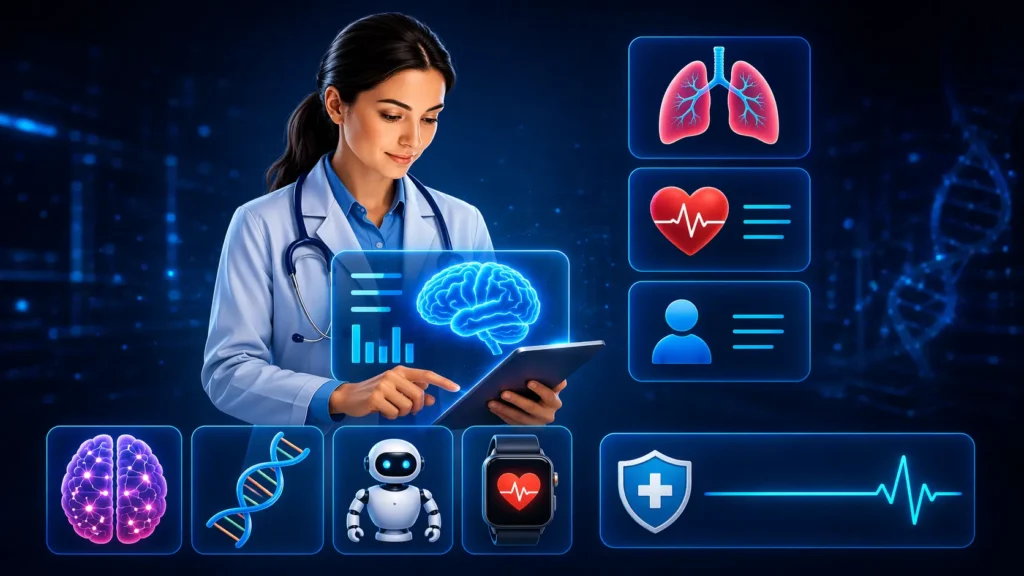
Back in 2020, Google’s artificial intelligence subsidiary DeepMind managed to solve a problem that eluded scientists for half a century – determining the 3D structure of proteins based on amino acid sequences. The implications for the development of drugs against illnesses ranging from Alzheimer’s to Parkinson’s disease and rare forms of cancer are far-reaching, but still very much in its early stages.
Insilico Medicine, for example, has already used AI to move from “we know the target” to “our drug candidate is currently in human trials” in less than 18 months. Now try comparing that to the minimum time of 4-6 years for traditional methods. Yes, that difference should not be overlooked.
Just think about the potential impact on a family affected by a rare genetic condition. On children suffering from leukemias which cannot be cured by the current methods. The difference between the 12 years that would normally pass before receiving a cure and the 18-month period it might take now is staggering.
Emergency Room 3 AM: Where Artificial Intelligence Is the Lifeline
Let me set the scene. It’s 3:15 AM. You are at a busy hospital. You have the night shift, but you are down two nurses. You have 34 patients in the ward. But one of those patients, an older gentleman who had come in with symptoms of a common infection, is getting worse. He is showing signs of distress that are hard to detect.
He is identified by the AI system monitoring his vital signs. A signal is sent to the nursing station. The nurse checks him, calls the on-duty physician. He shows early symptoms of sepsis. He is admitted to ICU before he dies.
This story is being told all around the world. Every year, sepsis claims 11 million lives around the world. Most of those are in well-equipped and well-staffed hospitals of rich nations. Time is very short with sepsis and there’s an ever-decreasing chance to save the victim after every hour wasted. The window of opportunity is now significantly increased by means of an advanced AI technology which saves tens of thousands of people per year.
AI won’t replace nurses. AI won’t replace doctors. What it really does is provides a tool to the tired, overloaded, and dedicated medical professionals which can keep track of everything at once. That is it, that’s all.
Healthcare equity on a global scale: the angle which needs more consideration
This may be difficult to admit, but if you are from a rural village of sub-Saharan Africa or a remote area of central India, there is hardly any specialist that can assist you. The fact is that there aren’t enough specialists. According to WHO statistics, there is a deficit of ten million health workers in the world – and it happens at the point when there are high rates of diseases prevalence.
However, this is the angle in which artificial intelligence may play its role and make the difference – providing people with medical assistance that they don’t have and cannot receive otherwise.
Artificial intelligence applications on basic Android phones in Kenya are being used to diagnose tuberculosis at a rate that is equal to the expert diagnosis — allowing community health workers with little or no training to detect TB patients who would otherwise have gone without diagnosis for months. Artificial intelligence-assisted maternal health initiatives in India are helping to detect high-risk pregnancies in rural regions and providing medical attention before any crises arise.
These are not beta testing trials in technology labs. These are actual applications occurring in the field right now.
Stuff That Just Isn’t Working Yet — Just because we should be honest
Well, let’s face it. Having written about technology for as long as I have, I’ve learned that each hype wave is always followed by some sort of a hangover. And while the use of artificial intelligence medicine isn’t any different in this respect, there really are things that need to be brought up along with all the excitement.
One major concern is that of bias in AI training. It has already been proved time and again that an AI system built mostly on training data coming from people of Western descent will perform worse with patients of other origins. Cardiac care AIs, skin cancer apps, and even predictive models have already exhibited such biases. An algorithm performing wonderfully well in Boston won’t cut it in Lagos. Period.
Over-reliance is always possible. Already there have been incidents of doctors blindly following what the AI says, without challenging conclusions that need to be challenged, simply because “the algorithm said so.” The algorithm does not know everything, and when it is wrong, it could be dead wrong. That poses risks.
The issue of data privacy can get very complex. AI in Healthcare services are powered by patient information – images, records, results. The ownership of this data, its protection, and the monetary gain associated with it is something that needs discussion. Out loud. Not in the fine print we rarely read and seldom pay attention to.
These issues cannot take away from the benefits. However, turning a blind eye to them would be dishonest on my part.
The Takeaway
To wrap it up, here’s something straightforward.
Sometime in your lifetime, or in the life of someone who means a great deal to you, you will find yourself needing medical treatment at its best and most effective. It’s not a negative outlook, but merely a recognition of what it is to be human. And in this case, you will be hoping that all the means, all the resources, and all the benefits will be utilized in your treatment process.
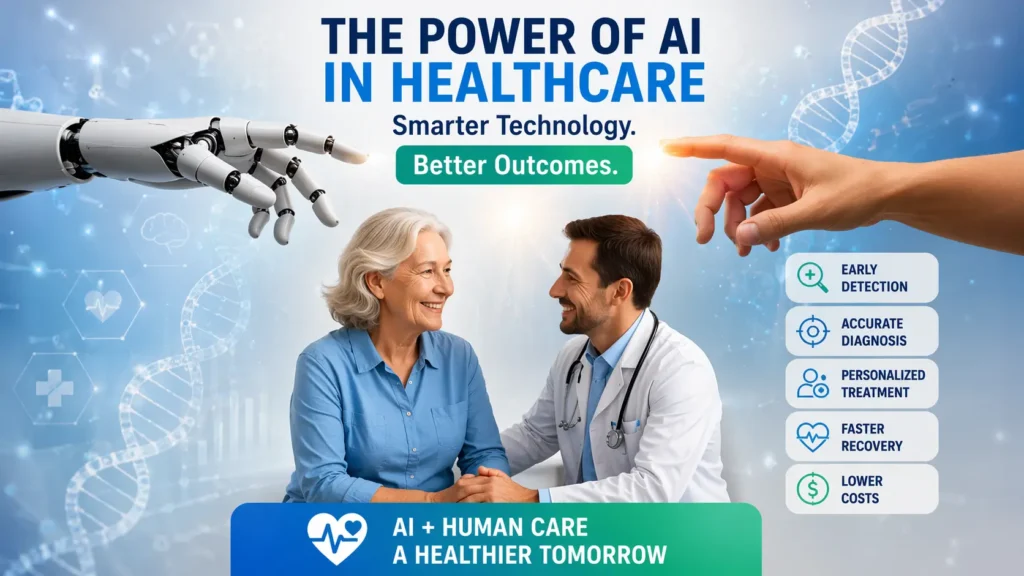
artificial intelligence medicine – when it is developed in an appropriate way, applied appropriately, and used for the benefit of the patients – is one such resource. It won’t take place of an experienced physician, but complement him. AI won’t replace humane medicine, but enhance it, as it helps save time and minimize mistakes and detect things that may be unnoticed by exhausted humans at three o’clock in the morning.
This is the beginning of something substantial. The instruments currently being put to use have saved countless lives already, from the timely identification of cancer on scans to the timely creation of the drug to the early detection of sepsis before it becomes fatal. And this is only the beginning.
The future of medicine is not robots replacing doctors. It’s doctors with better tools, more time, and fewer missed diagnoses. It’s a mother in rural India getting prenatal care she would never have had before. It’s a cancer survivor who only survived because an algorithm saw something a human almost didn’t.
Read More:- https://vitalmindflow.com/heatwave-2026/